
Nigeria has stepped up its plans to tax income earned abroad by remote workers and online professionals. The Chairman of the Presidential Committee on Fiscal Policy and Tax Reforms, Mr. Taiwo Oyedele, disclosed that Nigeria has signed agreements with over 100 countries, including the US, UK, Canada, and the UAE (Dubai), to automatically exchange financial information. This framework, primarily based on the Common Reporting Standards (CRS), allows Nigerian authorities to track foreign deposits and properties of its tax residents. Under the new law, all Nigerians receiving income from international companies or online platforms must self-declare their foreign earnings, as the system will now monitor the money once it enters their bank accounts.The government’s new strategy blends self-reporting by taxpayers with enhanced global intelligence gathering. Nigeria is a signatory to the Multilateral Competent Authority Agreement (MCAA) on the CRS, which facilitates the automatic, annual exchange of financial account information (like bank balances and account owner details) with over 100 partner jurisdictions.Oyedele emphasized that the system provides authorities with data about Nigerians who have money and properties abroad, ensuring transparency.Remote workers, freelancers, and digital earners are mandated to self-declare their foreign income in Naira for Personal Income Tax (PIT) purposes. Failure to do so may lead to the issuance of presumptive assessments with added penalties and interest.For individuals, the new tax laws taking effect in January 2026 will apply the tax based on progressive personal income tax rates (ranging from 0% to 25% for high earners), replacing the flat rate approach.

Nigerian lawmakers engage crypto industry ahead of proposed Virtual Asset Law
The House of Representatives’ ad hoc Committee on Cryptocurrency recently met with key stakeholders from the crypto industry to discuss a proposed Virtual Asset Law aimed at regulating digital assets.The meeting brought together representatives including Senator Ihenyen, executive chair of the Virtual Assets Service Providers Association of Nigeria (VASPA), who urged lawmakers to end the era of fear surrounding crypto and adopt a unified legal framework for responsible innovation and adoption.Despite the Investment and Securities Act of 2025 recognizing digital assets as securities, tensions remain. The Central Bank of Nigeria (CBN) still treats crypto with caution, limiting direct engagement with digital asset providers. This, combined with overlapping regulatory mandates among the CBN, SEC, and National Security Adviser (NSA), has created confusion and limited growth for startups.Senator Ihenyen stressed that the CBN cautious approach, though well-intentioned, fails to inspire confidence and that the ongoing web restrictions by the NSA contradict efforts to develop the sector and may violate various financial regulations.The proposed Virtual Asset Law aims to resolve these issues with key recommendations, which includes; If enacted, the law would transform Nigeria’s crypto landscape by integrating digital assets into the formal capital market system with clearer compliance and consumer protections.Lawmakers showed genuine engagement in understanding operators’ perspectives, and the committee is expected to continue consultations before drafting legislation, aiming for a harmonized legal framework with cross-agency support.

NITDA Director-General explains push for rebasing Nigeria’s ICT GDP amid digital economy growth
Kashifu Inuwa, the Director-General of the National Information Technology Development Agency (NITDA), recently shared insights on why his agency encouraged the Nigeria Bureau of Statistics (NBS) to rebase the Information and Communications Technology (ICT) sector‘s GDP. During the keynote address at the 3rd Annual Economic Confidential Lecture, themed “Agenda for a Digital Global Economy”, Inuwa stressed that recalculating the ICT contribution was critical due to how digital innovation permeates sectors including agriculture, healthcare, education, and finance. He explained that no economic area today can be viewed without considering the impact of technology. For example, The digital economy is all about harnessing technology to empower every economic activity. Recalculating the ICT GDP ensures we capture this reality accurately…if you exclude IT from finance, growth falters. Similarly, journalism and other sectors diminish without digital support. – he said Inuwa elaborated that digital technology is not a standalone economic segment but rather a vital tool powering the broader Nigerian economy. He stressed the potential of advancements like Artificial Intelligence to foster nationwide prosperity and inclusivity if embraced by relevant parties. Supporting this view, Dr. Tope Fasuwa, Special Adviser to the President on Economy, represented at the lecture by Aremu Olayinka Elijah, said that the newly revised economic data illustrates tangible progress as Nigeria transitions from conventional economic models to a future driven by technology. Fasuwa reaffirmed the Tinubu administration’s efforts to economic recalibration through digital innovation. The latest GDP report from the NBS highlights a remarkable 31.63% year-on-year increase in the ICT sector for the first quarter of 2025, soaring far above previous periods. The sector’s GDP contribution rose to 10.29%. The choice of 2019 as the new base year for GDP calculation was deliberate, attributed to its relatively stable economic conditions amid previous shocks. NITDA’s efforts to refine how ICT’s economic footprint is measured not only enhance data accuracy but also lay groundwork for policies supporting digital transformation. This rethink in valuation shows a progressive shift towards a tech-enabled Nigerian economy, creating opportunities for innovation-fueled growth.

Project Turing sets the path for Enugu youths to earn in dollars without leaving home
Enugu State has introduced Project Turing, a scheme designed to connect its young talents directly to international technology jobs. Launched in 2025 under Governor Peter Ndubuisi Mbah’s guidance, this program promises to transform the local workforce without requiring migration abroad. The global outsourcing sector, valued at over $260 billion in 2024, is rapidly expanding into Africa, with countries like Kenya and Egypt already well-established as prime outsourcing destinations. Nigeria, despite its large talent pool, has historically fallen behind due to infrastructure challenges and fragmented policies. Enugu is proactively changing this narrative through Project Turing, a comprehensive effort combining advanced skills training with upgraded physical infrastructure. This year-long full stack software engineering course, offered in partnership with Silicon Valley-backed Turing Tech, ensures participants a guaranteed role in remote or hybrid positions with a starting income of $1,500 monthly. Even after training subsidies and fees, graduates still net competitive salaries exceeding ₦12.8 million annually in their first year, increasing on subsequent years. This program is more than just a course. it’s a complete ecosystem that fuses premium talent development with assured employment and local outsourcing facilities. Ndi-Enugu youths now have the rare chance to earn dollar incomes while remaining at home. It’s a new model that can redefine brain drain, increase foreign earnings, and firmly place Enugu on Nigeria’s outsourcing map – Arinze Chilo-Offiah, Special Adviser on Digital Economy & MSMEs Alongside training, government-led renovation of idle public buildings is transforming these spaces into Business Process Outsourcing (BPO) hubs, ready to host international companies for customer service and IT-enabled outsourcing. This dual approach, combining human resource enhancement with physical readiness, distinguishes Enugu from other Nigerian states that typically emphasize only skill acquisition. A unique aspect of the project is its diaspora-backed funding structure. With Nigeria’s global diaspora remittances exceeding $20 billion annually, Enugu is channeling some of this wealth into sponsorships for trainees. This method, already successful in countries like Rwanda and Ghana, creates a virtuous cycle where local youths gain high-paying jobs, spend earnings locally, and reduce the economic pressures driving migration. Governor Mbah expressed the strategic importance of this approach; Our ambition is to elevate Enugu’s economy from $4.4 billion to $30 billion. Outsourcing offers a swift avenue to reach that goal by merging talent cultivation with foreign exchange inflows. With Project Turing and these new BPO centers, Enugu is to become Nigeria’s premier outsourcing destination and a beacon for young professionals. Should this model flourish, it has the potential to serve as a transformational blueprint for Nigeria’s digital economy by shifting reliance from remittances to sustainable foreign earnings. By blending training programs, modernized office spaces, diaspora investments, and global partnerships, Enugu is setting a new standard for growth in the outsourcing industry. Applications to join this transformative journey are now open. Enugu’s comprehensive approach combining education, infrastructure, and diaspora engagement could redefine Nigeria’s role in the global outsourcing arena. This evolving model may inspire similar initiatives across the country, catalyzing economic growth and expanding opportunities for the next generation of digital professionals.

FG partners with BPO companies to create jobs for 117,000 3MTT fellows – Bosun Tijani
The Nigerian government is teaming up with business process outsourcing (BPO) firms to help connect over 117,000 Nigerians trained under the 3 Million Technical Talent (3MTT) program to real job opportunities, both within Nigeria and abroad. Speaking on Arise TV, the Minister of Communications, Innovation, and Digital Economy, Dr. Bosun Tijani, explained that while training Nigerians with digital skills is important, the bigger challenge remains turning those skills into actual jobs. To tackle this, the government is now focusing on partnerships with BPO companies ready to employ the program’s graduates and offer outsourced services internationally. Dr. Tijani revealed plans to convert some government buildings into “talent cities”, hubs where BPO companies can operate and hire graduates. This will help create spaces for thousands of trained youths to find meaningful employment and boost the growing digital economy. The 3MTT initiative, launched in October 2023, aims to train 3 million Nigerians in four years. It is open to all Nigerians who can read and write, regardless of education level. The program already trained about 117,000 people, many of whom are interning and getting stipends. With support from telecom giants like MTN and Airtel, and development partners such as the UNDP, the training covers skills in digital marketing, data analysis, project management software, cloud platforms, graphics design, and more. Dr. Tijani stressed Nigeria’s youthful population as a key advantage, noting that nearly 70% of Nigerians are under 30 years old, while many developed countries face aging workforces. His goal is to prepare young Nigerians not just for local jobs but also for remote roles with international companies, enabling them to earn in foreign currency while living in Nigeria. This isn’t only about creating jobs locally. We want Nigerians ready to compete globally. Some will go abroad, but many will work for international firms from here, contributing to Nigeria’s economy – Dr Tijani The 3MTT program, with the government’s push to expand the digital workforce, could significantly impact Nigeria’s economic future by turning trained talent into paid jobs, helping reduce unemployment, and boosting Nigeria’s digital presence worldwide.
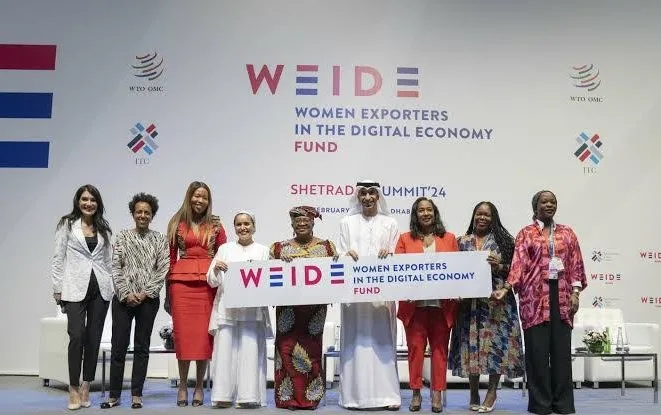
146 Nigerian women to benefit from $50 million WTO fund supporting digital economy entrepreneurs
The World Trade Organisation (WTO) has launched the first phase of a $50 million Women Exporters in Digital Economy (WEIDE) fund, set to benefit 146 Nigerian women entrepreneurs. This new programme aim to tackle barriers like limited access to finance, weak digital infrastructure, and poor networking opportunities that have held back many women-led businesses in Nigeria’s growing digital economy. The WEIDE Fund, created jointly by the WTO and the International Trade Centre (ITC), supports women-led micro, small, and medium enterprises (MSMEs) by improving access to funding, building skills, and opening connections to international markets. At the unveiling event on Thursday, Nigeria’s First Lady, Oluremi Tinubu, praised the fund as a vital step toward breaking down long-standing financial hurdles for women entrepreneurs. She was joined by WTO Director-General Ngozi Okonjo-Iweala, who confirmed that the first phase of the fund will provide $30,000 grants plus 18 months of technical support to 16 “booster track” participants, while the remaining 130 beneficiaries will each receive $5,000 and 12 months of business support. Special Assistant to the President on Media and ICT, Kwapchi Bata Hamman, described the $50 million investment as a significant opportunity for women to grow their digital businesses. Nana Shettima, representing the First Lady, stressed how the programme matches President Bola Ahmed Tinubu’s Renewed Hope Agenda to diversify Nigeria’s economy and empower women entrepreneurs. She also thanked the WTO and ITC for their role in launching this trailblazing project. Minister of Industry, Trade and Investment, Jumoke Oduwole, called the fund a global statement that women are key players in digital trade. Meanwhile, Customs Comptroller-General Adewale Adeniyi promised to simplify export procedures, making it easier for women-led businesses to reach global markets. The WEIDE Fund is backed by the FIFA World Cup 2022 Legacy Fund, along with the governments of Bahrain and the UAE. Since its launch in February 2024, it has attracted hundreds of applications, with Nigeria’s Export Promotion Council partnering in this first funding cycle. This injection of capital and support could be a game-changer for female entrepreneurs in Nigeria, helping them innovate and compete more effectively on the world stage.