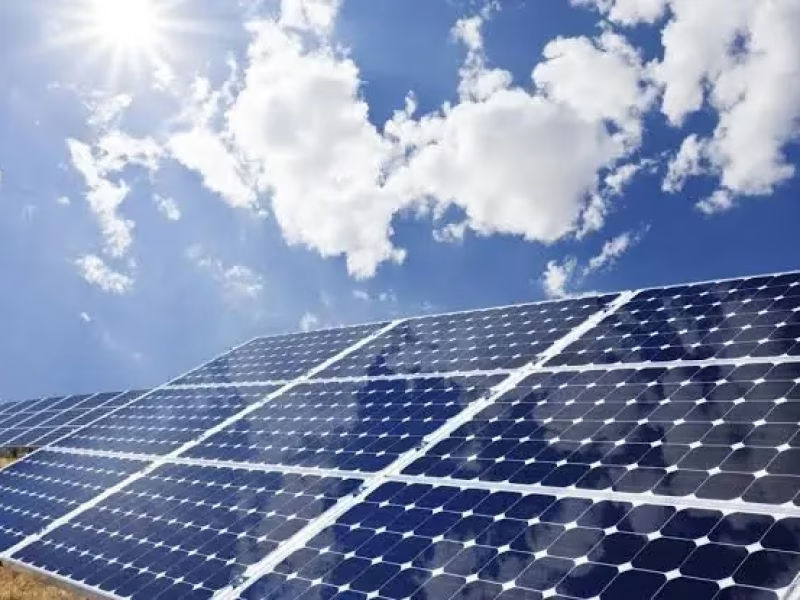
The Nigerian Federal Government has reiterated its commitment to banning the importation of photovoltaic (PV) solar panels, a move aimed at stimulating local manufacturing and reducing the country’s estimated N200 billion annual expenditure on imported solar equipment.
At a recent roundtable in Victoria Island, Lagos, between the Rural Electrification Agency (REA) and the Lagos State Government, REA Managing Director Abba Aliyu emphasized the government’s resolve to domesticate renewable energy equipment production. Aliyu highlighted Lagos as the “centre of excellence” poised to lead this industrial transformation, citing the expansion of a PV panel assembly plant in Ikotun from 10 megawatts to 100 megawatts capacity with REA’s collaboration.
Supporting this local manufacturing drive, the Minister of Science and Technology, Uche Nnaji, pointed to the National Agency for Science and Engineering Infrastructure (NASENI), which operates a solar panel manufacturing facility in Abuja. NASENI’s plant, upgraded to a 50-megawatt capacity in 2024 with plans to exceed 100 megawatts in 2025, produces high-quality monocrystalline solar panels certified by the Standards Organisation of Nigeria. Nnaji affirmed the government’s intention to enforce the ban on imports through Presidential Executive Order No. 5, aiming to nurture indigenous industries.
However, the policy has drawn criticism from industry experts who caution that Nigeria currently lacks the technological infrastructure to fully manufacture critical solar panel components such as solar wafers and cells. Theophilus Nweke, CEO of Cloud Energy, expressed skepticism at the 2025 Lagos Energy Summit, noting that local companies assemble panels using imported cells rather than manufacturing from raw wafers. He questioned the feasibility of enforcing an import ban without existing factories capable of producing these essential components.
Nweke urged the government to prioritize creating a supportive ecosystem for private-sector growth in renewable energy. He proposed establishing a renewable energy intervention fund to provide low-interest financing, akin to the agricultural intervention fund, to empower operators and citizens in adopting solar solutions.
The debate unfolds amid Nigeria’s growing renewable energy ambitions, including a recent Memorandum of Understanding between the Energy Commission of Nigeria, China Energy Engineering Corporation, and the Nigerian Governors’ Forum to establish the Nigeria-China Renewable Energy Research Centre. This initiative aims to boost technological innovation and human capacity development in the sector.
While the government’s push to localize solar panel manufacturing signals a strategic commitment to industrialization and energy independence, experts emphasize the need for phased implementation, technological investment, and collaborative frameworks to avoid disrupting the expanding solar market and financing startups that currently rely heavily on imports.
The success of the solar import ban will depend on how effectively local manufacturing capacity can be scaled without stalling the progress of solar energy deployment across the country.


