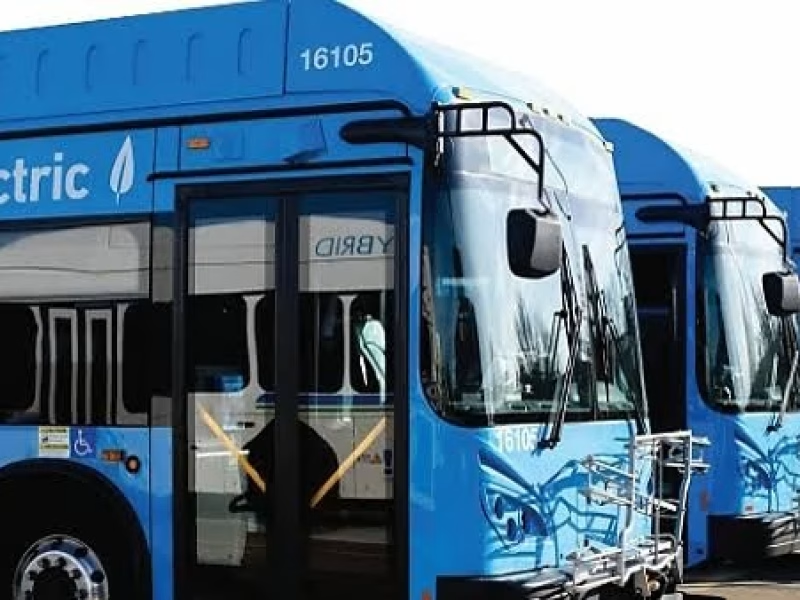
The Lagos Metropolitan Area Transport Authority (LAMATA) has announced plans to introduce articulated buses along the city’s Bus Rapid Transit (BRT) corridors, which represents a significant step toward expanding passenger capacity and modernizing Lagos’ public transport network.
LAMATA Managing Director, Abimbola Akinajo, revealed the initiative during a recent episode of the “Mobility Redefined” podcast, hosted by transport technology firm Modaxo. While no specific rollout date was provided, Akinajo emphasized that deploying articulated buses-longer vehicles with a flexible midsection-will allow the BRT system to carry more passengers and operate more efficiently on dedicated lanes.
“When we’re looking at BRT routes, obviously it’s about increasing the number of rolling stock we have, and beginning to look at the possibility of articulated rolling stock for the BRT routes because if they’re dedicated, then yes, we can utilize that,” Akinajo said.
This is a strategy to reduce Lagos’ heavy reliance on informal minibus operators, known locally as danfos. Currently, danfos account for about 75% of daily passenger movement in Lagos, with over 75,000 minibuses operating across the city’s roads. The Lagos State Government’s long-term plan, outlined in the Strategic Transport Master Plan (STMP), aims to replace these with a fleet of 15,000 high-capacity buses.
The STMP also includes the development of six rail lines, 14 BRT corridors, and more than 20 water transport routes. The first phases of the Blue and Red rail lines are already operational, with further extensions underway.
Akinajo highlighted that integrating informal operators into the regulated system will be crucial. Some danfo drivers may be retrained or absorbed into new first-and-last-mile services, which will be subject to stricter standards such as digital ticketing and GPS tracking.
LAMATA is also working to make Lagos’ public transport more sustainable. The agency is adopting cleaner fuel technologies, including compressed natural gas (CNG) and waste-to-energy solutions, and has started implementing an Intelligent Transport System (ITS) to improve bus scheduling, monitoring, and service delivery.
To support seamless travel across different modes of transport, new interchanges are being constructed to connect buses, ferries, and trains. Akinajo also confirmed that service on the Lagos Blue Line will soon improve, with trains expected to run every 10 minutes during peak hours.
Lagos state with this initiative, is taking bold steps to transform its public transport landscape, aiming for a safer, more efficient, and environmentally friendly system that meets the needs of its rapidly growing population.


