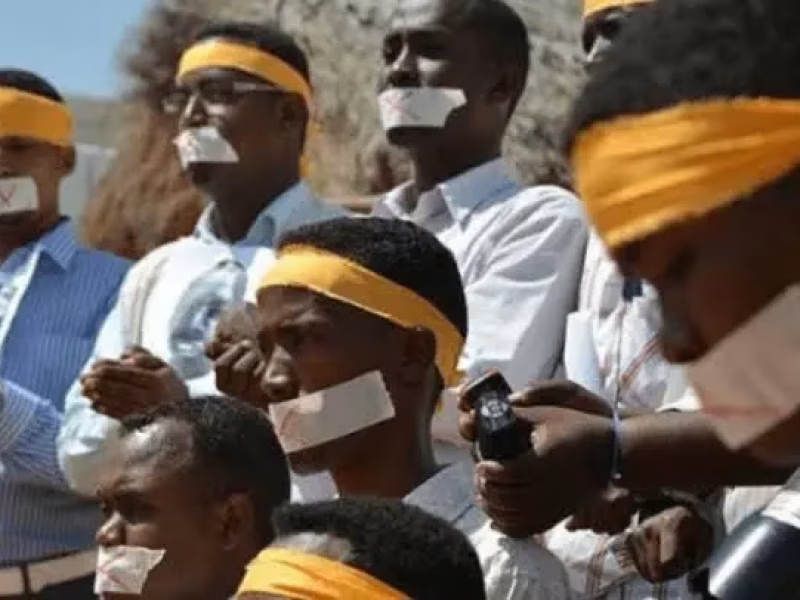
Ethiopia is facing harsh criticism over press freedom after the arrest of seven journalists from the Ethiopian Broadcasting Service (EBS) on terrorism charges. The arrests, confirmed by the Committee to Protect Journalists (CPJ), followed the broadcast of a controversial documentary that aired on March 23, 2025, raising serious allegations of sexual violence.
The documentary, part of EBS’s program Addis Meiraf, featured a woman named Birtukan Temesgen, who claimed she was abducted and raped in 2020 by men in military uniforms while she was a student. However, the story took an unexpected turn when Birtukan later appeared on state-owned media to retract her claims, stating they were fabricated. Following this, EBS founder Amman Fissehazion issued a public apology, admitting that the station had discovered inaccuracies in the story after its broadcast.
Despite these developments, Ethiopian authorities moved swiftly to detain the journalists involved, accusing them of attempting to incite conflict and undermine the government in collaboration with alleged extremist groups in the Amhara region. The arrested journalists, Nebiyu Tiumelissan, Tariku Haile, Hilina Tarekegn, Niter Dereje, Girma Tefera, Henok Abate, and Habtamu Alemayehu, were taken into custody between March 26 and March 28 after a police raid on EBS headquarters in Addis Ababa. The raid briefly forced the station off-air. Birtukan herself was also detained.
The arrests have sparked outrage among press freedom advocates and human rights organizations. Critics argue that using anti-terrorism laws to target journalists is a disproportionate response to what should be addressed as an issue of journalistic ethics. Muthoki Mumo, CPJ’s Africa Program Coordinator, described the move as heavy-handed and called for authorities to resolve such matters through Ethiopia’s media laws rather than criminal charges.
The Ethiopian Media Authority has also suspended Addis Meiraf indefinitely as of April 1, pending “corrective actions.” This adds an administrative penalty to what many see as an already excessive legal response.
Ethiopia has long struggled with press freedom. Ranked 141st out of 180 countries in the 2024 World Press Freedom Index by Reporters Without Borders (RSF), the country has faced repeated accusations of suppressing dissenting voices. Between 2019 and 2024 alone, at least 92 journalists were detained, making Ethiopia one of the most repressive nations for media workers in sub-Saharan Africa.
The arrests come amid escalating violence in Ethiopia’s Amhara region, where tensions between federal forces and local militias have intensified. The Fano militia group, once allied with the government during the Tigray conflict, turned against Addis Ababa following efforts to dismantle regional forces. Despite a state of emergency imposed from August 2023 to June 2024, large parts of Amhara remain outside federal control.
Authorities have linked the detained journalists to these ongoing conflicts, accusing them of working with extremist groups to destabilize the region. However, lawyers for the journalists argue that any editorial lapses should be addressed through regulatory frameworks rather than anti-terrorism laws that carry severe penalties.
The case has drawn international attention. Organizations such as Amnesty International and RSF have called for the immediate release of the journalists and urged Ethiopian authorities to allow independent investigations into alleged human rights abuses in Amhara.


