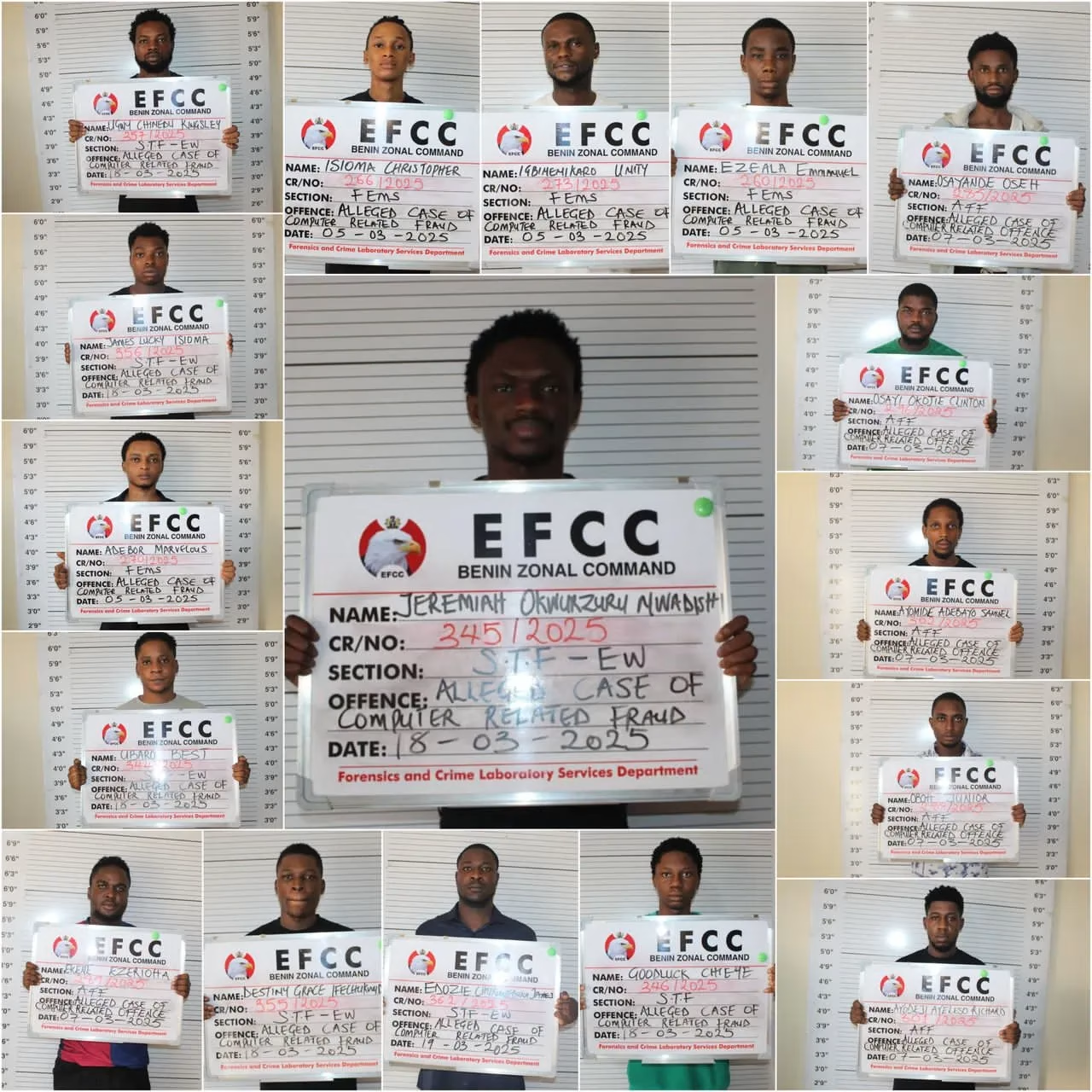
Seventeen internet fraudsters have been sentenced to prison terms by the Edo State High Courts in Benin City, following a crackdown by the Economic and Financial Crimes Commission (EFCC). The convictions were announced after the defendants were found guilty of various charges, including obtaining money under false pretenses and possessing fraudulent documents. The court proceedings, which took place before Justices A.N. Erhabor and W.I. Aziegbemhin, saw all defendants plead guilty to the charges brought against them. The EFCC’s Benin Zonal Directorate conducted a sting operation that led to their arrest, based on intelligence linking them to fraudulent online activities. Sentences varied among the convicted individuals. Nine of them received two-year prison sentences or were fined N200,000 each, while five others were sentenced to three years in prison or fined the same amount. Three additional defendants were given two-year sentences or fined N400,000 each. In addition to their prison terms and fines, the court ordered all convicts to forfeit their mobile phones, computers, and any funds in their bank accounts to the federal government. They were also required to submit written commitments to maintain good behavior in the future. This latest round of convictions comes shortly after another case where 29 suspected fraudsters were also sentenced by the same court. The EFCC has been intensifying its efforts to combat internet fraud, which has seen a troubling rise in Nigeria. The agency has previously raised alarms about internet fraudsters engaging in more violent crimes and has mourned the loss of one of its officers during an operation against such activities.
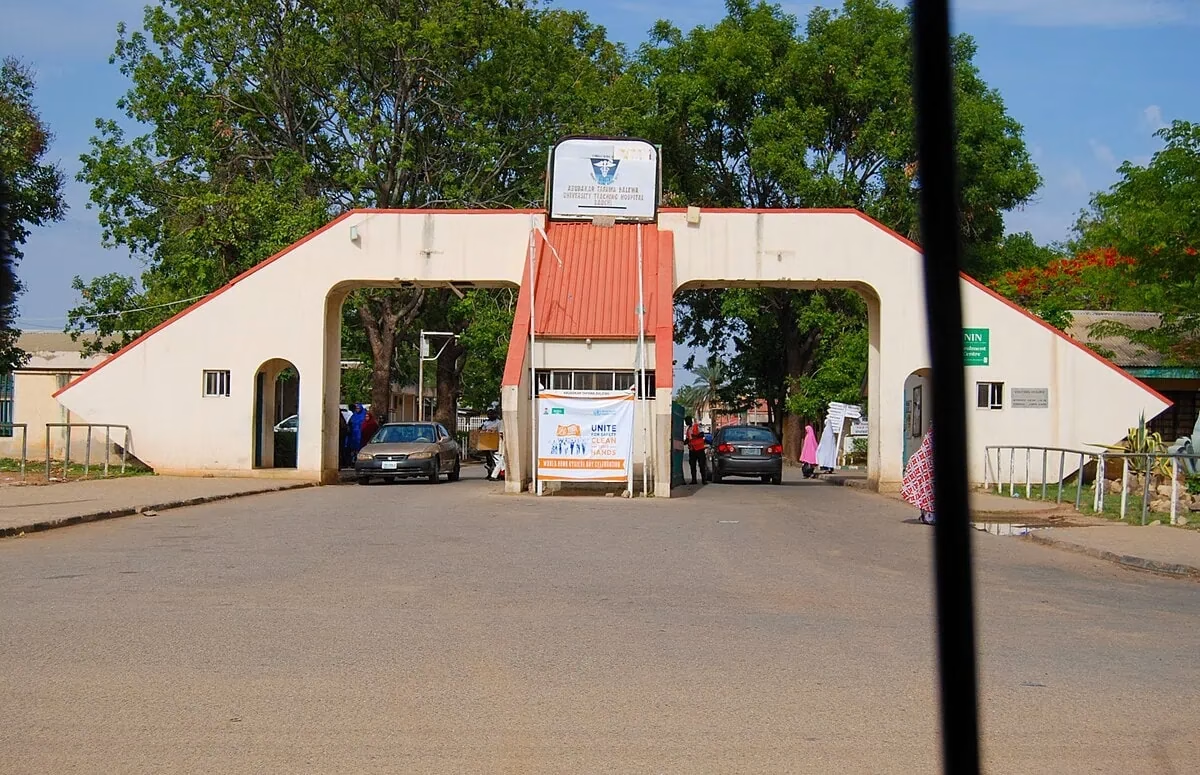
ATBUTH Bauchi warns the public against fraudulent laptop contract scam
The Abubakar Tafawa Balewa University Teaching Hospital (ATBUTH) in Bauchi has alerted the public about a fraudulent scheme involving impersonation of its Chief Medical Director, Professor Yusuf Bara Jibrin. Scammers are falsely claiming to award contracts for the procurement of 200 HP laptops, allegedly approved by the Federal Ministry of Health, as part of the hospital’s digitization efforts. In a statement issued by Usman Koli, Head of Public Relations at ATBUTH, the hospital clarified that no such procurement process has been initiated. The scammers have been using the phone number ‘08167069701’ to contact unsuspecting individuals via WhatsApp, phone calls, and SMS, attempting to deceive them into believing the legitimacy of the contract. Koli emphasized that all official procurement activities at ATBUTH strictly follow due process and legal procedures. He urged the public to remain vigilant and report any suspicious communication to relevant authorities immediately. The hospital management is collaborating with security agencies to identify and prosecute those responsible for the scam. This warning comes amidst increasing cases of fraudulent contract schemes in Bauchi State. In a related incident in 2022, a civil servant was sentenced to two years imprisonment for forging documents and fraudulently awarding fake laptop contracts. Such scams highlight the need for heightened public awareness and caution when dealing with unsolicited offers. ATBUTH reassures stakeholders of its commitment to transparency and accountability in all operations while working to protect the public from fraudulent activities.

Lagos Police crack down on four bank workers over £138,924 fraud
The Lagos State Police Command has apprehended four bank employees accused of orchestrating a sophisticated scheme to divert substantial funds from international airline accounts. The alleged theft involves a staggering sum of over £138,924, equivalent to more than N270 million. The intricate operation, which involved transferring money from domiciliary accounts into personal accounts before dispersing it to various destinations, was brought to light when the affected bank detected unauthorized transactions and promptly alerted the authorities. The suspects, identified as Oluwatobiloba Olaleye, Oladunjoye Adegoke, Austin Alfred, and Jude Uzobuaku, were subsequently arrested following a thorough investigation. According to the police, the stolen funds were initially channeled into an account belonging to one of the suspects before being distributed across multiple accounts in an attempt to conceal the trail. The authorities are now working diligently to identify any additional accomplices and recover the remaining stolen funds. The suspects are currently in custody and will face prosecution as the investigation unfolds. The public is urged to remain vigilant and report any suspicious financial transactions to aid in the ongoing efforts to safeguard the financial sector.

EFCC cracks down on ponzi scheme academy in Abuja, arrests 133 suspects
The Economic and Financial Crimes Commission (EFCC) has arrested 133 suspects linked to a Ponzi scheme academy in Abuja. The academy, operating under the name Q University (also known as Q-Net), was busted on Monday at the Compensation Layout in Gwagwalada, following actionable intelligence. According to the EFCC, Q University lured young Nigerians with promises of unrealistic profits through a training program called “Special Training for New Generation Billionaires.” Recruits were required to purchase an “Independent Representative Application Form” with slogans like “I’m a Champion” and “I’m Unstoppable.” The operation was conducted in collaboration with the 176 Guards Battalion of the Nigerian Army. Items seized from the suspects include phones, computers, and other electronic gadgets. The EFCC plans to charge the suspects in court once investigations are completed. This operation comes amid heightened legal scrutiny against Ponzi schemes, following the passage of the Investments and Securities Repeal and Re-enactment Bill, 2024, which proposes severe penalties for operators of such schemes.

FBI and IRS uncover $50 million fraud scheme involving two Nigerians and others
The Federal Bureau of Investigation (FBI) and the Internal Revenue Service (IRS) have revealed a major fraud scheme involving six individuals, including two Nigerians, Solomon Aluko and Nosakhare Nobore. The suspects are accused of stealing approximately $50 million through fraudulent activities targeting U.S. government programs, including COVID-19 relief funds. According to a statement from the U.S. Department of Justice, the six defendants operated a sophisticated check fraud and money laundering network between 2021 and 2025. The scheme involved the use of fake identities and sham businesses to deposit stolen or fraudulent checks. These checks included U.S. Treasury payments intended for COVID-19 relief, tax refunds, and benefits for veterans and the elderly. Acting U.S. Attorney for the Southern District of New York, Matthew Podolsky, condemned the exploitation of government programs designed to assist citizens during times of crisis. “We allege that the defendants stole tens of millions of dollars in COVID-19 relief and other checks, using a ‘Fraud Bible’ to guide their actions,” Podolsky stated. “This Office will not tolerate such exploitation, and we will hold those responsible fully accountable.” The six individuals charged in this case are: Nosakhare Nobore, 29, Edgewater, New Jersey Solomon Aluko, 29, Hackensack, New Jersey Shan Anand, 34, Queens, New York Nicholas Pappas, 28, Miami, Florida Leonard Ujkic, 44, Fort Lauderdale, Florida Jorge Gonzalez, 28, North Bergen, New Jersey Each defendant faces multiple charges: Wire and bank fraud (maximum sentence: 30 years) Money laundering (maximum sentence: 20 years) Conspiracy to defraud the government (maximum sentence: 10 years) Aggravated identity theft (mandatory sentence: 2 years) Federal investigators revealed that the suspects used a document known as the “Fraud Bible,” which provided detailed instructions on committing various financial crimes such as credit card fraud and ATM fraud. Evidence from their communications showed that some defendants openly shared methods to manipulate financial systems for illegal gains. Leslie R. Backschies, Acting Assistant Director in Charge at the FBI’s New York Field Office, highlighted the scale of the operation: “These six defendants allegedly used sham businesses and stolen identities to run a multi-year fraud scheme that resulted in $50 million being deposited into their accounts. Their actions exploited multiple government programs meant to support struggling Americans.” IRS Special Agent in Charge Harry T. Chavis Jr. emphasized how deliberate and brazen these crimes were. “This group openly communicated about their fraudulent activities while stealing funds meant to help struggling businesses and vulnerable populations,” Chavis noted. If convicted on all counts, each defendant could face up to 62 years in prison for their role in this elaborate scheme. Federal authorities have reiterated their commitment to prosecuting those who exploit government programs designed to assist citizens during emergencies.

Nigeria customs intercepts $578,000 in undeclared cash at Lagos airport, EFCC launches probe
The Nigeria Customs Service (NCS) has seized $578,000 in undeclared foreign currency from a passenger at Lagos’ Murtala Muhammed International Airport (MMIA), marking one of the largest recent cash interceptions linked to suspected money laundering. The incident occurred on Friday, March 21, when a male traveler arriving from Johannesburg aboard South African Airways Flight SA60 declared $279,000 at the airport’s currency desk. However, during a routine inspection, customs officers discovered an additional $299,000 concealed in multiple packages within his luggage, alongside €100 and a counterfeit $250 note. The total undeclared amount of $578,000, nearly 60 times the legal limit, was immediately confiscated. Effiong Harrison, Comptroller of the MMIA Command, confirmed the seizure violated Nigeria’s Money Laundering (Prohibition) Act of 2011, which mandates that travelers carrying over $10,000 (or equivalent in foreign currency) must declare it to authorities. “This was a deliberate attempt to bypass financial regulations,” Harrison stated. “The suspect’s actions undermine Nigeria’s economic integrity and investor confidence. We’ve handed over his international passport and all documents to the EFCC for prosecution.” The Economic and Financial Crimes Commission (EFCC), Nigeria’s anti-graft agency, has taken custody of the funds and launched an investigation into the source of the money. Ahmed Ghali, Acting Director of EFCC’s Lagos Office 2, warned that undeclared cash movements risk severe penalties. “Full disclosure is non-negotiable. Honest travelers face no issues, but evasion will be met with strict legal action,” he said. This seizure follows a similar incident days earlier at Abuja’s Nnamdi Azikiwe International Airport, where customs intercepted $193,000 hidden inside a carton of yogurt. Authorities attribute the uptick in interceptions to heightened surveillance at major entry points, part of a federal push to curb capital flight and money laundering. Customs officials emphasized that undeclared cash often fuels illegal activities, including terrorism financing and tax evasion. Harrison reiterated the NCS’s commitment to “safeguarding Nigeria’s financial systems” and urged travelers to comply with declaration rules to avoid forfeitures and criminal charges. While the Lagos suspect’s identity remains undisclosed, EFCC sources say the probe will trace the money’s origins and potential ties to broader syndicates. The agency has secured 29 convictions for internet fraud in Benin City this week alone, signaling intensified efforts to tackle financial crimes ahead of global anti-corruption reviews. Experts note that Nigeria’s porous borders and cash-driven economy make it a hotspot for illicit financial flows, with the World Bank estimating $18 billion annually lost to money laundering.