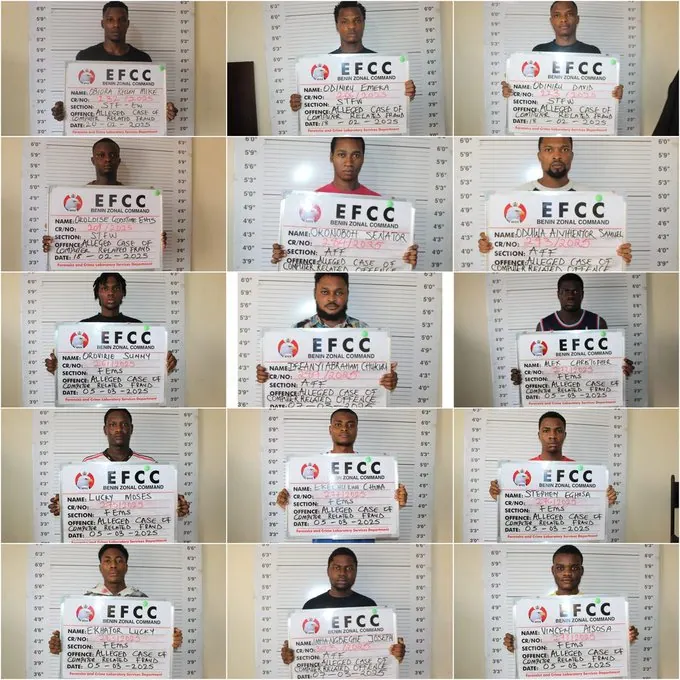
The Edo State High Courts in Benin City have convicted 29 individuals for internet fraud, sentencing them to varying jail terms or fines. Justices A.N. Erhabor and W.I. Aziegbemhin delivered the judgments on Thursday, following charges brought by the Economic and Financial Crimes Commission (EFCC). The convicts, identified as Edeyibo Rukewe Hope, Igbafe David, Emakhu Bonfrey, Genesis Ndujifor, Okolosie Godstime, Chukwu David, Ebuka Emmanuel, Akhere Akahomhen, Odiniru Emeka Vet, Obiora Mike Kelvin, and others, were arrested during a sting operation by the EFCC’s Benin Zonal Directorate. The arrests were based on credible intelligence linking them to fraudulent online activities. Each defendant faced charges ranging from obtaining money under false pretenses to possession of fraudulent documents. All pleaded guilty when the charges were read in court. Justice Erhabor sentenced 18 of the convicts to two years in prison or an alternative fine of ₦200,000 each. Justice Aziegbemhin imposed similar sentences on others but increased the fine to ₦400,000 for some offenders. Additionally, the court ordered the forfeiture of assets linked to the crimes. This included a red Mercedes Benz C300 with registration number BEN258CM and other items such as mobile phones, computers, and cash. The convicts were also required to sign undertakings to exhibit good behavior moving forward. EFCC’s Ongoing Fight Against CybercrimeThis case highlights the EFCC’s relentless efforts to combat internet fraud in Nigeria. The agency has consistently warned about the growing sophistication of cybercriminals and their involvement in other crimes such as ritual killings and armed violence. The crackdown comes amid rising concerns over cybercrime’s impact on Nigeria’s reputation and economy. Earlier this year, the EFCC mourned the loss of one of its officers, Aminu Sahabi Harisu, who was killed while pursuing a suspected internet fraudster. This serves as a stern warning to those engaging in fraudulent activities and reinforces the government’s commitment to upholding justice and safeguarding citizens from cybercrime threats.

Microsoft warns of new crypto-targeting malware: what you need to know
Tech giant Microsoft has raised the alarm about a new and sophisticated malware threat targeting cryptocurrency users. Dubbed “StilachiRAT,” this remote access trojan (RAT) is designed to steal sensitive information from crypto wallets and browsers, particularly Google Chrome. Key Features of StilachiRATWallet Targeting: The malware actively scans for wallet extensions in Chrome, affecting at least 20 popular wallets including MetaMask, Trust Wallet, and Coinbase Wallet. Data Theft: Once it identifies wallet extensions, StilachiRAT can extract credentials and configuration details, potentially allowing attackers to drain funds from victims’ wallets. Clipboard Monitoring: The malware keeps an eye on clipboard activity, searching for copied cryptocurrency keys or passwords. Advanced Evasion: StilachiRAT uses anti-forensic techniques to bypass security defenses, including identifying analysis tools and delaying execution. While not yet widespread, StilachiRAT represents a significant threat to digital asset security. Its ability to grant attackers remote command execution and persistent access to infected systems is particularly concerning. Microsoft security researcher Taylor Monahan highlighted the evolving nature of such threats, noting that cybercriminals are increasingly using sophisticated social engineering tactics, such as fake job interviews, to distribute malware. Protecting YourselfMicrosoft has emphasized the importance of proactive defense against this new threat. They recommend several measures to mitigate risks: Download software only from official sources Enable Microsoft Defender real-time protection Turn on cloud-delivered security Use SmartScreen to block malicious websites Remember, the best defense against malware like StilachiRAT is vigilance and adherence to cybersecurity best practices. Always be cautious when interacting with unfamiliar software or websites, especially those related to your cryptocurrency holdings.
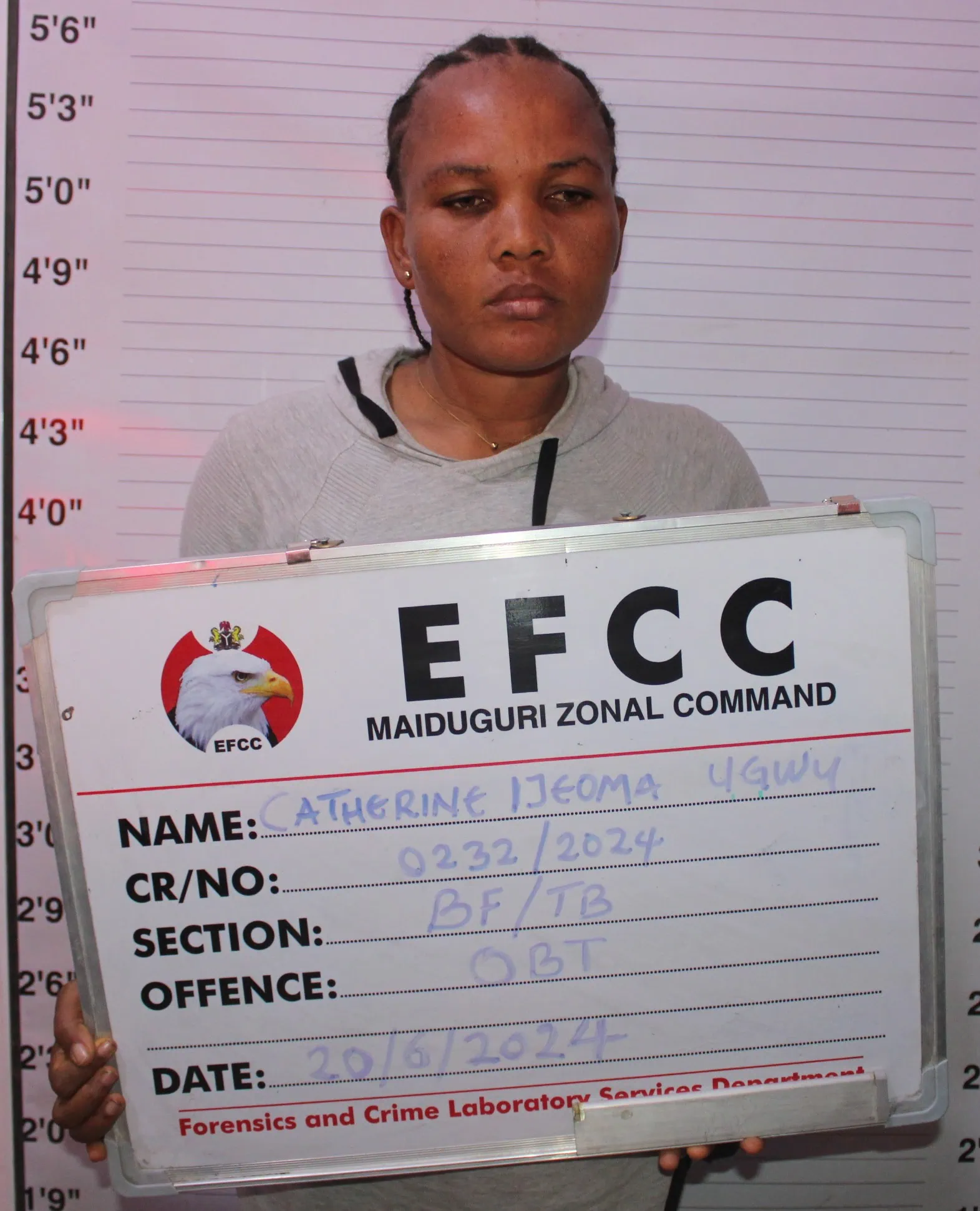
Woman arraigned for alleged N6.8 million romance scam in Maiduguri
The Economic and Financial Crimes Commission (EFCC) has arraigned Catherine Ijeoma Ugwu for her alleged involvement in a romance scam. The case, which involves obtaining money by false pretence, criminal misappropriation, and impersonation, totals N6,815,300. Ugwu was brought before Justice Aisha Kumaliya at the Borno State High Court in Maiduguri, where she pleaded not guilty to the charges. The prosecution, led by S.O. Saka and Faruku Muhammad, requested that she be remanded in a correctional center until the trial begins on April 8, 2025. The alleged scam involved Ugwu impersonating the fiancée of Emmanuel Ani, deceiving him into transferring N6.8 million under false pretences. When confronted, Ugwu was unable to account for or return the money, leading to her legal troubles. This case highlights the EFCC’s commitment to tackling financial crimes and protecting citizens from exploitation. As romance scams continue to pose a threat, law enforcement agencies are stepping up efforts to prosecute offenders and ensure justice for victims.

Telegram founder Pavel Durov temporarily leaves france on five million euros bail amid ongoing probe
The Agence France-Presse reports that Pavel Durov, the founder and CEO of Telegram, has been granted permission to temporarily leave France. This move comes as part of an ongoing investigation into alleged criminal activities linked to the messaging app. Durov, who holds Russian, French, and UAE passports, was detained at Le Bourget airport near Paris in August 2024 and charged with multiple infractions, including failing to curb extremist content. He was released on a €5 million bail and had been prohibited from leaving France until now. An investigating judge has authorized Durov to leave for several weeks, and he is believed to have departed for Dubai on Saturday morning. This decision marks a relaxation of his obligations under the probe, which has strained relations between Paris and Moscow and sparked debates on free speech and digital regulation. Durov’s departure has been met with mixed reactions, with some viewing it as a victory for freedom of speech, while others question whether it signals a strategic mover to evade further legal complications. The case continues to attract international attention, with support from figures like Elon Musk, who has publicly backed Durov.
NAFDAC cracks down on international scam: syndicate dupes foreign firms with fake documents
The National Agency for Food and Drug Administration and Control (NAFDAC) has exposed a sophisticated fraud syndicate that has been impersonating the agency to scam foreign businesses using counterfeit documents. This revelation followed a petition from Thani Almaeeni Trading Group, based in Abu Dhabi, UAE, which fell victim to the scheme. In a statement issued by NAFDAC’s Director General, Prof. Mojisola Christianah Adeyeye, the agency disclosed that the operation was led by Ikoro Mang Ifendu, who was arrested on February 7, 2025, in Aba, Abia State. Ifendu allegedly defrauded multiple foreign firms by posing as a NAFDAC official and issuing fake approvals and certificates. How the Scam OperatedNAFDAC revealed that the syndicate employed a complex three-step scheme involving a buyer, a bank, and a lawyer. Here’s how it worked: The Buyer: The fraudsters would contact foreign companies under the guise of purchasing goods for importation into Nigeria. The Bank: Victims were introduced to a bank where they were informed that NAFDAC approval was required for the transaction. The Lawyer: A supposed legal representative would then offer to facilitate the NAFDAC certification process for a fee. Using this strategy, the group issued fake receipts and counterfeit NAFDAC certificates to unsuspecting victims. Investigations revealed that the syndicate managed 15 domiciliary accounts and 5 local accounts across seven Nigerian banks, with inflows exceeding $950,000 in Nigeria and $450,000 in offshore accounts in Cotonou, Benin Republic. Even after Ifendu’s arrest, victims continued sending money, with one recent transfer amounting to $75,000. The fraudulent documents included: A counterfeit Certificate of Registration for Dried Fish (Seafood) under NAFDAC Registration No. A2-7059. Fabricated revenue receipts amounting to millions of naira. Forged processing requirement documents purportedly signed by a retired NAFDAC director. Fraudulent Swift Advice copies and telegraphic transfer records showing significant dollar transactions. The syndicate also used fake letterheads under the name “HALI & CO Chambers,” operated by Ifendu and another accomplice named Rosemary Obosi. Foreign Companies AffectedSeveral international companies fell victim to this scam. These include: Thani Almaeeni Trading Group (UAE) Japan Long Tie (China) Co. Ltd (China) BEYOND-Korea (USA) Aquaforest SP (Poland) Nomea srl (Italy) Tianyan Filter Cloth Co. Ltd (China) Siam Canadian China Ltd (China) NAFDAC has transferred the case to the Economic and Financial Crimes Commission (EFCC) for further investigation. The probe will extend beyond NAFDAC-regulated products to track assets acquired through fraudulent activities under the Proceeds of Crime Act (POCA). “This investigation will invoke POCA on all assets illegally acquired during these fraudulent activities,” NAFDAC stated. NAFDAC has warned businesses against engaging unauthorized consultants or intermediaries claiming to facilitate product registrations. The agency urged firms to verify all registration processes directly through its official portal.
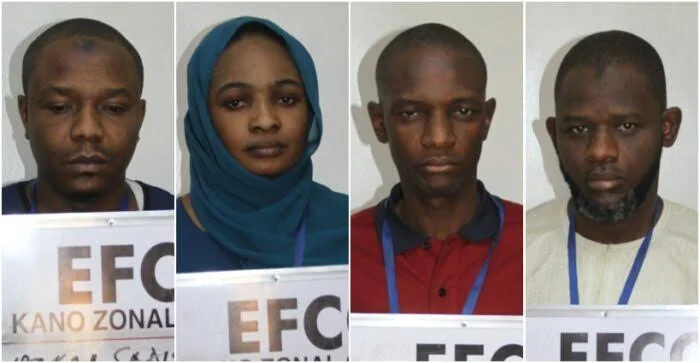
A couple and two others face charges for impersonating Katsina First Lady in N197 million fraud
The Economic and Financial Crimes Commission (EFCC) has arraigned four individuals before the Kaduna State High Court on allegations of a sophisticated fraud scheme involving the impersonation of Fatima Dikko Radda, wife of the Katsina State Governor. The defendants allegedly defrauded victims of nearly N198 million through an elaborate currency exchange scam. In a statement released on Thursday, the EFCC confirmed the arraignment of Baba Sule Abubakar Sadiq, Hafsat Kabir Lawal, Abdullahi Bala, and Ladani Akindele Ayodele on a six-count charge before Justice Amina Bello. The quartet faces serious allegations of obtaining money by false pretenses, engaging in money laundering activities, and committing theft amounting to N197,750,000. According to the anti-graft agency, the defendants allegedly worked together to defraud their victims through multiple tactics, with the primary strategy involving the impersonation of the Katsina State Governor’s wife. The case initially came to light through the Department of State Services (DSS), which arrested the suspects before transferring them to the EFCC upon determining that the offenses fell under the category of financial crimes. The charges detail how the defendants allegedly obtained substantial sums under false pretenses. One count specifically outlines how they allegedly secured N89,000,000 from a victim named Aminu Usman by falsely claiming to have $53,300 to exchange for the naira equivalent. This transaction reportedly involved payments into a Taj Bank account belonging to defendant Abdullahi Bala. During the court session, all four defendants entered not guilty pleas when the charges were read by the court registrar. Their legal representation, including Senior Advocate of Nigeria M.S. Katu, along with counsels Jazuli Mustapha and Paul A. Okachi, informed the court that they had filed and served various bail applications on behalf of their clients. The prosecution, represented by Bright C. Ogbonna, requested that the court set a trial date and asked that the defendants be remanded in a correctional facility pending the determination of their bail applications. Ogbonna strongly opposed the bail applications, arguing that they were not yet ready for consideration by the court. After hearing arguments from both sides, Justice Bello ordered the defendants to be remanded in a correctional facility and adjourned the case until March 17, 2025, when the court will hear the bail applications. The EFCC’s investigation revealed a calculated operation that leveraged high-profile impersonation to gain trust and access to significant funds. According to the commission, defendant Hafsat contacted the victims while pretending to be the wife of Katsina State Governor Malam Dikko Radda. Under this fraudulent identity, she allegedly obtained N89,000,000 and an additional N108,000,000 from a petitioner, claiming to possess $118,300 that she was willing to sell at favorable rates. Further investigations uncovered that Hafsat’s husband, Sadiq (the second defendant), allegedly provided his wife with two SIM cards that were registered on Truecaller as “Fatima Dikko Radda.” This digital disguise was reportedly crucial to establishing credibility with potential victims. The scheme allegedly expanded when Sadiq contacted defendant Ladani Akindele, a former colleague from a new-generation bank, requesting the contact information of Unity Bank Chairman Hafiz Bashir. Through this connection, they obtained contact details for the petitioner, Aminu Usman, who operates as a bureau de change operator. The EFCC statement indicates that after securing nearly N198 million from Usman under the pretext of having dollar equivalents to exchange, the funds were deposited into Abdullahi Bala’s bank account. From there, the money was allegedly distributed among the four defendants and systematically laundered through various channels. The case highlights the growing sophistication of impersonation fraud in Nigeria, where criminals leverage the names and positions of high-profile individuals to execute financial crimes. The EFCC continues to warn the public about such schemes while pursuing prosecutions against those involved in similar offenses. If convicted, they face substantial penalties under the Advance Fee Fraud and Other Fraud-Related Offences Act of 2006. This case comes amid increasing efforts by Nigerian law enforcement agencies to combat financial crimes and fraud schemes that have damaged both individual victims and the nation’s financial reputation. The EFCC has recently intensified its operations against various forms of financial crimes, including a recent alert about 58 illegal Ponzi scheme operators. The commission continues to urge Nigerians to exercise caution when engaging in financial transactions, particularly those involving currency exchange or investment opportunities that promise unusually favorable returns.