
The Federal Government is stepping up efforts to protect Nigeria’s digital infrastructure from growing cyber threats, unveiling new initiatives at the first-ever National Cybersecurity Conference in Abuja. National Security Adviser Malam Nuhu Ribadu said cybersecurity is now a key part of national security and economic stability. He announced plans to create a National Cybersecurity Coordination Centre to respond to cyber threats in real time. The government is also updating the Cybercrime Act and the National Cybersecurity Policy to tackle new challenges, including those from Artificial Intelligence. EFCC Chairman Ola Olukoyede stated risks facing Nigeria’s fintech sector, such as malware, crypto scams, and fake platforms. He revealed that EFCC is enhancing digital forensics and intelligence sharing to fight cyber financial crimes. By 2026, a Cybersecurity Research Centre will be set up to redirect cybercriminal skills into productive jobs. NITDA’s Director-General Kashifu Inuwa said the conference aims to boost partnerships between government, private sector, and academia to strengthen cybersecurity policies and innovation. Senate Committee Chairman Shuaibu Salisu urged lawmakers to engage more on digital security to update Nigeria’s cyber laws. This push matters because Nigeria’s digital economy is growing fast, but so are cyber risks. The new measures seek to build resilience and protect citizens and businesses from costly attacks. The government’s next steps include launching the coordination centre and rolling out updated policies to keep Nigeria’s cyberspace safe.

EFCC drags CBEX crypto promoters to court over alleged N1.3 trillion scam
Two promoters of the failed CryptoBank Exchange (CBEX) have been arraigned in Abuja for allegedly promising Nigerians huge investment returns without SEC approval. On Monday, the Economic and Financial Crimes Commission (EFCC) brought Avwerosuo Otorudo and Chukwuebuka Ehirim before the Federal High Court in Abuja. They are accused of luring Nigerians to invest in CBEX, a cryptocurrency scheme that promised up to 88% returns. The EFCC says they did this without getting written consent from the Securities and Exchange Commission (SEC). The case follows months of public outcry after CBEX collapsed, leaving many Nigerians with massive losses. According to the EFCC, the scam may have cost investors as much as N1.3 trillion. The Commission has promised to work with Interpol and other agencies to recover lost funds. Court documents show that between January 2024 and May 2025, the two men allegedly invited the public to deposit money with CBEX, even though they were not licensed banks or authorized to take deposits. The EFCC says this breaks several Nigerian financial laws, including the Investment and Securities Act and the Banks and Other Financial Institutions Act. At the hearing, both defendants pleaded not guilty. The EFCC’s lawyer, Fadila Yusuf, asked the judge to keep them in custody until trial, arguing that they might run away because of the scale of the alleged scam. The defence lawyer, J. A. Otorudo, said his clients had not been convicted before and had cooperated with investigators. He asked for bail, saying there was no evidence they took money by false pretence. After listening to both sides, the judge ordered the men to be kept in the Kuje Correctional Facility. A ruling on their bail application is set for July 18, 2025. EFCC spokesperson Dele Oyewale earlier assured Nigerians that the Commission is committed to recovering lost investments, stating, “We are working with international partners to bring justice and get people’s money back.” This case is part of a wider crackdown on illegal crypto schemes in Nigeria. The new Investment and Securities Act, signed into law in March 2025, aims to protect investors and clean up the crypto industry. Many in the tech and finance community hope it will restore trust and stop scammers from taking advantage of Nigerians.
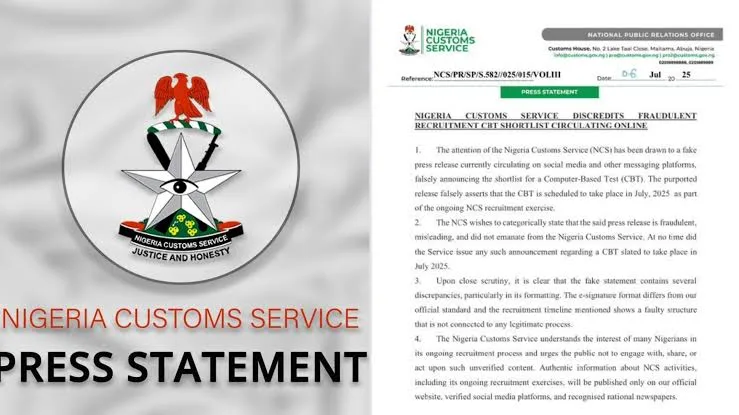
Nigeria Customs warns Nigerians about fake recruitment shortlist
The Nigeria Customs Service (NCS) has warned the public about a fake Computer-Based Test (CBT) recruitment shortlist making the rounds on social media. On Sunday, the NCS said the document, which claims that a shortlist for a recruitment test has been released for July 2025, is completely false. The agency stressed that it did not issue any such announcement and that the information did not come from any official Customs channel. Abdullahi Maiwada, Assistant Comptroller of Customs and National Public Relations Officer, described the viral document as “fraudulent and misleading.” He pointed out that the fake statement had clear errors, including formatting issues and an electronic signature that did not match the agency’s standard. The recruitment timeline in the document was also inconsistent with any real Customs recruitment process. “The NCS wishes to categorically state that the said press release is fraudulent, misleading, and did not emanate from the Nigeria Customs Service. At no time did the Service issue any such announcement regarding a CBT slated to take place in July 2025,” Maiwada said. The NCS reminded Nigerians that all authentic information about recruitment and other activities will only be shared on its official website, verified social media pages, and recognised national newspapers. The agency urged people not to share or act on unverified messages, especially those promising jobs or shortlisting for exams. The Customs Service is now working to trace the source of the fake release and says it will take action against those behind it. The agency also thanked Nigerians for being alert and reporting suspicious messages. The NCS opened applications for recruitment in December 2024 after getting approval to hire 3,927 new officers in 2025. The agency has warned before that scammers might try to take advantage of the recruitment process to trick people. The NCS says it will notify the public through proper channels when it is ready to move to the next stage of recruitment. Nigerians are advised to stay vigilant and rely only on official sources for updates.

FBI busts Lagos-based crypto fraudster over ₦460 million scam linked to Trump inauguration
The FBI has launched a crackdown on a Lagos fraudster accused of stealing over ₦460 million in cryptocurrency meant for Donald Trump’s 2025 presidential inauguration. Ehiremen Aigbokhan, based in Lagos, allegedly led a Business Email Compromise (BEC) scam impersonating officials from the Trump-Vance Inaugural Committee. Using fake emails mimicking Steve Witkoff, a co-chair of the event, they tricked a donor into transferring 250,300 USDT.ETH, valued at more than ₦400 million in late 2024. The stolen crypto was quickly moved through multiple digital wallets to evade detection. The FBI, working with Tether, identified the fraud and froze the accounts on December 31, 2024. They traced the operation back to Aigbokhan in Lagos, sparking a full investigation. He is also wanted for other cryptocurrency fraud and money laundering activities. The FBI’s ongoing probe signals tougher enforcement against cross-border crypto fraud, a concern for Nigeria’s tech and financial sectors as they expand. More arrests or asset seizures could follow as the investigation continues. This story serves as a warning to donors and investors to verify digital transactions carefully.

EFCC arrests 18 suspected internet fraudsters in Ogun, recovers fake U.S. IDs
Nigeria’s Economic and Financial Crimes Commission (EFCC) has arrested 18 people suspected of internet fraud at a hotel in Ogun State. The suspects were caught at Prime Garden Hotel, Atun-iju, along Idi-Iroko Road, following intelligence linking the location to online scams. Among them is a key suspect accused of defrauding someone of N200 million. The EFCC seized a red Lexus IS 250, jewellery, cash in local and foreign currencies, a U.S. driver’s licence, and a U.S. military ID during the raid. Other items recovered include laptops, vehicles, and documents used for fraud. This bust adds to a rising number of cybercrime arrests in Nigeria. In June, 38 suspects were arrested in Enugu, and in April, 24 people were caught in Lagos for scams involving fake profiles and identity theft targeting foreigners. The EFCC has warned hospitality businesses to avoid hosting fraudsters and promised ongoing operations to fight cybercrime. EFCC Chairman Ola Olukoyede stressed the agency’s zero-tolerance policy, saying cybercriminals harm Nigeria’s reputation and must be held accountable. The arrests show the government’s efforts to curb “Yahoo Yahoo” fraud, which remains a major challenge for Nigeria’s digital economy and international image.The suspects will be charged in court after investigations conclude.

Man caught hiding in FCMB ceiling overnight in alleged hack attempt
A man was caught hiding inside the ceiling of a First City Monument Bank (FCMB) branch overnight after trying to hack the bank’s systems. The incident happened on Sunday, June 30, 2025, at one of FCMB’s branches. According to staff, the man entered during business hours pretending to be a customer. Instead of doing any banking, he went to the restroom, locked himself in, and climbed into the ceiling. He stayed hidden there until the bank closed for the day. The next morning, employees found the restroom door locked from inside. When they forced it open, they discovered the man tampering with the bank’s computer systems. Some computers showed unusual messages like “restarting, click OK to accept,” suggesting he was trying to access sensitive data. The man was quickly caught and removed, but footage of the arrest went viral online. Many Nigerians questioned how he managed to sneak in and hide unnoticed, raising concerns about the bank’s security measures and surveillance. Some social media users suspected he had inside help, saying it would be impossible to locate the ceiling space and computer systems without guidance. There was also strong public criticism about how the man was treated after being caught. Videos showed security guards and police officers beating him, leading to calls for more humane handling of suspects and better police professionalism. This case shows serious gaps in bank security and the urgent need for improved surveillance and protocols to protect customer data. FCMB and law enforcement have yet to issue official statements, but the incident has sparked nationwide discussion about cybercrime risks and security standards in Nigerian banks.