
The Inspector General of Police (IGP), Kayode Egbetokun, has announced the recovery of properties valued at N6 billion from suspects linked to a massive fraud and money laundering scheme involving over 2,000 bank accounts across Nigeria. The ongoing investigation centers on an alleged N21.4 billion fraud, with 2,039 bank accounts frozen following a March 4 court order. These accounts, spread over 56 financial institutions, are suspected of being used to disguise the origin and ownership of illicit funds through companies and cronies. Audu Garba, Legal Officer of the Force Intelligence Department, told the Federal High Court in Abuja that the police have arrested several suspects who have made confessional statements implicating themselves and others. The investigation is still active, with the police seeking to prevent suspects from liquidating funds prematurely. Garba requested a 60-day extension of the freezing order to allow the police to complete their inquiries and ensure effective prosecution. Justice Obiora Egwatu granted the extension, emphasizing the need to preserve the status quo and prevent the dissipation of assets. The investigation continues as authorities work to identify additional individuals involved in the scheme and trace the flow of funds.

EFCC arrests three over Q-net scam, fake university degrees in Abuja
Operatives of Nigeria’s Economic and Financial Crimes Commission (EFCC) have arrested three men in Abuja for allegedly running a fraudulent scheme linked to the Q-net brand and operating a fake university, authorities confirmed on Thursday. The suspects-Olaniyan Joshua, Oyetunde Julius Akano, and Victor Oluwale-were taken into custody on May 1, 2025. According to the EFCC, they operated under the name “Mighty Infinity Millionaire Limited” and falsely claimed to represent Q-net, a global e-commerce and direct selling company. Q-net has denied any connection to the suspects or their activities. Investigators say the trio lured victims with promises of university degrees in fields such as Medicine, Nursing, Cybersecurity, and Geology, claiming a partnership with Quest International University in Malaysia. The Malaysian institution has also denied any affiliation. Classes were reportedly held under makeshift pavilions and even under trees. Victims, mostly students, paid between ₦1.2 million and ₦1.3 million each in registration fees. The EFCC estimates the suspects collected hundreds of millions of naira through the scam. This latest arrest follows a March 24, 2025, EFCC raid on “Q-net University” in Gwagwalada, Abuja, where 133 suspects were detained for similar offenses. The EFCC says the suspects are currently under interrogation and will be charged to court after investigations conclude. Authorities are urging the public to be cautious of fraudulent schemes and to verify the legitimacy of organizations before making financial commitments.

EFCC traces CBEX crypto funds to four countries, says full recovery unlikely
The Economic and Financial Crimes Commission (EFCC) has tracked funds from the failed CBEX crypto bridge exchange scheme to at least four countries, but warns that full recovery for victims may not be possible. EFCC Chairman Ola Olukoyede revealed this development during an interview on Channels Television. He explained that while the agency has managed to freeze several accounts and block some funds, the majority of the transactions were carried out in cryptocurrency and routed through wallets outside Nigeria’s jurisdiction. “We have been able to block some accounts. We have been able to freeze some funds, which I will not be able to give you a figure, but some reasonable amount of funds, we have been able to freeze,” Olukoyede said. “I will not sit down and tell you that we are going to restitute every victim. It will become practically impossible because quite a certain number of money has been dissipated and not within our system.” Olukoyede also stated that the main suspects behind the scheme are foreigners, complicating recovery efforts. The EFCC has arrested three individuals who are currently in custody and have provided useful information to investigators. The CBEX platform collapsed in April, leaving many Nigerians unable to access their investments. The Securities and Exchange Commission later confirmed that CBEX was not registered in Nigeria. A federal high court has since authorized the EFCC to detain six CBEX promoters over a $1 billion fraud allegation. Despite ongoing efforts and collaboration with international partners, the EFCC cautions that some victims may never recover their lost funds due to the cross-border nature of the crime and the use of digital currencies.

Nigeria and UK launch joint case team to tackle cybercrime
The Federal Government of Nigeria has officially launched the Joint Case Team on Cybercrimes (JCTC), a multi-agency initiative designed to revolutionize the country’s response to digital crime, to combat the rising threat of cybercrime. The launch, held at the Federal Ministry of Justice in Abuja, also marked the signing of a Memorandum of Understanding (MoU) with the United Kingdom, strengthening international collaboration in the fight against cybercriminals. Attorney General of the Federation and Minister of Justice, Lateef Fagbemi SAN, described the JCTC as a “bold and transformative stride” in Nigeria’s criminal justice system. “We are building a system that will protect you, defend your rights, and bring cybercriminals to book,” Fagbemi declared, emphasizing that the initiative is rooted in synergy, coordination, and mutual respect among key institutions. The JCTC brings together representatives from several critical agencies, including: Nigeria Police Force National Cybercrimes Centre (NPFNCCC) Economic and Financial Crimes Commission (EFCC) Nigeria Financial Intelligence Unit (NFIU) National Agency for the Prohibition of Trafficking in Persons (NAPTIP) Nigeria Computer Emergency Response Team (NgCERT), Office of the National Security Adviser Federal Ministry of Justice Federal High Court The new team aims to address the complexity of cybercrime by fostering intelligence sharing, reducing bureaucratic bottlenecks, and ensuring that investigators and prosecutors work side by side from the outset of each case. According to Fagbemi, “An effective criminal justice response requires seamless cooperation between relevant actors-namely, investigators and prosecutors. Cybercriminals may exploit a lack of coordination.” The UK’s Minister of State for Home Affairs, Lord David Hanson, who attended the launch, called the event a “historic moment” for both nations. He highlighted the importance of international cooperation in tackling cybercrime, which is increasingly transnational in nature. International partners, including the UK National Crime Agency, the Foreign, Commonwealth & Development Office, and the Commonwealth Secretariat, have already provided IT equipment and foundational training to support the JCTC’s work. The launch of the JCTC comes as Nigeria faces mounting cyber threats, with the country recently ranked among the top five global sources of cybercrime activity. Officials hope that this coordinated, multi-agency approach will not only bring more offenders to justice but also restore public confidence and foster economic growth by making Nigeria’s digital space safer for all. Stakeholders from government, law enforcement, and the judiciary are united in their commitment to act together, innovate, and ensure that Nigeria’s response to cybercrime is both effective and enduring.

Access bank fires staff over secret restroom filming scandal
Access Bank has dismissed Stephen Ifeanyichukwu Ejezie, a former quality assurance specialist at its Oniru, Lagos contact centre, after he was caught secretly filming female colleagues in the bank’s restrooms. The incident, which occurred around 1:30 a.m. last Wednesday, has sparked outrage among staff and the public after reports revealed Ejezie had recorded hundreds of videos without his colleagues’ knowledge. According to multiple sources, a female staff member discovered a phone camera pointed at her from a toilet cubicle while she was bathing. She raised the alarm, leading colleagues to confront Ejezie, who was found hiding in the cubicle. Subsequent investigations uncovered over 400 explicit videos on his devices, many allegedly shared or sold online. Access Bank responded by immediately terminating Ejezie’s employment and reporting the matter to law enforcement. The bank stated it is fully cooperating with authorities and providing support to affected employees. In an official statement, management reiterated a zero-tolerance policy for harassment and privacy violations, assuring that employee safety and dignity remain top priorities. Despite the swift dismissal, some staff have expressed concerns about the pace of the investigation and whether justice will be served, especially as Ejezie has reportedly been released from police custody.
Nigerian government raises alarm over cyber-slavery targeting youths
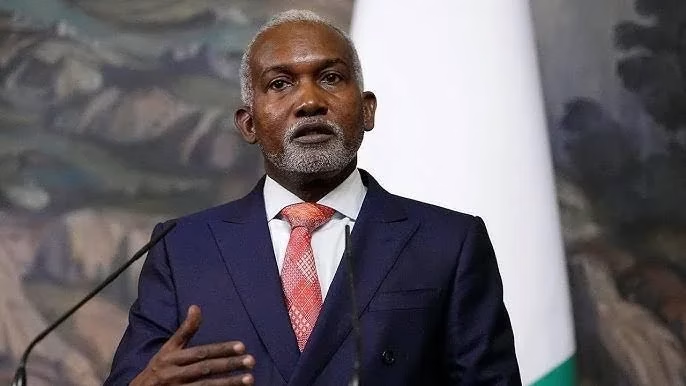
The Federal Government has sounded a strong warning about a disturbing rise in cyber-slavery targeting young Nigerians across West Africa. Authorities say criminal syndicates are luring teenagers and youths with fake promises of high-paying jobs-especially in the booming cryptocurrency sector-only to traffic them into what are now being called “419 cyber-scam factories”. According to the Ministry of Foreign Affairs, victims, some of them minors, are deceived into traveling abroad for supposed employment. Instead, they end up trapped in criminal call centres, where they are forced under harsh and inhumane conditions to send thousands of fraudulent emails, texts, and calls to scam people worldwide. A recent rescue operation in Accra, Ghana, brought the crisis into sharp focus: over 200 Nigerians were freed from such cybercrime rings, where they had been held captive and compelled to commit online fraud. “This incident highlights the severe exploitation and abuse associated with cybercrime operations,” said Foreign Affairs Minister Yusuf Tuggar. “It underscores the urgent need to dismantle these multibillion-dollar criminal networks and reduce the vulnerability of potential victims”. The government is urging Nigerians-especially young people and their families-to be extremely cautious about job offers that promise easy money, overseas travel, or remote work involving cryptocurrencies. Officials stress the importance of verifying any employment opportunity through official channels and reporting suspicious offers to the authorities. The Ministry of Foreign Affairs reaffirmed its commitment to working with regional and international partners to combat cyber-slavery, rescue victims, and bring perpetrators to justice. Awareness campaigns are being intensified to protect Nigerian citizens at home and abroad from falling prey to these sophisticated scams.