
Nigerian financial market experts are sounding the alarm on the urgent need for advanced security measures to protect the country’s increasingly digital trading and settlement platforms. Their recommendations come as the government ushers in sweeping regulatory reforms, including the landmark Investment and Securities Act (ISA) 2025, which brings digital assets firmly under regulatory control. At the recent African and Middle East Depositories Association (AMEDA) conference in Lagos, industry leaders highlighted the growing risks facing Nigeria’s capital markets. Stuart Turner, CEO of Avenir Technology Limited, emphasized that resilient system architecture and cutting-edge security models are now essential. “The key is to prioritize a resilient architecture spread across data centers. Specifically, the zero-security model, where individuals can access trading and settlement systems but must verify every action they take, makes it much harder for breaches to occur,” Turner said. Experts are urging the adoption of “zero trust” security frameworks, which require continuous verification of every user action, and advanced reCAPTCHA technologies that analyze human behaviors-such as the way passwords are entered-to identify imposters and block unauthorized access. These measures are seen as crucial in an era where artificial intelligence can now bypass traditional security tools like Google’s reCAPTCHA v2 with near-perfect accuracy. Jim Micklethwaite, Managing Director of Financial Markets at Thomas Murray, added that Central Securities Depositories (CSDs) should run breach simulations to detect lingering threats, rather than simply patching vulnerabilities and moving on. Regulatory Shake-Up: Digital Assets Now Under SEC OversightThe push for stronger digital security comes as Nigeria’s regulatory landscape undergoes its most significant transformation in years. The newly signed ISA 2025 formally recognizes digital assets-including cryptocurrencies and tokenized securities-as regulated financial instruments. This ends years of legal ambiguity and brings all digital asset operators under the direct supervision of the Securities and Exchange Commission (SEC). Previously, the Central Bank of Nigeria (CBN) had imposed restrictions on crypto-related transactions, and digital asset activities operated in a legal grey area. Now, Virtual Asset Service Providers (VASPs), exchanges, and related platforms must comply with SEC rules, aligning Nigeria’s market with international standards and boosting investor confidence. ISA 2025 also introduces clearer classifications for securities exchanges, separating them into composite (all asset classes) and non-composite (specialized) categories, making it easier for investors and companies to navigate the market. Nigeria’s fintech sector continues to evolve rapidly, with regulators balancing innovation and consumer protection. The Central Bank, SEC, and Nigeria Data Protection Commission have all stepped up oversight, especially as AI adoption surges in the industry. Nearly 30% of fintech firms now use generative AI for content creation, and new regulations are being introduced to ensure safe and ethical use of emerging technologies. Analysts predict that by 2030, fintechs could dominate Nigeria’s lending market unless traditional banks accelerate their digital transformation. Regulatory bodies are expected to develop a comprehensive framework for fintech and digital assets, moving from outright bans to controlled engagement, and possibly introducing incentives for banks investing in advanced technologies. The message from industry leaders and regulators is clear; innovation and security must go hand in hand to build trust and resilience in Nigeria’s digital financial ecosystem.
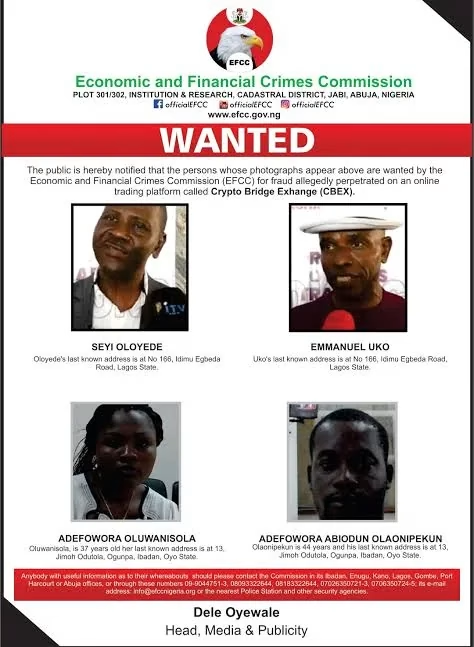
EFCC declares eight wanted over alleged $1 billion CBEX crypto fraud
The Economic and Financial Crimes Commission (EFCC) has declared eight individuals-four Nigerians and four foreign nationals-wanted in connection with a massive fraud scheme linked to the online trading platform, Crypto Bridge Exchange (CBEX). The Nigerian suspects are: Seyi Oloyede Emmanuel Uko Adefowora Oluwanisola Adefowora Abiodun Olaonipekun Their alleged foreign accomplices are: Johnson Otieno Israel Mbaluka Joseph Michiro Kabera Serah Michiro The EFCC accuses the suspects of luring thousands of Nigerians into investing in CBEX, promising unrealistic returns of up to 100% per month. Investors were reportedly unable to withdraw their funds, sparking widespread suspicion that the platform was a Ponzi scheme. Investigations revealed the promoters used a front company, ST Technologies International Limited, to attract investors. The EFCC stated that over $1 billion may have been lost to the scheme. A Federal High Court in Abuja has authorized the EFCC to arrest and detain six of the platform’s promoters, including some of those declared wanted. The agency published the wanted notice across its official channels and is appealing to the public for information on the suspects’ whereabouts. The EFCC urges anyone with useful information to contact its offices nationwide or the nearest police station. The agency has assured the public that all information will be treated confidentially as it intensifies efforts to tackle online financial crimes. CBEX’s collapse is a reminder for Nigerians to remain cautious of investment platforms promising high returns.

Nigeria’s foreign affairs ministry warns against fake online recruitment
The Ministry of Foreign Affairs has issued a strong warning to Nigerians about a fraudulent recruitment exercise currently making the rounds online and on social media. In an official statement signed by spokesperson Kimiebi Imomotimi Ebienfa, the Ministry categorically disassociated itself from the fake job advertisements, which falsely claim to offer employment opportunities within the Ministry and even bear the forged signature of the Honourable Minister of Foreign Affairs. “The Ministry unequivocally disassociates itself from this misleading and malicious advertisement and urges the general public to disregard such announcements and refrain from engaging with individuals or entities promoting these fraudulent schemes,” the statement read. The Ministry emphasized that all legitimate recruitment into the Nigerian Foreign Service is handled exclusively by the Federal Civil Service Commission (FCSC), not directly by the Ministry. The FCSC is the only authorized body to conduct hiring for federal ministries and agencies. The Ministry further stressed that it does not request or accept payments for job applications or appointments, warning the public to remain vigilant and avoid falling victim to scams. The FCSC recruitment process is transparent and merit-based. All announcements are made through official government channels. Applications are only accepted via the official recruitment portal: recruitment.fedcivilservice.gov.ng. Applicants are required to submit only one application and upload necessary documents, including: Curriculum Vitae (CV) Degree, HND, NCE, or equivalent certificates WAEC/NECO/NABTEB certificate NYSC discharge or exemption certificate Birth certificate or declaration of age Local government identification Recent passport photograph The FCSC’s current recruitment drive, which began on January 27, 2025, was extended to March 17, 2025, due to high applicant traffic and technical challenges on the portal. The Commission assured the public that these issues are being addressed to ensure a smooth application process. The recruitment is open to all eligible Nigerians, including those with physical challenges. The Ministry of Foreign Affairs reaffirmed its commitment to transparency and integrity in all its processes, urging Nigerians to rely only on official communication channels for information about job opportunities. Any official announcement regarding recruitment into the Foreign Service will be made through authorized government platforms in partnership with the FCSC. Nigerians are advised to disregard unsolicited job offers, never pay anyone for job applications, and report suspicious activity to the authorities. For genuine updates on vacancies and application procedures, always refer to the FCSC’s official portal and trusted news outlets.

SEC warns influencers to verify investments or face 10-year jail for promoting ponzi schemes like CBEx
The Securities and Exchange Commission (SEC) has issued a strong warning to celebrities, social media influencers, and bloggers: promoting unregistered or fraudulent investment schemes, including notorious platforms like CBEX, now carries severe legal consequences, including up to 10 years in prison and fines of at least ₦20 million under the new Investments and Securities Act (ISA) 2025. The warning comes in the wake of the collapse of CBEX, a digital investment platform accused of defrauding Nigerians of over ₦1.3 trillion. CBEX lured investors with promises to double their funds within a month and incentivised referrals, classic hallmarks of a Ponzi scheme. The platform’s sudden inability to process withdrawals sparked panic, protests, and widespread outrage across the country. Dr. Emomotimi Agama, Director General of the SEC, emphasised that the new law specifically targets individuals who use their platforms to promote unregistered or fraudulent investment schemes. “We are, therefore, using this medium to caution individuals against promoting unregistered entities,” Agama stated, adding that the SEC is working with the EFCC, Nigerian Police, and other agencies to investigate and prosecute violators. Agama warned that “becoming influencers or introducing meme coins that do not benefit the Nigerian public will not be tolerated. We now have the legal teeth to bite,” referring to the SEC’s expanded prosecutorial powers under ISA 2025. New Law Closes Digital Asset LoopholesFor the first time, Nigerian law now recognises virtual assets as securities, bringing digital asset platforms and exchanges under SEC regulation. All such platforms must register with the Commission and comply with transparency and anti-fraud guidelines. CBEX, for example, was not registered with the SEC, making its operations illegal under the new regime. Protecting Investors and the MarketThe SEC has ramped up its surveillance and enforcement efforts, creating specialised departments to monitor market activities and swiftly respond to suspicious operations. Agama reaffirmed the Commission’s commitment to investor protection and market development, urging Nigerians to verify investment opportunities via the SEC’s official registry before investing. “If an offer sounds too good to be true, it likely is,” Agama cautioned, advising the public to consult professionals and avoid schemes promising unrealistic returns. The new ISA 2025 aims to restore investor confidence, strengthen market integrity, and ensure that Nigeria’s growing digital finance sector remains safe for all. Promoting unregistered investment schemes now carries a minimum ₦20 million fine and 10-year jail term. CBEX, which promised 100% monthly returns, is unregistered and considered illegal by the SEC. Influencers, celebrities, and bloggers are urged to verify all investment promotions and avoid endorsing dubious schemes. Nigerians are advised to always check the SEC’s registry before investing and report suspicious platforms for prompt action.

UN raises alarm, Asian cybercrime syndicates go global, fueling surge in online scams and human trafficking
The United Nations has sounded a stark warning about the explosive global spread of Asian cybercrime syndicates, whose operations have evolved from regional scams into a vast, multibillion-dollar criminal industry now reaching Africa, South America, and beyond. A new UN report reveals that these syndicates, originally rooted in Southeast Asia’s notorious “Golden Triangle” region, have become increasingly sophisticated, harnessing cutting-edge technology like artificial intelligence, deepfakes, and malware to supercharge their online scams and evade law enforcement. The result: an underground cybercrime economy generating up to $3 trillion a year worldwide, according to Interpol, an unimaginable scale just a decade ago. These criminal networks lure thousands of people from around the world with fake job offers, only to traffic them into guarded compounds in countries like Myanmar, Cambodia, and Laos. There, victims are forced to work brutal hours running online scams, including investment fraud and “pig-butchering” romance scams that have cost Americans alone billions in losses. The syndicates have rapidly diversified, recruiting workers from over 50 countries and targeting victims across continents. Their operations are so entrenched that even major crackdowns in Asia have simply pushed them to new, less regulated regions, including parts of Africa and South America, where they partner with local criminal groups to expand money laundering and fraud. Tech-Powered, Harder to StopExperts warn that the integration of generative AI and deepfakes is making these scams more convincing and harder to detect, lowering the barrier for less tech-savvy criminals to join in. Social engineering attacks are becoming more frequent and sophisticated, threatening individuals, businesses, and even critical infrastructure worldwide. UN officials are calling for urgent international cooperation and stronger laws to disrupt these syndicates’ financing and recruitment, warning that the crisis now rivals the scale and complexity of the global drug trade. “What began as a regional crime threat in Southeast Asia has become a global human trafficking crisis, with millions of victims, both in the cyber scam centres and as targets,” said Interpol Secretary General Jurgen Stock.

EFCC arrests 40 suspected internet fraudsters in Niger State
Operatives of the Economic and Financial Crimes Commission (EFCC), Kaduna Zonal Directorate, have arrested 40 individuals suspected of engaging in internet fraud in Bida and Minna, Niger State. The arrests followed credible intelligence linking the suspects to various cyber-related crimes. According to Dele Oyewale, the EFCC’s Head of Media and Publicity, the suspects were apprehended after thorough investigations. Items recovered from them include three cars, ten motorcycles, eight laptops, sixty Android phones, eight power generating sets, one air conditioner, two power stabilizers, and four Bluetooth speakers. In addition to technological devices and vehicles, the EFCC also seized several fetish items believed to be used in the commission of their crimes. These included three calabashes adorned with feathers, traditionally made soap and sponge, a bottle of hot drink, twenty cowries, a waist bead, and four pairs of women’s underwear. The EFCC is continuing its investigations and will prosecute the suspects accordingly. This operation highlights the commission’s ongoing commitment to tackling cybercrime and internet fraud across Nigeria. The arrest is part of a broader national effort to curb internet fraud, which has seen similar crackdowns by security agencies in various states. The EFCC’s proactive measures aim to protect Nigerians from the growing menace of cybercrime and restore confidence in the digital economy.