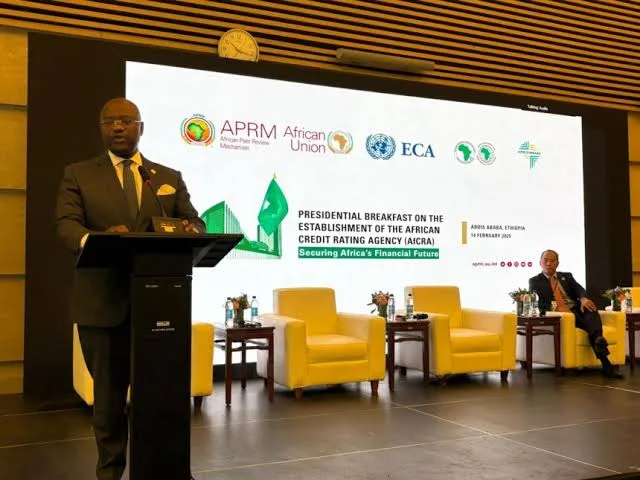
A new Africa-led credit rating agency, the African Credit Rating Agency (AfCRA), is scheduled to begin operations by the end of September 2025. The agency aims to provide a homegrown alternative to the dominant global firms Fitch, Moody’s, and S&P, which many African policymakers criticize for unfairly low ratings that inflate borrowing costs across the continent. AfCRA will issue its first sovereign credit rating by late 2025 or early 2026, according to Misheck Mutize, lead expert on credit rating agencies at the African Peer Review Mechanism (APRM), an African Union body. The agency is currently finalizing the appointment of its Chief Executive Officer, expected by the third quarter of this year. African countries have long expressed frustration with international rating agencies, arguing that their assessments often overlook local economic and political realities. For example, Ghana and Zambia have publicly condemned multiple downgrades that contributed to higher borrowing costs and financial distress. The APRM recently challenged Fitch’s downgrade of the African Export-Import Bank, accusing the agency of flawed analysis and misunderstanding of African financial institutions. To maintain independence and credibility, AfCRA will not be owned by African governments but primarily by African private-sector entities, Mutize said. The agency will focus on rating local-currency debt to strengthen domestic capital markets and reduce reliance on foreign currency borrowing. Mutize emphasized that AfCRA will not shy away from downgrading countries when warranted, dispelling concerns that it will issue overly favorable ratings for Africa. The United Nations Economic Commission for Africa (ECA) has highlighted the disparity in borrowing costs between African nations and developed countries. Claver Gatete, ECA’s Executive Secretary, noted that while Germany can borrow $1 billion at 2.29% interest, Zambia may pay nearly ten times as much under current ratings.

SEC issues strong warning to Nigerians against investing in unregistered Meme Coin $PUN and other unauthorized platforms
The Securities and Exchange Commission (SEC) has issued a firm warning to Nigerians about the risks of investing in the unregistered meme coin known as Punisher Coin, or $PUN, amid growing concerns over fraudulent digital asset schemes in the country. In a public notice released on its official website, the SEC clarified that the promoters of $PUN are not registered or authorized to operate within Nigeria’s capital market. Despite this, the coin continues to be aggressively marketed across various online platforms. “Meme coins like $PUN typically lack real utility or intrinsic value, and their prices are often driven by hype and social media buzz,” the SEC explained. “Such coins are highly susceptible to market manipulation, including pump and dump schemes, where promoters artificially inflate prices before selling off their holdings, leaving ordinary investors with significant losses.” The Commission urged Nigerians to exercise extreme caution and to verify the registration status of any digital asset or investment opportunity through official SEC channels before investing. This alert comes as part of the SEC’s broader efforts to protect investors from unregulated and potentially fraudulent investment schemes. The Commission also highlighted recent unauthorized investment platforms such as Risevest Technologies Limited and Stecs Multipurpose Cooperative Society, which have similarly not received SEC approval to operate in Nigeria. Emomotimi Agama, the SEC Director-General, also issued a stern message to Nigerian celebrities, warning them against endorsing unregistered meme coins. “The new Investments and Securities Act 2025 sets clear rules for digital asset platforms to promote transparency and investor protection. Celebrities must be cautious about the products they promote, as introducing unregistered coins can harm the public and will not be tolerated,” Agama said. Investors are reminded that participation in unregistered schemes is at their own risk, and the SEC continues to monitor and take enforcement actions against fraudulent operators to safeguard the Nigerian investment landscape.

Ecobank names Ayo Adepoju as Group Executive Director to boost financial leadership
Ecobank Transnational Incorporated (ETI) has appointed Ayo Adepoju, the bank’s current Group Chief Financial Officer (CFO), as Group Executive Director, effective June 4, 2025. This strategic move is aimed at strengthening Ecobank’s financial management and operational excellence across its markets. Adepoju brings over 20 years of leadership experience in financial management, capital markets, strategic planning, treasury operations, and enterprise transformation. Since joining Ecobank in 2012, he has held key roles including Group Financial Controller and Group Head of Business Performance and Analytics before becoming CFO. Under his leadership, Ecobank has successfully executed landmark financial initiatives such as Eurobond issuances, Basel III-compliant instruments, and sustainability-linked debt offerings. These efforts have enhanced the bank’s presence in international financial markets and boosted investor confidence. Adepoju holds a first-class degree from the University of Lagos, is a Fellow of the Institute of Chartered Accountants of Nigeria (ICAN) and the Chartered Institute of Management Accountants (CIMA), UK. He also earned an MBA from Warwick Business School and a PhD in Organisational Leadership from Regent University, USA. Prior to Ecobank, he worked at PricewaterhouseCoopers (PwC) in London and Lagos. Ecobank Chairman Papa Madiaw Ndiaye praised Adepoju’s appointment, calling it a “natural and strategic” step that reflects his trusted relationship with the Board. Group CEO Jeremy Awori highlighted Adepoju’s critical role in driving financial resilience and sustainable growth for the bank. This appointment comes on the heels of Ecobank’s recent successful $125 million Eurobond issuance, which was oversubscribed and priced at an improved yield of 9.375%, marking a significant milestone for the bank and the African Eurobond market.

Zenith Bank named best bank in Nigeria for 2025 at global finance awards
Zenith Bank Plc has been honoured as the “Best Bank in Nigeria” for 2025 by Global Finance magazine, marking the fifth time in six years the bank has received this prestigious recognition. The announcement was made as part of Global Finance’s 32nd Annual Best Banks Awards, which recognised outstanding banks across 36 African countries. The award highlights Zenith Bank’s strong performance in meeting customer needs amid challenging economic conditions, managing assets and liabilities adeptly despite volatile interest rates, and laying a solid foundation for future growth. Selection was based on extensive consultations with corporate finance executives, bankers, analysts, and consultants worldwide, evaluating factors such as asset growth, profitability, innovation, geographic reach, and strategic partnerships. Dame (Dr.) Adaora Umeoji, Group Managing Director and CEO of Zenith Bank, expressed delight at the achievement, stating, “This award is a testament to our unwavering commitment to delivering exceptional customer service, innovative financial solutions, and dedication to efficiency and corporate governance. We will continue to invest in our people, technology, and processes to maintain the highest service standards.” She also acknowledged the visionary leadership of the bank’s founder, Jim Ovia, the guidance of the board, the dedication of staff, and the loyalty of customers. Joseph D. Giarraputo, publisher and editorial director of Global Finance, noted the evolving banking landscape, emphasizing the growing role of artificial intelligence in transforming the sector. He said, “Global Finance’s Best Bank Awards honour institutions that excel in diverse offerings, long-term stability, and technological innovation.” Zenith Bank’s consistent excellence is reflected in numerous accolades, including being ranked Nigeria’s number one bank by Tier-1 Capital for 15 consecutive years in The Banker magazine’s Top 1000 World Banks ranking. The bank has also won multiple awards for corporate governance, digital banking solutions, sustainability, and gender equality, underscoring its leadership position in the Nigerian and African banking sectors. The Global Finance Best Banks Awards are widely regarded as a benchmark for excellence in the banking industry, with winners selected from over 150 countries and territories worldwide since the awards’ inception in 1987.

PalmPay named top fintech and second fastest-growing company in Africa by financial times
PalmPay, a leading fintech platform focused on emerging markets, has been ranked the fastest-growing financial services company in Africa and second overall among 130 companies on the Financial Times’ Fastest-Growing Companies in Africa 2025 list. The recognition highlights PalmPay’s remarkable growth, with a compound annual growth rate of 583.6% from 2020 to 2023, driven by its tech-enabled financial services in Nigeria and beyond. The company now boasts over 35 million registered users and processes up to 15 million daily transactions, underscoring its role in Africa’s digital economy transformation. Sofia Zab, PalmPay’s Founding Chief Marketing Officer, said the accolade validates the company’s mission to close financial access gaps in underserved communities. “We’ve combined cutting-edge technology with local innovation to build a neobank that tens of millions rely on for payments, credit, savings, insurance, and more,” Zab said. PalmPay’s platform integrates a user-friendly app with an extensive offline network of over one million merchants and agents. Its services include money transfers, merchant payments, embedded credit, micro-insurance, and business tools for micro, small, and medium enterprises. Operating in Nigeria, Ghana, Tanzania, and Bangladesh, PalmPay also offers B2B payment solutions to streamline collections and disbursements. Jiapei Yan, Group Chief Commercial Officer, emphasized the company’s commitment to financial inclusion and regional collaboration. “Our growth is propelled by a clear vision: to empower businesses and individuals with reliable financial tools,” Yan said. Since its launch in 2019, PalmPay has played a pivotal role in onboarding previously excluded populations into the formal economy, with a quarter of users reporting PalmPay as their first financial account. Customers average over 50 transactions per month, using the platform for daily payments and long-term financial health products.

Access Holdings’ Aigboje Aig-Imoukhuede joins Nigeria’s national AI trust to boost AI development
Access Holdings Chairman, Mr. Aigboje Aig-Imoukhuede, has been appointed to the Federal Government’s National AI Trust, a newly established body aimed at accelerating the growth and strategic development of Artificial Intelligence (AI) in Nigeria. Announced by the Minister of Communications, Innovation, and Digital Economy, Dr. Bosun Tijani, on June 4, 2025, the National AI Trust was approved by the Federal Executive Council earlier this year. The Trust comprises 10 AI experts, including Tijani himself and the Minister of Science, Innovation, and Technology. The Trust’s mandate is to mobilize resources, provide oversight, and guide Nigeria’s AI initiatives to align with the country’s economic goals. It is tasked with ensuring investments in AI are future-proof and positioned to drive job creation, attract foreign direct investment, and establish Nigeria as a leader in the global AI landscape. Dr. Tijani highlighted Mr. Aig-Imoukhuede’s valuable experience and leadership, noting his foundation’s role in advancing digital transformation efforts within government. Specifically, the Aig-Imoukhuede Foundation has collaborated on the Nigeria Web Design Standards, which aim to create a more user-friendly and inclusive public service. This appointment coincides with the recent launch of the Nigerian AI Scaling Hub, supported by a $7.5 million grant from the Bill & Melinda Gates Foundation. The Hub is designed to identify, develop, and scale impactful AI solutions across key sectors, bringing together government, private sector, academia, and development partners to foster innovation. “AI is transforming how we address development challenges, unlocking new ways to improve lives and strengthen systems,” said Uche Amaonwu, Nigeria Country Director at the Gates Foundation. “We are proud to support the Nigeria AI Scaling Hub, investing in local talent and innovation to ensure AI benefits reach those who need them most.” Mr. Aig-Imoukhuede’s involvement in the National AI Trust marks a significant step in Nigeria’s commitment to harnessing AI for sustainable economic growth and technological leadership in Africa.