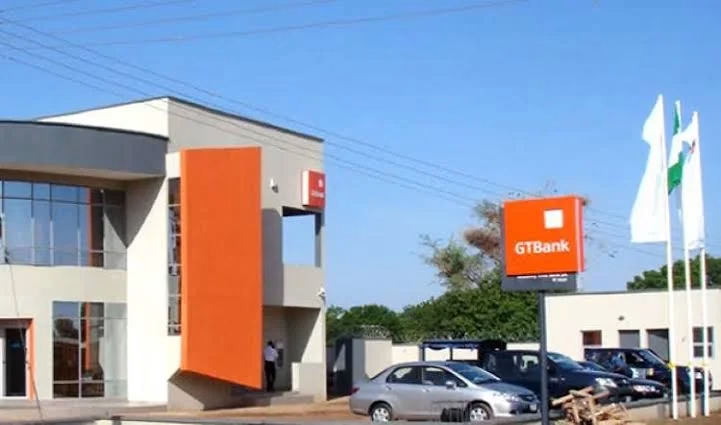
Guaranty Trust Bank (GTBank) has announced a 50% increase in its SMS transaction alert fee, raising the cost from N4 to N6 per message. The new rate takes effect on Thursday, May 1, 2025, and applies to all customers who receive transaction notifications via SMS. The bank attributes the fee hike to recent increases in telecommunication service rates. In a notice to customers, GTBank explained, “This adjustment is due to a recent increase in telecom rates as communicated by the telecommunication service providers”. Telecom operators in Nigeria-including MTN, Airtel, Globacom, and 9mobile-have faced mounting financial pressures in recent years. Rising energy costs, the depreciation of the naira, and frequent disruptions to fibre-optic infrastructure have driven operational expenses higher. Despite these challenges, telecom tariffs remained largely unchanged for over a decade. Earlier this year, telecom operators petitioned the Nigerian Communications Commission (NCC) for a 100% tariff hike. The NCC ultimately approved a 50% increase, which has now led to higher SMS and data charges across the industry. For example, MTN’s 1.8GB monthly data plan jumped from N1,000 to N1,500, while the 20GB plan rose from N5,500 to N7,500. Banks, including GTBank and Ecobank, are now passing these increased costs on to customers by raising SMS alert fees. GTBank emphasized the importance of SMS transaction alerts as a key tool for monitoring account activity and enhancing security. Real-time notifications help customers detect unauthorized or suspicious transactions quickly. However, the bank also acknowledged customer concerns about rising costs and offered an opt-out option for those who wish to avoid the new fee. Customers can stop receiving SMS alerts by completing a transaction alert form and sending it to gtbankmailsupport@gtbank.com. The fee hike comes at a time when many Nigerians are already grappling with rising living costs. While banks and telecom operators argue that the increases are necessary for operational sustainability, customers have expressed frustration, especially as network quality and service reliability remain ongoing concerns. Regulators, including the NCC and the Federal Competition and Consumer Protection Commission (FCCPC), have called on telecom operators to improve service quality in exchange for the higher tariffs. Consumer advocacy groups continue to push for greater accountability and transparency in the sector.

Zenith bank surpasses CBN’s capital mandate, confirms no need for further fundraising
Zenith Bank Plc has announced that it is not under any pressure to raise additional capital after exceeding the Central Bank of Nigeria’s (CBN) new minimum capital requirement for international banks. The bank’s capital base now stands at an impressive N614.65 billion, well above the N500 billion threshold set by the CBN, following a highly successful hybrid capital raise earlier this year. The recapitalization, completed in January 2025, saw Zenith Bank raise N350.46 billion through a combination of a rights issue and a public offer. Both components of the offer were oversubscribed, reflecting strong investor confidence in the bank’s strategy and future prospects. The rights issue was 100.18% subscribed, while the public offer saw a 160.47% subscription rate. Speaking at the bank’s Annual General Meeting in Lagos, Group Managing Director and CEO, Adaora Umeoji, assured shareholders that Zenith Bank’s robust capital structure means there is no need to seek further funds for recapitalization. “We have finalized our recapitalization exercise and have reached 160% capitalization. We are not under any pressure to go back for the second time to raise money. Our robust capital structure allows us to continue delivering value to our shareholders,” Umeoji said. Zenith Bank’s strong financial performance in 2024 underpins this confidence, with profit before tax rising 67% to N1.3 trillion and continued growth in both interest and non-interest income. The bank’s market capitalization has also climbed, reaching N1.87 trillion and cementing its position as one of Nigeria’s leading financial institutions.

CBN orders Nigerian banks to adopt PAPSS for cross-border payments
The Central Bank of Nigeria (CBN) has directed all banks in the country to immediately adopt the Pan-African Payment and Settlement System (PAPSS) for processing cross-border transactions. This move, announced in a circular dated April 28, 2025, is designed to boost intra-African trade, make payments more efficient, and reduce Nigeria’s reliance on foreign currencies like the US dollar. PAPSS, launched in 2022 by Afreximbank in partnership with the African Union and the African Continental Free Trade Area (AfCFTA) Secretariat, serves as a centralized platform enabling instant, secure, and cost-effective payments across Africa. By allowing transactions in local currencies, PAPSS aims to cut transaction costs and speed up settlements for businesses and individuals trading within the continent. Key Policy ChangesSimplified Documentation: For transactions up to $2,000 (individuals) and $5,000 (corporates), only basic Know Your Customer (KYC) and Anti-Money Laundering (AML) documents already submitted to banks are required. Higher-Value Transactions: Transactions above these limits must still comply with full documentation requirements as outlined in the CBN Foreign Exchange Manual. Foreign Exchange Sourcing: Banks can now source foreign exchange for PAPSS settlements directly from the Nigerian Foreign Exchange Market, without needing CBN approval. Export Proceeds: All export proceeds repatriated through PAPSS must be certified by the processing banks to ensure compliance. The CBN is urging exporters, importers, and individuals to familiarize themselves with these new requirements and take advantage of PAPSS for their cross-border transactions. The regulator believes this initiative will make payments faster, cheaper, and more accessible for Nigerian businesses and support the country’s integration into Africa’s growing trade ecosystem.

OPay shines as only fintech winner at 2025 Vanguard awards
OPay, one of Nigeria’s leading digital financial service providers, has clinched the title of “Most Innovative Fintech of the Year” at the 2025 Vanguard Awards, standing out as the only fintech company recognised at the event held at Eko Hotel and Suites, Lagos, on April 11, 2025. The award spotlights OPay’s relentless drive to expand financial inclusion and boost digital security for millions of Nigerians. The company has rolled out several groundbreaking features, including the Large Transaction Shield for enhanced security and NightGuard, which restricts account access during high-risk nighttime hours. These innovations, combined with user-friendly tools like network status notifications before transfers, double verification to prevent errors, facial verification for transactions, lightning-fast transfers, and responsive in-app customer service, have earned OPay widespread praise on social media and set it apart in Nigeria’s crowded fintech sector. Receiving the award, Elizabeth Wang, OPay’s Chief Commercial Officer, said, “We are deeply honored to be recognized as the Fintech Company of the Year. This award reaffirms our vision of creating a secure, inclusive, and innovative financial ecosystem for every Nigerian. We dedicate this achievement to our loyal customers who inspire us every day to do better”. Founded in 2018, OPay is licensed by the Central Bank of Nigeria and insured by the NDIC. The company offers a wide range of digital financial services, including money transfers, bill payments, airtime and data purchases, and merchant payments. This latest recognition cements OPay’s leadership role in shaping Africa’s digital payment landscape and its commitment to innovation, security, and customer-centric solutions.

OPay launches ₦60 million scholarship scheme for UNILORIN students
Nigeria’s leading fintech company OPay has unveiled a ₦60 million scholarship programme set to run over the next decade, at the University of Ilorin (UNILORIN). Each year, 20 deserving UNILORIN students will receive ₦300,000 each to help cover their academic expenses. The scholarship, which will run for 10 years, is designed to ensure that more young Nigerians can focus on their studies and personal growth without being held back by financial barriers. OPay’s Corporate Social Responsibility Manager, Itoro Udo, emphasized that the programme is not just about financial aid but also about enhancing the employability and long-term success of beneficiaries. “We want to support hardworking youths who are striving to make their lives better through education,” Udo said during a visit to the university’s Registrar. UNILORIN’s Registrar, Mr. Mansur Alfanla, welcomed the initiative, describing it as a timely intervention that aligns with the university’s commitment to student-focused programmes. Vice Chancellor Professor Wahab Egbewole (SAN) also expressed gratitude, noting that OPay’s gesture supports the national agenda for educational advancement. The OPay scholarship is open to undergraduates from all departments, with recipients selected through a transparent, merit-based process managed by the university. The programme is part of OPay’s ongoing efforts to give back to the society, particularly to young people who form a significant part of its customer base. Launched in 2024, OPay’s nationwide scholarship scheme covers 20 universities across Nigeria, reaffirming the company’s role as not just a financial service provider but a partner in shaping the country’s future. Applications for the scholarship typically open in August each year, and interested students are encouraged to prepare their academic records and other required documents in advance.

Access holdings sets new tech spending record, slashes fraud losses by 73%
Access Holdings Plc, the parent company of Access Bank, has made headlines with a record-breaking ₦193.5 billion ($120.5 million) investment in technology and electronic business in 2024, a 147% jump from the previous year and the highest among Nigerian banks. This bold move comes as the company reports a dramatic 73% drop in fraud-related losses, from ₦6.15 billion to ₦1.64 billion, according to its latest financial statement. The surge in tech spending was driven by several factors: inflation, exchange rate volatility, major upgrades to its core banking software, cybersecurity enhancements, and expansion into new markets like Tanzania, Namibia, and Hong Kong. These investments, Access Holdings says, are necessary to support its fast-growing digital customer base and compete with fintech challengers such as Opay, PalmPay, and Moniepoint. A company spokesperson explained that most of the IT budget goes to licensing (80%), support services (15%), and consultancy. “Our technology spend reflects a deliberate balance between capital investments in new capabilities and operating expenses that support existing systems,” the spokesperson said. Analysts credit the sharp drop in fraud losses to these tech upgrades, especially in cybersecurity. “I suspect that the group invested in some cybersecurity infrastructure, especially given that the amount lost to fraud declined significantly,” said Mobifoluwa Adesina, an investment research analyst at Afrinvest West Africa Limited. The impact is clear when compared to competitors: GTCO spent ₦88 billion on IT in 2024, Zenith Bank ₦67.3 billion, and UBA ₦48 billion, each well below Access Holdings’ outlay. While GTCO and UBA saw modest improvements in fraud losses, Zenith Bank’s losses spiked, highlighting the urgent need for stronger fraud prevention across the sector. Nigeria’s banking sector has seen a surge in digital transactions, and with it, a rise in fraud cases. Yet, Access Holdings’ aggressive investment in technology shows that targeted spending can pay off, both in customer trust and the bottom line. The company plans to continue investing in modernization, innovation, and staff training to maintain its lead and further reduce risks.