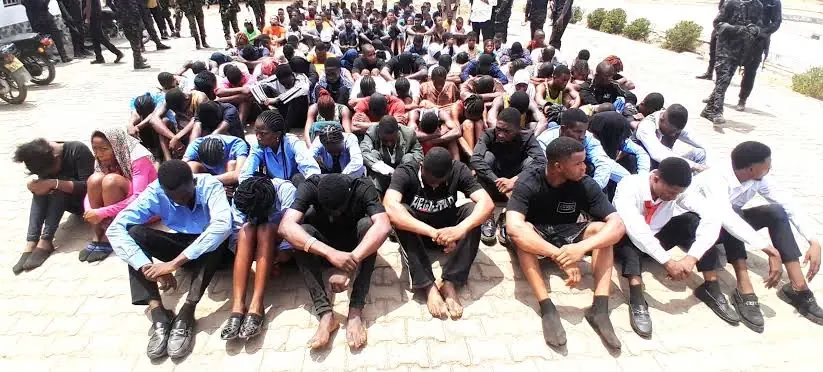
The Economic and Financial Crimes Commission (EFCC) has arrested 133 suspects linked to a Ponzi scheme academy in Abuja. The academy, operating under the name Q University (also known as Q-Net), was busted on Monday at the Compensation Layout in Gwagwalada, following actionable intelligence. According to the EFCC, Q University lured young Nigerians with promises of unrealistic profits through a training program called “Special Training for New Generation Billionaires.” Recruits were required to purchase an “Independent Representative Application Form” with slogans like “I’m a Champion” and “I’m Unstoppable.” The operation was conducted in collaboration with the 176 Guards Battalion of the Nigerian Army. Items seized from the suspects include phones, computers, and other electronic gadgets. The EFCC plans to charge the suspects in court once investigations are completed. This operation comes amid heightened legal scrutiny against Ponzi schemes, following the passage of the Investments and Securities Repeal and Re-enactment Bill, 2024, which proposes severe penalties for operators of such schemes.
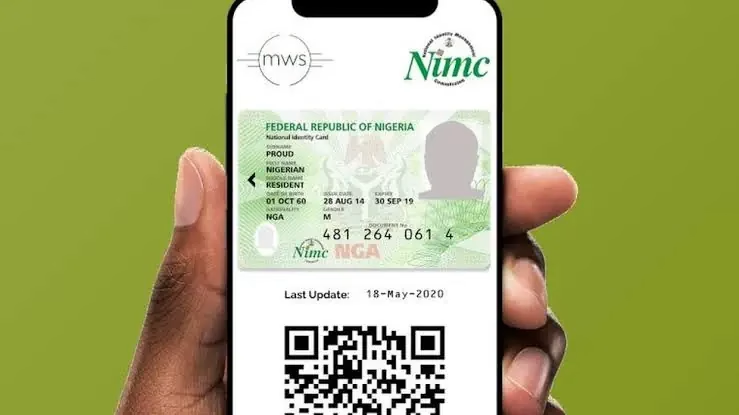
NIMC cracks down on unauthorized NIN card printing
The National Identity Management Commission (NIMC) has issued a stern warning against the unauthorized printing of National Identity Number (NIN) cards. The commission emphasized that only the NIN slip is recognized as a legal means of identification, and any other form of NIN card is not authorized. NIMC has observed that some individuals, cyber cafes, and organizations are indiscriminately printing these unauthorized cards, often charging exorbitant fees to unsuspecting citizens. This practice is not only illegal but also violates the NIMC Act No. 23 of 2007. As a result, security agencies have been mandated to arrest and prosecute those involved in this illicit activity. In response to public demand for a more robust identification solution, NIMC is preparing to launch its General Multipurpose Card (GMPC), which will serve as both a physical ID and a payment card. Powered by AfriGO, a local payment platform, this card aims to address various social and economic challenges by providing a secure and multifunctional identification tool for Nigerians. The public is advised to refrain from using unauthorized NIN cards and to report any instances of such illegal printing activities to the authorities. NIMC remains committed to upholding national identity security and preventing fraud.
Nigerian Police officers allegedly caught stealing phones worth over N1 million in Ondo State
Police officers from the Special Weapons and Tactics (SWAT) unit of the Nigeria Police Force have been accused of stealing mobile phones worth over N1 million from a shop in Idogun, Ose Local Government Area of Ondo State. The incident, captured on CCTV, reportedly occurred on March 22, 2025, amid heightened tension in the community. Seketi Adebowale, the shop owner, shared CCTV footage showing two policemen entering his store and leaving with items. He posted three videos on social media, including one showing an expelled shell casing. Adebowale alleges that the SWAT officers were involved in a larger conflict between a Navy captain, Jide Falade, and the local king. The unrest began after the community’s king accused Falade of armed robbery and kidnapping. Following his arrest and court appearance on March 21, tensions escalated when supporters of Falade protested his detention. On March 22, SWAT officers reportedly used tear gas and live ammunition to disperse protesters, leading to violent clashes. Protesters retaliated by throwing stones, forcing police to retreat. Adebowale claims that SWAT officers targeted specific homes and shops under the king’s instructions during the unrest. His shop was among those affected. He further alleged that police assaulted residents, including women and children, and even killed animals during their operations. In one video shared online, a woman and her son displayed injuries allegedly inflicted by police officers. The son claimed he was beaten with sticks, while the woman recounted being threatened with death. “They kicked the door open and came in. They cut my son with a cutlass and used the blunt part to beat me. One of them threatened to slash my head,” she said. The Ondo State Police Command has refuted claims of theft by its officers. In a statement issued on Sunday, the Command acknowledged that policemen were deployed to Idogun for intervention but denied the existence of any phone shop in the area. “The video is misleading as it has been confirmed by the traditional leader, stakeholders, and men on duty that there is no mobile phone shop in Idogun,” the statement read. The Command urged anyone with evidence to file a formal complaint with the Commissioner of Police for proper investigation. Adebowale has called for an independent investigation into the actions of the SWAT officers and justice for victims of alleged police misconduct during the unrest. The incident has sparked widespread outrage online, with many Nigerians demanding accountability from law enforcement agencies.

FBI and IRS uncover $50 million fraud scheme involving two Nigerians and others
The Federal Bureau of Investigation (FBI) and the Internal Revenue Service (IRS) have revealed a major fraud scheme involving six individuals, including two Nigerians, Solomon Aluko and Nosakhare Nobore. The suspects are accused of stealing approximately $50 million through fraudulent activities targeting U.S. government programs, including COVID-19 relief funds. According to a statement from the U.S. Department of Justice, the six defendants operated a sophisticated check fraud and money laundering network between 2021 and 2025. The scheme involved the use of fake identities and sham businesses to deposit stolen or fraudulent checks. These checks included U.S. Treasury payments intended for COVID-19 relief, tax refunds, and benefits for veterans and the elderly. Acting U.S. Attorney for the Southern District of New York, Matthew Podolsky, condemned the exploitation of government programs designed to assist citizens during times of crisis. “We allege that the defendants stole tens of millions of dollars in COVID-19 relief and other checks, using a ‘Fraud Bible’ to guide their actions,” Podolsky stated. “This Office will not tolerate such exploitation, and we will hold those responsible fully accountable.” The six individuals charged in this case are: Nosakhare Nobore, 29, Edgewater, New Jersey Solomon Aluko, 29, Hackensack, New Jersey Shan Anand, 34, Queens, New York Nicholas Pappas, 28, Miami, Florida Leonard Ujkic, 44, Fort Lauderdale, Florida Jorge Gonzalez, 28, North Bergen, New Jersey Each defendant faces multiple charges: Wire and bank fraud (maximum sentence: 30 years) Money laundering (maximum sentence: 20 years) Conspiracy to defraud the government (maximum sentence: 10 years) Aggravated identity theft (mandatory sentence: 2 years) Federal investigators revealed that the suspects used a document known as the “Fraud Bible,” which provided detailed instructions on committing various financial crimes such as credit card fraud and ATM fraud. Evidence from their communications showed that some defendants openly shared methods to manipulate financial systems for illegal gains. Leslie R. Backschies, Acting Assistant Director in Charge at the FBI’s New York Field Office, highlighted the scale of the operation: “These six defendants allegedly used sham businesses and stolen identities to run a multi-year fraud scheme that resulted in $50 million being deposited into their accounts. Their actions exploited multiple government programs meant to support struggling Americans.” IRS Special Agent in Charge Harry T. Chavis Jr. emphasized how deliberate and brazen these crimes were. “This group openly communicated about their fraudulent activities while stealing funds meant to help struggling businesses and vulnerable populations,” Chavis noted. If convicted on all counts, each defendant could face up to 62 years in prison for their role in this elaborate scheme. Federal authorities have reiterated their commitment to prosecuting those who exploit government programs designed to assist citizens during emergencies.
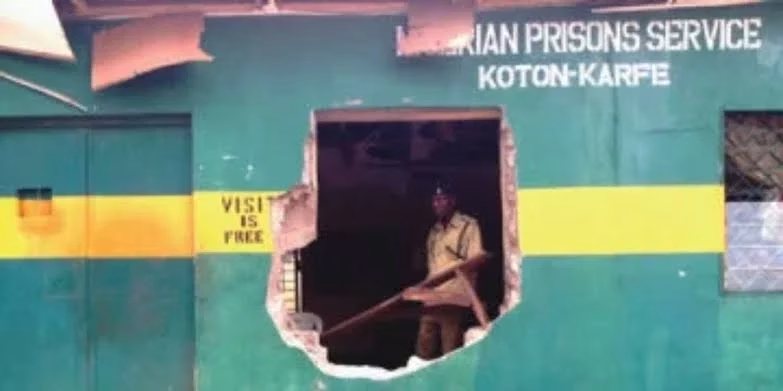
Kogi prison break: Minister Vows to recapture escapees using biometrics and technology
A recent prison break at the Koton Karfe Correctional Centre in Kogi State has led to the escape of 12 inmates, with five recaptured so far. The Minister of Interior, Dr. Olubunmi Tunji-Ojo, has vowed to leverage biometrics and technological solutions to capture the remaining escapees. This incident resulted in the death of a correctional officer and has prompted an immediate probe into the circumstances surrounding the jailbreak. The escape occurred early on Monday when inmates manipulated padlocks in a section of the facility. The Nigerian Correctional Service (NCoS) quickly mobilized personnel to secure the area and initiate a manhunt for the escapees. The Minister has ordered a comprehensive audit to prevent future incidents and ensure the recapture of all escapees using advanced technology. The Minister described the incident as unfortunate and assured that all necessary measures are being taken to apprehend the fleeing inmates. The Acting Controller General of the NCoS, Sylvester Ndidi, has been tasked with evaluating the situation and conducting a thorough investigation. The public is urged to cooperate with security agencies by providing any useful information that may assist in the recapture efforts.

Consumer group condemns MultiChoice Nigeria’s 21% price hike on DStv, GOtv
A consumer advocacy group, Save the Consumers, has criticized MultiChoice Nigeria for its recent 21% increase in subscription prices for DStv and GOtv services, describing the move as exploitative and discriminatory. The price adjustment, which took effect on March 1, has sparked outrage among subscribers and renewed calls for regulatory intervention. Dr. Aliyu Ilias, Executive Director of Save the Consumers, issued a statement on Sunday condemning the hike. He highlighted the disparity between MultiChoice’s pricing strategies in Nigeria and South Africa, where the company recently reduced subscription fees by 38%, added new channels, and introduced enhanced features. “This double standard, lowering prices in South Africa while increasing them in Nigeria, is indefensible,” Ilias said. “It reflects a disturbing trend of treating Nigerian consumers as second-class subscribers.” Despite MultiChoice’s justification for the price increase, citing inflation and rising operational costs, Nigerian subscribers continue to report frequent service disruptions and poor customer support. These unresolved issues have further fueled frustrations among customers who feel they are not receiving value for their money. “MultiChoice claims the hike is necessary to deliver world-class content,” Ilias added. “Yet Nigerian subscribers still face persistent challenges that remain unaddressed. This is unacceptable and shows a lack of respect for Nigerian consumers.” Breakdown of New Subscription PricesUnder the new pricing structure, DStv Premium subscribers now pay ₦44,500 monthly, up from ₦37,000. Other packages have also seen increases: DStv Compact Plus: ₦30,000 (previously ₦24,500) DStv Compact: ₦16,000 (previously ₦15,700) DStv Confam: ₦10,000 (previously ₦9,000) GOtv Supa Plus: ₦16,800 (previously ₦13,500) GOtv Jolli: ₦5,800 (previously ₦4,850) MultiChoice has defended the price adjustments as necessary to continue offering premium content and advanced technology to its customers. The Federal Competition and Consumer Protection Commission (FCCPC) had earlier directed MultiChoice to maintain existing prices pending an investigation into the proposed hike. However, the company proceeded with the increase despite this directive. The FCCPC has since filed legal charges against MultiChoice Nigeria and its CEO, John Ugbe. Dr. Ilias called on the National Broadcasting Commission (NBC) to take decisive action to foster competition in the pay-TV sector. He also urged Nigerian consumers to explore alternative platforms or consider boycotting DStv and GOtv until MultiChoice demonstrates respect for their rights. “The Nigerian market deserves dignity—not exploitation,” Ilias said. “No company should be allowed to operate above the law or treat Nigerian consumers unfairly.” The backlash against MultiChoice comes amid growing concerns about affordability in Nigeria’s pay-TV market. Many subscribers are questioning whether they can continue to afford these services as economic pressures mount. For now, Save the Consumers is calling for an immediate reversal of the price hike and compensation for affected customers. Whether these demands will lead to tangible changes remains uncertain as regulatory bodies continue their investigations into MultiChoice’s practices.