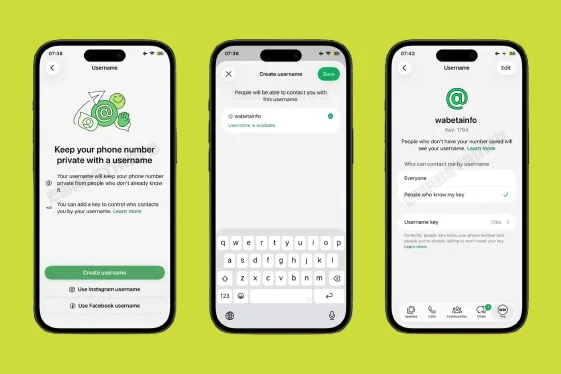
WhatsApp has begun rolling out global username reservations, allowing users to secure unique usernames that will let them connect without sharing their phone numbers. The new privacy feature, announced on June 29, enables users to reserve their preferred usernames ahead of an in-app rollout later this year. The new WhatsApp usernames feature is designed solely for private communication, with no public directory or username suggestions. Users will need to know a person’s exact username to initiate contact. According to WhatsApp, the feature gives users greater control over their privacy, particularly in group chats and conversations with people they do not know personally. The platform will also introduce an optional username key, providing an additional layer of security by requiring others to enter a unique key before they can make contact. “We heard from people that they don’t always want to share their phone numbers, especially in group chats. This gives users control over how they choose to show up on WhatsApp” – Alice Newton-Rex, (WhatsApp’s Head of Product) When the feature becomes available, users will be able to communicate using usernames instead of phone numbers while retaining existing options to block or report unwanted contacts. Usernames will be limited to 35 characters, and WhatsApp said restrictions will apply to high profile names to reduce the risk of impersonation. For creators, businesses, and organisations, WhatsApp will also allow users to claim usernames that match their existing Instagram or Facebook accounts, in order to maintain consistent identity across Meta’s platforms. The company said availability will expand gradually, and that users will receive notifications when the feature becomes accessible in their country.

Facebook launches AI-powered creator studio for content creators
Facebook has unveiled a standalone AI-powered Creator Studio app, aimed at helping content creators grow their audiences, improve engagement, and manage their activities more efficiently. The new Creator Studio, announced by Facebook, is designed as an AI-first platform that provides creators with personalized recommendations, daily priorities, content insights, and community management tools in a dedicated space separate from the main Facebook app. According to the company, the app uses artificial intelligence to understand a creator’s audience, content style, and goals, offering guidance on improving reach, engagement, and monetization. It also features an AI-powered assistant that can help creators brainstorm ideas, answer content-related questions, and recommend growth strategies. Facebook said the platform includes AI-driven comment management tools capable of identifying important audience interactions and drafting responses in the creator’s voice, while allowing users to review and approve replies before posting. In addition to launching the standalone app, Facebook is redesigning its existing creator tools within the main platform. The company plans to split its Professional Dashboard into two separate products, containing a Creator Dashboard for content creators and a Business Dashboard for businesses, providing more specialized experiences for each group. The company has begun testing the new Creator Studio with a limited group of creators and has opened a waitlist ahead of the rollout.

TikTok removes 4 million Nigerian videos as AI moderation expands
TikTok says it removed over four million videos from Nigeria between October and December 2025 as part of efforts to enforce its community standards and strengthen online safety. According to the latest Community Guidelines Enforcement Report of the platform, most of the content was detected automatically. TikTok stated that 99.9% were caught and taken down before a single user reported them, while 98.4% were removed within 24 hours of posting. The report also revealed that TikTok interrupted more than 86,000 live-streaming sessions in Nigeria during the same period for violating platform rules. Globally, the company removed 175.3 million videos in the fourth quarter, with the majority identified through automated systems. A key focus of TikTok’s enforcement strategy is the growing challenge posed by artificial intelligence-generated content. The company requires creators to label realistic AI-generated videos, images, and audio. To support compliance, TikTok uses C2PA Content Credentials, a technology that embeds digital metadata into AI-generated content. The company said these measures have helped label more than 1.3 billion videos worldwide. TikTok restates stronger moderation is necessary to limit misinformation, harmful content, and deceptive AI-generated material. The platform also noted its collaboration with Nigeria’s Office of the National Security Adviser and civil society groups on digital safety initiatives. However, questions remain about the accuracy of automated moderation. TikTok acknowledged that 8.4 million videos globally were later restored after human review, which shows that some content was removed incorrectly.

FG cracks down on bandits social media accounts
The Federal Government has launched a campaign against the online activities of criminal networks, announcing on Tuesday, December 23, that it has pinpointed and removed multiple social media accounts operated by bandits and terrorists. Major General Adamu Laka, Director-General of the National Counter Terrorism Centre (NCTC), stated that sites used to flaunt stolen goods and broadcast live criminal discussions are being dismantled one after the other. There was a time when bandits flaunted their loot on TikTok. We’ve shut those accounts down, you don’t see it anymore. They even went live… but we’ve tackled all that – Maj.-Gen. Adamu Laka This is aimed towards addressing the rising pattern of non-state actors, leveraging on social media platforms to boast about attacks, collecting ransom payments, and sometimes for recruitment. For years now, bandits leaders like Bello Turji have turned to platforms like TikTok and Facebook to terrorize vulnerable communities, display ransom money stacks and arsenals to lure new members. Security forces are partnering closely with TikTok, Meta (Facebook and Instagram), Snapchat, and X to flag and suspend unverified profiles linked to terror groups. The security forces have been victorious in tracking ransom transactions from Point-of-Sale (POS) operators. Criminals often use POS terminals to receive ransom transfers and withdraw cash, making it more difficult to trace than traditional bank transfers. The NCTC plans to enforce key strategies in dismantling the online activities of criminal groups in 2026, under its new Strategic 2025-2030 plan, which utilizes AI-driven tools and network analysis to foresee and disrupt terror funding at the POS stage. The public is encouraged to flag any social media accounts suspected of promoting banditry or fundraising for crimes.
Sowore arraigned on cybercrime charges over tweet against President Tinubu
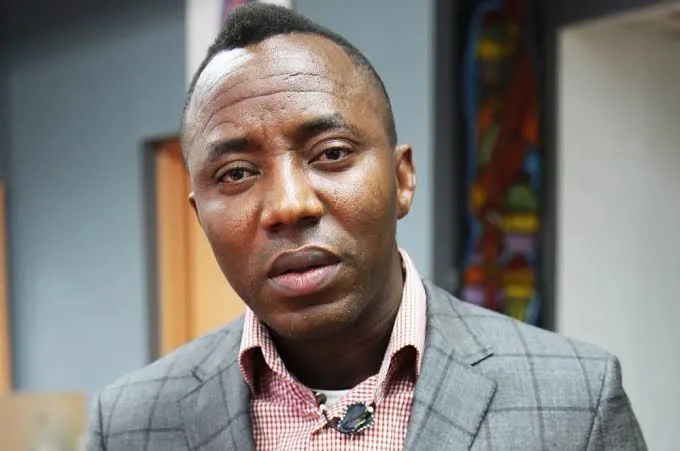
The Department of State Services (DSS) arraigned political activist and publisher Omoyele Sowore before a Federal High Court in Abuja on Tuesday, charging him with five counts of cybercrime and defamation for calling President Bola Tinubu a “criminal” in a social media post. After two earlier attempts to arraign him, Sowore pleaded not guilty to the charges. Justice Mohammed Umar, the presiding judge, granted him bail on self-recognition, considering his previous status as a presidential candidate. The five-count charge (FHC/ABJ/CR/484/2025) accuses Sowore of violating the Cybercrimes (Prohibition, Prevention, etc) Amendment Act, 2024, and the Criminal Code Act. The charges relate to posts Sowore made on X and Facebook in August 2025, where he allegedly labeled President Tinubu a “criminal.” The DSS also named X Incorp (formerly Twitter) and Meta (Facebook) Incorp as co-defendants, likely due to their refusal to remove the contested posts. Sowore, who ran for president under the African Action Congress (AAC) in 2019 and 2023, denied all five charges. Justice Umar granted bail without requiring a bond or sureties, a privilege given to prominent individuals like Sowore. He noted that Sowore’s international passport was already in court custody from a previous case. The judge also prohibited Sowore from making further statements that could threaten national peace and security, warning that violating this condition would result in bail revocation.

Police bust cult using WhatsApp channel ‘Red Chamber’ to recruit teens in Sokoto
Police in Sokoto, have arrested the leaders of a suspected cult group accused of using a WhatsApp group called the “Red Chamber” to recruit and initiate teenagers into their cult group.The crackdown, announced on Saturday, led to the arrest of three suspects, including the alleged mastermind, Usman Shu’aibu. The operation by the Anti-Kidnapping Unit exposes the new trend of digitalization adopted by criminal networks, to expand their reach and influence over the youth.The group, known locally as “Sai Malam,” operated discreetly across parts of Sokoto State. Investigators discovered that the WhatsApp group was central to their operations, promising secret powers and loyalty to new recruits.The suspects confessed to using the WhatsApp platform to initiate members remotely. Police described the strategy as an attempt to exploit impressionable young people who might be seeking belonging or protection.The breakthrough came Friday night when the Anti-Kidnapping Unit raided the group’s location. The Commissioner of Police, Ahmed Musa, framed the arrests as a response to public outcry regarding youth involvement in harmful secret societies.Police spokesperson Ahmed Rufai emphasized the need for parents to scrutinize their children’s digital footprint, stressing that social media is becoming a frontline for criminal manipulation. The police have launched a manhunt for fleeing members of the “Sai Malam” group, in order to restore law and order across the state.