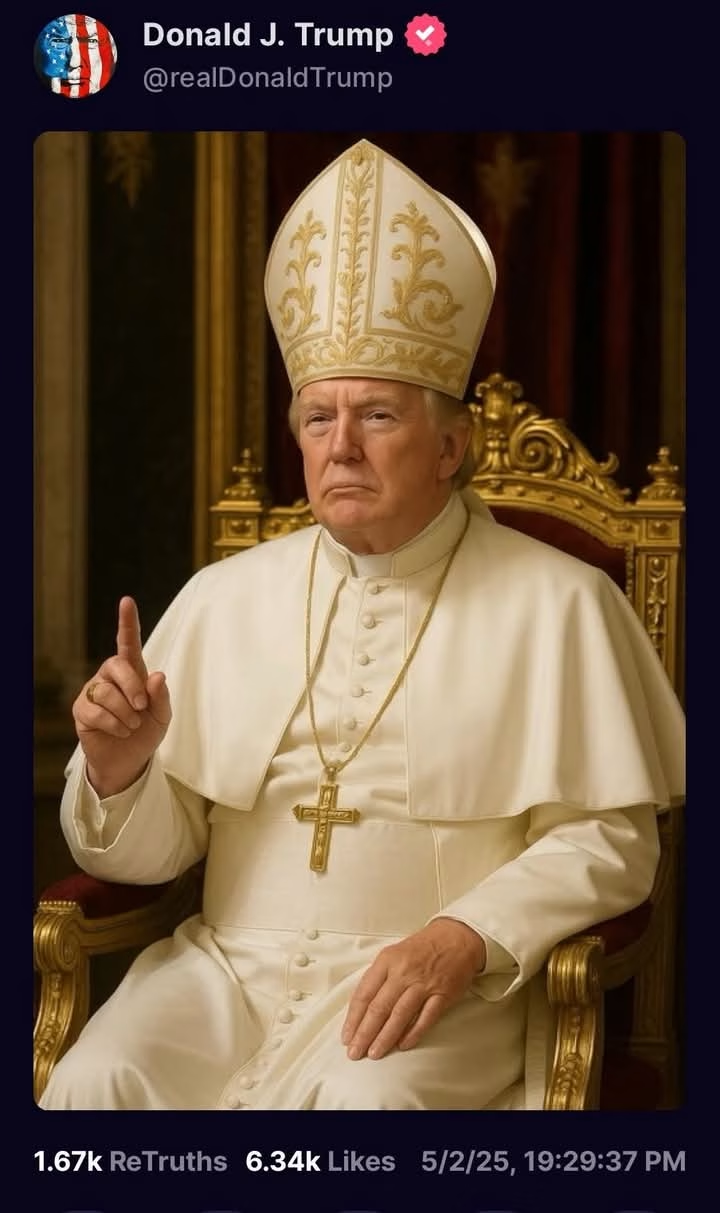
US President Donald Trump ignited controversy on Saturday after posting an AI-generated image depicting himself as the new Pope. The image, shared on his Truth Social platform, showed Trump in traditional papal robes, complete with a mitre and golden crucifix, seated on a papal throne with his finger raised. The post quickly garnered over 12,000 reactions and was later reposted by the White House’s official X account. The timing of the post drew particular attention, coming just days after the death of Pope Francis at age 88. Trump, when asked by reporters about the papal succession, had joked, “I’d like to be Pope. That would be my number one choice,” further fueling discussion around the image. Public reaction was swift and divided. Many Catholics and social media users condemned the post as disrespectful, especially as the Catholic community mourns the late pontiff. “Please take this down,” pleaded one user. “Many Catholics, myself included, find this as a great disrespect to the past and future leader of our church.” Others described the image as a mockery of a sacred institution. Trump also faced criticism for his conduct at Pope Francis’ funeral last week, where he was seen wearing a blue suit and chewing gum during the ceremony. Some commentators called his actions and the AI post inappropriate during a period of mourning. The incident has sparked a wider debate about the use of AI in political satire and the boundaries of public figures’ behavior, especially during sensitive times. As the conclave to select a new pope continues, the controversy underscores the challenges of navigating respect, technology, and public discourse in 2025.
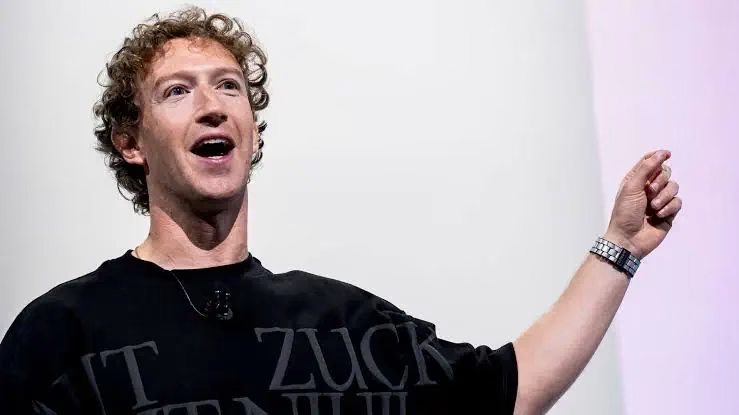
Meta threatens to shut down Facebook and Instagram in Nigeria over $290 million fines
Millions of Nigerians could soon lose access to Facebook and Instagram as Meta, the parent company of both platforms, has threatened to suspend its services in the country following a series of hefty fines and what it calls “unrealistic” regulatory demands from Nigerian authorities. Last year, three Nigerian regulatory agencies-the Federal Competition and Consumer Protection Commission (FCCPC), the Advertising Regulatory Council of Nigeria (ARCON), and the Nigerian Data Protection Commission (NDPC)-slapped Meta with fines totaling more than $290 million. The penalties stem from alleged violations of competition, advertising, and data protection laws, including claims of anti-competitive practices, unauthorized advertising, and breaches of user privacy through the transfer of data abroad without proper consent. Meta challenged the fines in Nigeria’s Federal High Court in Abuja but lost. The court has now ordered the tech giant to pay the full amount by the end of June 2025. In court documents, Meta warned that it may be forced to “effectively shut down the Facebook and Instagram services in Nigeria in order to mitigate the risk of enforcement measures” if the situation is not resolved. While Meta also owns WhatsApp, the company did not mention the messaging app in its shutdown threat, suggesting that WhatsApp may remain available in Nigeria for now. Facebook remains the most widely used social media platform in Nigeria, serving tens of millions of users daily for communication, news, and business. The platform is especially vital for small online entrepreneurs and content creators who rely on it for their livelihoods. If Meta follows through with its threat, the shutdown could disrupt communication, online business, and access to information for millions across the country. At the heart of the dispute are Nigeria’s strict data protection requirements. Authorities have demanded that Meta obtain explicit approval before transferring any user data out of the country and add visible links on its platforms leading to educational content about the risks of manipulative and unfair data practices. Meta has described these demands as excessive and impractical, arguing that they place an unreasonable burden on its operations in Nigeria. The FCCPC’s chief executive, Adamu Abdullahi, said investigations conducted with the NDPC uncovered “invasive practices against data subjects/consumers in Nigeria,” though specific details were not disclosed. Meta has until the end of June to comply with the court’s order and pay the fines. The company has not yet announced its final decision, but the possibility of losing access to Facebook and Instagram has sparked concern among Nigerian users and businesses who depend on these platforms for daily activities. The BBC and other outlets have reached out to Meta for further comment, but the company has not responded as of press time.
Australia unveils digital tools to speed up 2025 student Visa applications
Australia has launched two new digital tools aimed at making student visa applications faster and easier for international students starting in 2025. The Department of Home Affairs announced the rollout of the Visa Finder and Document Checklist Tool, part of a broader digital upgrade designed to reduce errors, improve document accuracy, and cut approval times for student visas. The Visa Finder helps applicants quickly identify the right visa for their needs by asking questions about their travel purpose, nationality, and length of stay. This feature is especially helpful for students deciding between the Student visa (subclass 500) and other options, such as Training or Graduate visas. Meanwhile, the Document Checklist Tool generates a personalized list of required documents based on the applicant’s country of passport and chosen education provider. This tool supports special categories, including government-sponsored students and those extending visas for PhD thesis marking, and is integrated with the ImmiAccount application system. Officials say these innovations will streamline the application process, reduce delays caused by missing paperwork, and improve approval chances for students. “By leveraging these digital tools, Australia aims to provide a smoother and more user-friendly experience for individuals seeking to study, work, or travel to the country,” the Department stated. Applicants are advised to use the tools via the Home Affairs website, ensuring all required documents are attached to avoid processing delays or refusals. For those whose education provider is not yet listed in the system, a placeholder option is available until records are updated. The launch comes as Australia continues to reform its migration system, with changes including higher student visa fees set for 2025.
TikTok fined €530 million for illegal user data transfers to China
ByteDance’s TikTok has been slapped with a €530 million ($600 million) fine by the European Union for unlawfully transferring user data to China, violating the bloc’s strict privacy standards. The penalty was handed down by Ireland’s Data Protection Commission (DPC), which acts as TikTok’s lead EU regulator due to the company’s European headquarters in Dublin. The platform has been given six months to halt all unauthorized data transfers. “TikTok did not address potential access by Chinese authorities to EEA personal data under Chinese anti-terrorism, counter-espionage and other laws identified by TikTok as materially diverging from EU standards,” said Deputy Commissioner at the DPC, Graham Doyle. The regulator revealed that TikTok admitted in April that European user data had been stored on servers located in China-directly contradicting earlier claims made during the investigation. The DPC further criticized TikTok for failing to adequately safeguard user information from potential access by Chinese state authorities under Beijing’s national security laws. In response, TikTok said it will appeal the decision in full, maintaining that it has never received a data request from Chinese authorities, nor provided any European user data to them. This latest fine ranks as the third largest ever under the EU’s GDPR framework, trailing penalties against Meta Platforms Inc. (€1.2 billion) and Amazon.com Inc. (€746 million). It also follows a €345 million fine in 2023 against TikTok for mishandling children’s personal data. The Irish watchdog has long warned about Big Tech firms transferring EU user data to jurisdictions with weaker privacy protections. Its investigation into TikTok began in 2021, amid concerns that maintenance and AI engineers in China could potentially access European data. Beyond privacy concerns, TikTok is also facing a probe under the EU Digital Services Act for allegedly failing to prevent the spread of fake accounts and foreign interference during Romania’s 2024 presidential election. The platform remains under scrutiny for its addictive design and perceived failure to protect underage users.

Philippines Launches Digital Nomad Visa, Inviting Remote Workers to Paradise
The Philippines has officially joined the global digital nomad movement, launching a new visa program that lets remote workers live and work in the country for up to one year-with the possibility of renewal. The initiative, backed by President Ferdinand Marcos Jr., aims to boost tourism and tap into the growing trend of location-independent work. Under the new Digital Nomad Visa, eligible foreign professionals can enjoy the Philippines’ vibrant cities, tropical beaches, and rich culture-all while working remotely for employers or clients based outside the country. The program is designed to attract long-term visitors who contribute to the local economy without competing for local jobs. Who Can Apply?Applicants must meet several requirements: Be at least 18 years old Work remotely using digital technology, with all income generated from outside the Philippines Show proof of a stable and sufficient income Hold valid health insurance for the entire stay Have a clean criminal record Be a citizen of a country that offers similar digital nomad privileges to Filipinos and where the Philippines has a Foreign Service Post The Department of Foreign Affairs will oversee the visa’s rollout, with details on the application process expected soon. The visa grants an initial 12-month stay, with the option to renew for another year. Holders are allowed multiple entries during their stay and are exempt from local income taxes, provided their earnings come from abroad.The Philippines is positioning itself as a top destination for remote professionals seeking both adventure and productivity.
YouTube turns 20: From humble beginnings to a global video powerhouse
YouTube, the world’s largest video-sharing platform, is celebrating its 20th anniversary-a milestone that marks not just two decades of digital innovation, but a revolution in how people across the globe create, share, and consume content. From a 19-Second Clip to 20 Billion VideosLaunched in 2005 by Steve Chen, Chad Hurley, and Jawed Karim, YouTube started with a simple mission: to let anyone upload and share videos with the world. The very first upload, a 19-second clip titled “Me at the Zoo,” featured co-founder Jawed Karim at the San Diego Zoo and quietly kicked off a digital revolution. Fast forward to 2025, and YouTube’s growth is nothing short of staggering. The platform now hosts over 20 billion videos, with more than 20 million new uploads every single day. In 2024 alone, users posted an average of 100 million comments daily, and creators responded to about 10 million of those comments each day. The engagement is massive, with videos racking up more than 3.5 billion likes per day. What began as a simple video-sharing website has evolved into a cultural phenomenon. YouTube is now a launchpad for careers, a platform for activism, and a global stage for education, entertainment, and creativity. It has blurred the lines between traditional media and personal expression, giving rise to a new era of digital storytelling. “YouTube has grown into a force, driving culture and fundamentally reshaping how we watch and create entertainment,” said Neil Mohan, CEO of YouTube, as the company marked its 20th birthday on April 23, 2025. To mark its 20th anniversary, YouTube has rolled out new features, shared fresh statistics, and hidden playful “Easter eggs” across the platform for users to discover. These touches are designed to celebrate not just YouTube’s longevity, but the vibrant community that powers it every day. YouTube’s impact goes far beyond numbers. The platform has empowered millions of creators worldwide to build audiences, launch businesses, and share voices that might otherwise go unheard. In Africa, for example, YouTube has become a major economic driver, offering new income streams and reshaping digital culture as internet access expands across the continent. From viral music videos to educational channels, comedy skits to podcasts, YouTube continues to be a dynamic hub for creativity, connection, and opportunity, YouTube remains at the heart of the world’s digital conversation-a testament to the power of sharing stories, one video at a time.