
Pope Francis, who passed away at age 88 on Easter Monday, leaves behind a legacy that deeply shaped the global conversation about technology and ethics. Throughout his papacy, Francis consistently called for technology to be used as a tool for unity, dignity, and the common good, rather than a source of division or inequality. In his final months, Francis urged the world to ensure that new technologies, especially artificial intelligence, do not replace real human relationships or exclude the most vulnerable. “Something’s wrong if we spend more time on our cell phones than with people,” he warned in his April 2025 message, emphasizing the risk of isolation and the loss of authentic connection in the digital age. He stressed that technology, a fruit of human intelligence, must not benefit only a privileged few but should help unite people, improve lives, and care for the earth. Francis applauded the positive impact of technology in areas like medicine, education, and communication, but repeatedly insisted that its use must be guided by ethical principles and always respect human dignity. He challenged world leaders and tech innovators to make sure digital progress addresses global crises, such as poverty and climate change, and does not deepen existing inequalities. The Pope also warned against a “technocratic paradigm”, the idea that unchecked technological progress could endanger humanity and the environment. He called instead for a culture of encounter, interdisciplinary dialogue, and critical awareness about how technology shapes society. As the world reflects on his legacy, Pope Francis’s message is clear: technology should help us look each other in the eyes, not just at screens. It must serve every person, especially the weakest, and promote genuine human relationships, solidarity, and care for our common home.
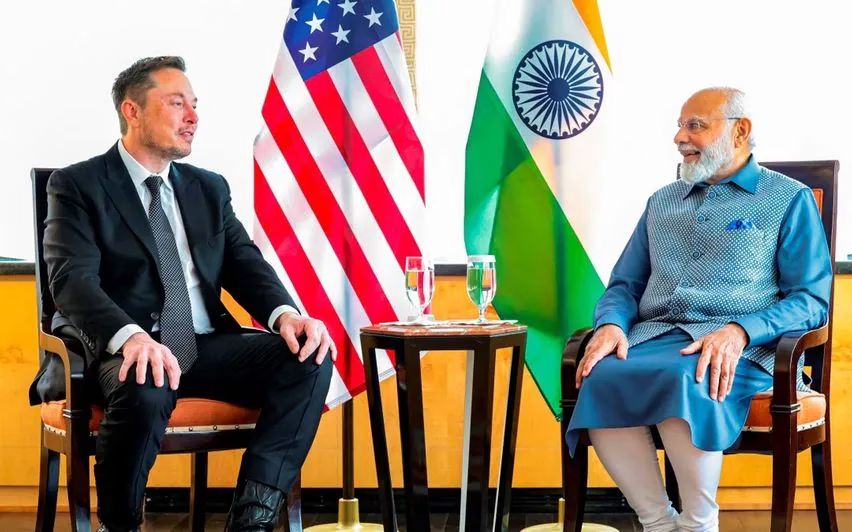
Starlink gains green light in India as Jio and Airtel power nationwide satellite internet rollout.
Elon Musk’s Starlink, the satellite internet service by SpaceX, is gearing up for a landmark launch in India as early as January 2025, pending final government approvals. The move is expected to transform internet access across the country, especially in rural and remote regions where traditional broadband has struggled to reach. Starlink delivers high-speed internet via a network of thousands of low-Earth orbit satellites, bypassing the need for extensive ground infrastructure. This makes it ideal for India’s vast and diverse terrain, where laying fiber or building towers is often impractical or too expensive. With speeds ranging from 25 to 220 Mbps and low latency, Starlink aims to support everything from online education and telemedicine to streaming and business needs, even in the country’s most isolated corners. Starlink’s entry comes through a partnership with telecom giant Bharti Airtel, which will help distribute the service and equipment across India. The rollout will begin in areas with low internet penetration, such as hilly, border, and rural regions, before expanding nationwide. Users will need to purchase a Starlink kit (including a satellite dish and Wi-Fi router) and set it up with a clear view of the sky to get connected. Starlink has cleared several regulatory milestones and is now awaiting final licenses from India’s Department of Telecommunications and space regulator. Once approved, it will become the third company after Jio Satellite Communications and OneWeb to offer satellite-based broadband in India. What Can Users Expect?High-speed internet: Download speeds of 25–220 Mbps, suitable for streaming, video calls, gaming, and more. Low latency: Typically 25–50 milliseconds, enabling real-time online activities. Wider reach: Coverage in remote and underserved areas, helping bridge the digital divide. Direct-to-mobile: New satellites will soon allow direct connectivity to mobile phones, further expanding access. Starlink’s launch is set to be a game-changer for India’s digital landscape, supporting the government’s Digital India initiative and opening new opportunities for millions who have long been left offline. While pricing details are yet to be announced, the service is expected to particularly benefit rural households, schools, and businesses seeking reliable internet for the first time.

Flutterwave launches tech skills workshop for young Africans
Africa’s leading payments company, Flutterwave, has introduced the Accelerate Workshop, a two-day virtual program aimed at equipping young Africans with in-demand tech skills. Targeting university students, recent graduates, and early-career professionals, the initiative focuses on bridging the gap between education and industry demands. The workshop offers hands-on training in four high-growth fields: Data Privacy & Cybersecurity: Led by experts like Abisola Epoyun (Data Privacy Manager) and Nujinim Egwegbete-Odukwu (Head of Infrastructure Security), sessions will cover compliance regulations and security best practices. Design: Ted Oladele, Mira CEO and former Flutterwave VP, will share insights on user-centric design. Marketing: Noel Ozoemena, Senior Branding Manager, will teach storytelling techniques for impactful campaigns. Product Management: Flutterwave’s Oluwatobiloba Animashaun will guide participants through product development strategies. Beyond technical skills, the program emphasizes soft skills and real-world challenges in African tech startups. Participants will learn to navigate data privacy laws, ethical design principles, and market-driven product strategies. Event Details Dates: April 26 and May 3, 2025 Format: Virtual, with registration open via Flutterwave’s Calendly link. Goal: Empower Africa’s youth to drive innovation and inclusion in the digital economy. Yewande Akomolafe-Kalu, Flutterwave’s branding lead, stated: “We’re giving young Africans the tools and confidence to transform the continent’s tech landscape.”
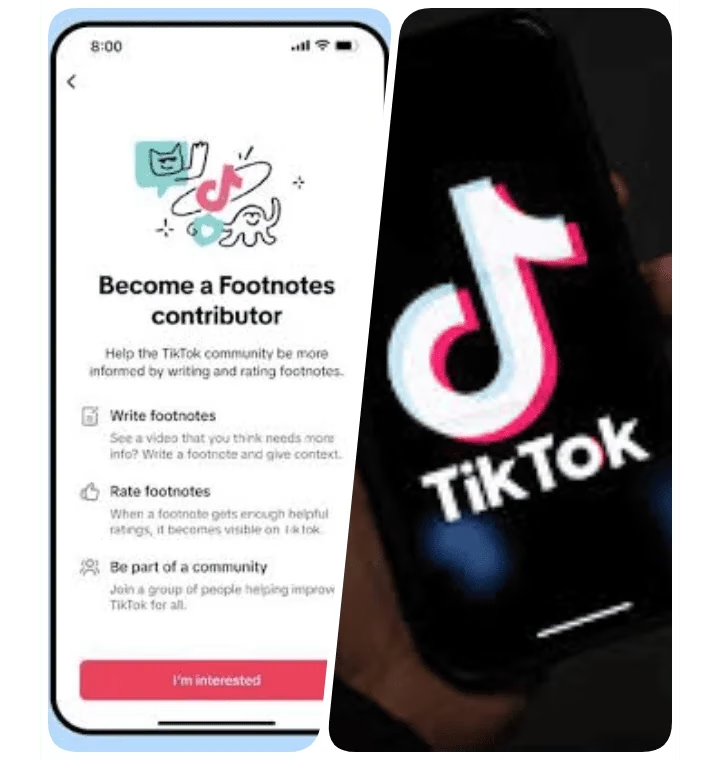
TikTok launches “Footnotes” to boost content clarity and trust
TikTok has unveiled a new pilot feature called “Footnotes,” aiming to help users better understand and trust the content they see on the platform. The feature, now being tested in the United States, lets select users add extra context to videos, especially those with complex topics or potentially confusing information. Announced by Adam Presser, TikTok’s Head of Operations and Trust and Safety, Footnotes is designed to tap into the collective knowledge of the TikTok community. Contributors can add relevant information to videos, helping viewers make sense of everything from STEM concepts to breaking news or statistics that might otherwise be misinterpreted. “Today we’re announcing the test of Footnotes, a new feature that will give our community more context about content on TikTok,” Presser said. To ensure credibility, TikTok has set eligibility rules: contributors must be over 18, have had an account for at least six months, and maintain a clean record on the platform. Once admitted, these users can add footnotes and rate those submitted by others. Only footnotes rated as “helpful” by a diverse group of contributors will be visible to the wider community, thanks to a bridge-based ranking system that encourages input from different perspectives. The company already uses content labels, search banners, and partners with fact-checkers worldwide. Footnotes adds a new layer, letting users directly enrich discussions and improve the overall experience for viewers and creators.
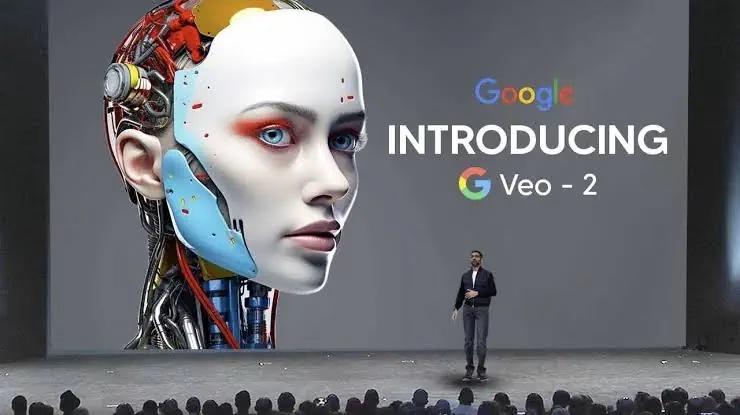
Google unveils Veo 2, a next-gen AI video generator that sets a new benchmark for creativity
Google has officially launched Veo 2, its most advanced AI video generator yet, raising the bar for what’s possible in text-to-video creation. Developed by Google DeepMind, Veo 2 transforms simple text prompts or reference images into high-quality, lifelike video clips, opening up new creative frontiers for marketers, filmmakers, educators, and content creators worldwide. Veo 2 produces videos with stunning realism, accurately simulating real-world physics, natural motion, and cinematic effects. Users can specify camera angles, lens types, special effects, and even exclude unwanted elements, ensuring videos match their creative vision down to the finest detail. The model supports resolutions up to 4K, though most users will currently see 720p output, with the potential for even higher quality as the technology matures. Creating a video with Veo 2 is as simple as describing your idea in detail. The AI interprets both simple and complex instructions, generating eight-second clips that can be further refined or downloaded in MP4 format. For developers and advanced users, Veo 2 is accessible via Google AI Studio and the Gemini API, allowing seamless integration into apps and creative workflows. Veo 2’s versatility shines across industries, from cinematic storytelling and advertising to scientific visualization and education. Its ability to handle intricate prompts and deliver consistent, visually appealing results makes it a favorite among professionals and hobbyists alike. Pre-designed templates and real-time adjustments for pacing, tone, and transitions further expand its creative potential. Currently, Veo 2 is available through a waitlist, with broader rollout expected soon. While it excels in realism and creative flexibility, users may still encounter minor glitches in complex scenes or rapid motion, a reminder that the technology, though groundbreaking, is still evolving. Google isn’t just keeping pace with competitors like OpenAI’s Sora, it’s setting a new standard for AI-driven video creation. As access expands, Veo 2 is poised to revolutionize how we bring ideas to life on screen, making professional-quality video production more accessible than ever before.
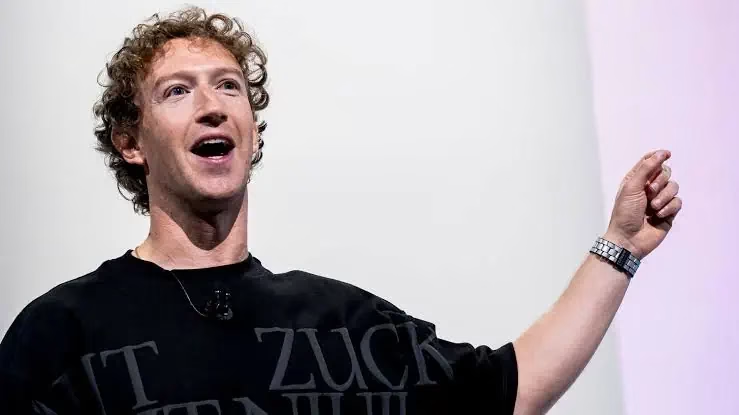
Zuckerberg defends Meta’s Instagram, WhatsApp acquisitions in antitrust trial
Meta CEO Mark Zuckerberg defended the company’s acquisitions of Instagram and WhatsApp during a high-profile antitrust trial in Washington, D.C., pushing back against U.S. government claims that these deals were meant to squash competition. The Federal Trade Commission (FTC) argues that Meta’s purchases of Instagram in 2012 and WhatsApp in 2014 were strategic moves to maintain its dominance in social media by eliminating potential rivals. The agency is seeking a court order that could force Meta to sell one or both platforms, which would significantly reshape the tech giant’s business. Zuckerberg testified that the acquisitions were part of Meta’s efforts to adapt to changing social media trends, not to stifle competition. He acknowledged that user behavior shifted over time, with people sharing less publicly on Facebook and more privately through messages, a change Meta initially misunderstood. The FTC pointed to internal emails suggesting Meta saw Instagram and WhatsApp as threats that needed to be neutralized. However, Meta counters that the social media landscape has evolved, with new competitors like TikTok, YouTube, and Apple’s messaging app offering strong alternatives. The trial also highlights the challenge regulators face in defining the relevant market. The FTC focuses on platforms where users share content with friends and family, such as Snapchat and MeWe, while Meta argues that broader platforms like TikTok compete directly for users’ attention. If the FTC prevails, forcing Meta to divest Instagram or WhatsApp could have major financial consequences. Instagram is a core part of Meta’s advertising revenue, and WhatsApp holds the company’s largest daily user base, playing a key role in future business messaging and monetization plans. This case is part of a wider push by U.S. regulators to hold Big Tech accountable for anti-competitive practices, a movement that has gained momentum over recent years. The trial is expected to continue through July, with a final decision that could reshape the social media industry.