
Sony has announced a price increase for its PlayStation 5 console in multiple regions, including Africa, Europe, and Asia-Pacific, citing inflation and volatile currency exchange rates as key reasons. This decision comes as the gaming industry faces mounting economic pressures globally. The price adjustments, which exclude the U.S. market, took effect immediately. In Europe, the digital-only PS5 now costs €499.99 ($570), reflecting a rise of over 10%. Similarly, in the UK, the same model is priced at £429.99 ($566.53). Australia and New Zealand also saw hikes for both digital and standard editions, with the latter featuring a Blu-ray disc drive. Sony clarified that African markets would also experience price increases but did not provide specific details. Interestingly, the PS5 Pro model, introduced in late 2024, will retain its current pricing, while the external Blu-ray disc drive accessory will see a slight price reduction.
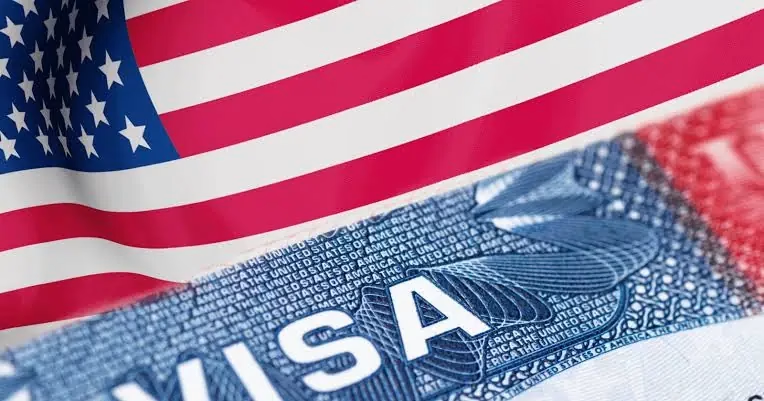
U.S. embassy tightens visa application rules for Nigerians starting April 22
The United States Embassy in Nigeria has announced new, stricter guidelines for visa applications, effective April 22, 2025. The updated rules are designed to streamline the application process and reduce delays caused by technical errors. Under the new policy, all visa applicants must ensure that the barcode number on their DS-160 form matches the one used to book their visa appointment. This requirement is mandatory for all applications submitted at the U.S. Embassy in Abuja and the Consulate General in Lagos. The DS-160 barcode must begin with “AA” followed by two zeroes, and appointments must be scheduled at the same location selected when filling out the form. Applicants whose barcode numbers do not match will be denied entry to the Consular Section and will not be allowed to attend their visa interviews. The embassy is urging applicants to double-check their DS-160 barcode numbers at least two weeks before their scheduled interview date. If errors are found, applicants should log into their AVITS account at least 10 days before their appointment to submit a support ticket for corrections. For those turned away due to mismatched barcodes, a new appointment must be booked after resolving the issue. If the visa fee has expired during this time, applicants may need to pay a new fee before rescheduling. The U.S. Embassy stated that these changes are necessary to ensure smoother and faster processing of visa applications. By eliminating mismatched barcodes and other errors, applicants can avoid unnecessary delays and complications. The DS-160 form is a critical component of most nonimmigrant visa applications, including visitor visas (B1/B2), student visas (F-1/M-1), work visas (H-1B), and others. While there is no fee for filing the DS-160 itself, applicants must pay a visa processing fee based on the type of visa they are applying for. Applicants are encouraged to carefully follow all instructions provided by the embassy to ensure compliance with these updated rules.

Elon Musk’s net worth surges by $35.9 billion in one day amid Tesla stock rally
Elon Musk, CEO of Tesla and the world’s richest person, saw his net worth skyrocket by $35.9 billion on Wednesday, April 9, 2025, following a dramatic 22.25% surge in Tesla’s stock price. This rally was fueled by positive market sentiment and key developments in U.S. trade policy. Tesla’s market capitalization reached $876 billion as its stock climbed to $271.22 per share during trading hours. The broader market also experienced gains, with the S&P 500 rising 7.2% and the Nasdaq Composite jumping 9.7%. Analysts attributed Tesla’s exceptional performance to optimism surrounding its upcoming vehicle launches and ambitious robotaxi strategy. The rally was further supported by President Donald Trump’s announcement of a temporary pause on reciprocal tariffs for most trading partners, excluding China. This policy shift eased investor concerns and boosted growth stocks like Tesla. Benchmark analysts upgraded Tesla as one of their top investment ideas despite lowering its price target to $350 per share, citing strong upside potential and innovative initiatives. Tesla’s gross margin stands at 17.86%, and its trading volume exceeded average levels, reflecting heightened investor interest. Musk’s wealth remains heavily tied to Tesla’s performance, alongside stakes in SpaceX, Neuralink, and other ventures. While his net worth has fluctuated significantly over the past year, this latest surge solidifies his position as the leading figure in global wealth rankings.
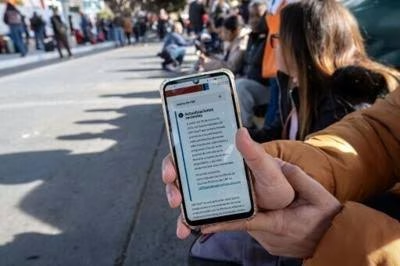
U.S. revokes parole status for migrants who entered via asylum app
The United States government has ordered migrants who entered the country using a special asylum scheduling app to leave immediately, following the revocation of their temporary parole status. This decision affects thousands of individuals who crossed the southern border and were granted permission to stay and work legally under a program introduced during the Biden administration.The CBP One app, launched to streamline asylum appointments, allowed migrants to schedule interviews and provided them with temporary legal status for up to two years, including work authorization. However, the Department of Homeland Security (DHS) has now canceled their parole status, rendering them unauthorized to remain in the U.S. Notices sent to affected migrants warn that failure to leave could lead to removal proceedings, fines, or even criminal prosecution. The CBP One app, launched to streamline asylum appointments, allowed migrants to schedule interviews and provided them with temporary legal status for up to two years, including work authorization. However, the Department of Homeland Security (DHS) has now canceled their parole status, rendering them unauthorized to remain in the U.S. Notices sent to affected migrants warn that failure to leave could lead to removal proceedings, fines, or even criminal prosecution. The revocation of parole status means these individuals lose access to work permits and other benefits tied to their temporary stay. Migrants have reported receiving emails instructing them to “leave the United States immediately” or face legal consequences. While the exact number of people impacted remains unclear, DHS has confirmed that notices have been sent out. Under the Trump administration, the CBP One app has been rebranded as CBP Home, shifting its focus from facilitating asylum appointments to encouraging voluntary self-deportation. The updated app now allows undocumented migrants to self-report their intent to leave the U.S., asking questions about their financial ability and passport validity for departure. This move is part of broader efforts by the U.S. government to address immigration challenges and secure its borders. DHS has emphasized that revoking paroles is a necessary step in managing the influx of migrants at the southern border. Additionally, plans for a national registry for undocumented migrants were announced earlier this year, requiring individuals aged 14 and older to submit personal information such as addresses and fingerprints. While these measures aim to strengthen border security, experts have raised concerns about enforcement difficulties and practical challenges in implementing these policies effectively. The situation highlights ongoing tensions in U.S. immigration policy as authorities balance border control with humanitarian considerations.
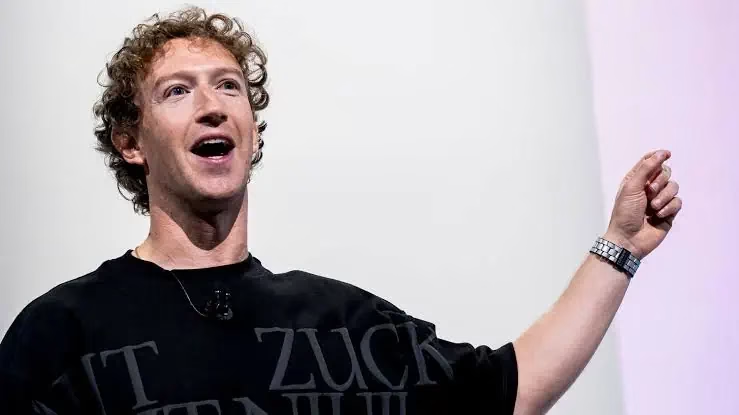
Meta rolls out teen account features on Facebook and Messenger to enhance safety for young users
Meta Platforms Inc. has announced the rollout of its Teen Accounts feature on Facebook and Messenger, a move aimed at providing safer digital experiences for users under the age of 18. The initiative, which launched on April 8, 2025, in the United States, United Kingdom, Australia, and Canada, is expected to expand to other regions, including Africa, in the near future. The Teen Accounts feature introduces built-in protections designed to shield teens from harmful content and interactions. Under these accounts, teens are automatically placed under strict privacy settings that limit who can contact them and what content they can view. Additionally, public accounts are restricted to make them less discoverable by strangers. “We want to make it easier for parents to have peace of mind when it comes to their teens’ experiences across Meta’s apps,” the company said in a statement. Key Features of Teen AccountsContent Restrictions: Teens are shielded from sensitive content and unwanted interactions. Messaging Controls: Direct messaging is limited to mutual followers or approved contacts. Screen Time Management: Notifications are disabled overnight, and users are prompted to take breaks after 60 minutes of screen time. Parental Oversight: Parents can monitor friend lists and approve certain activities. This expansion builds on Meta’s earlier efforts with Instagram, where Teen Accounts have been active since 2024. According to Meta, 97% of teens aged 13–15 have remained within the recommended safety settings on Instagram. Currently, there are over 54 million teen Instagram users operating under these restrictions. New Safety Measures for InstagramAlongside the Facebook and Messenger rollout, Meta has introduced additional protections for Instagram: Teens under 16 will need parental approval to host live videos. A nudity-blurring feature in direct messages will now require parental consent to disable. Teens will be prevented from sharing images containing suspected nudity via direct messages. These updates reflect Meta’s ongoing commitment to creating safer online spaces for young users. The company has faced increasing scrutiny over its platforms’ impact on teenagers and has invested heavily in privacy and safety measures. Since 2019, Meta has allocated $5.5 billion toward its privacy program and expanded its privacy-focused teams to over 3,000 employees.

Spanish Police arrest six in $20M AI-powered crypto scam
Spanish authorities have dismantled a sophisticated AI-driven cryptocurrency scam that defrauded over 208 victims worldwide of $20 million. The operation led to the arrest of six suspects in Granada and Alicante, following a two-year investigation dubbed “COINBLACK – WENDMINE”. The scammers employed cutting-edge artificial intelligence, including deepfake technology, to create highly convincing advertisements featuring manipulated videos of national celebrities endorsing fake crypto investments. Victims were targeted using algorithms that analyzed their online profiles, focusing on individuals engaged with cryptocurrency or financial content. Tailored ads promised high returns with “zero risk,” luring victims into investing in a fake platform. Once victims attempted to withdraw their funds, they discovered the platform was fraudulent. In a cruel twist, the scammers re-contacted them, posing as investment managers or Europol agents, claiming the funds were frozen and could be recovered for additional fees. This multi-layered deception extracted even more money from victims desperate to recover their losses. During raids, police seized phones, computers, hard drives, and documents linking the suspects to the scam. The operation uncovered over 50 false identities used by the ringleader and shell companies created to launder stolen funds through complex networks. This case highlights the growing threat of AI-enhanced financial crimes. Experts warn that generative AI is making scams more scalable and affordable for criminals. Despite the arrests, only €100,000 of the stolen €19 million has been recovered so far, highlighting challenges in tracing stolen cryptocurrency. Authorities urge caution against investment schemes promising guaranteed returns or featuring celebrity endorsements manipulated by AI.