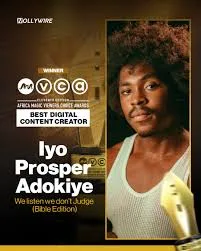
Digital content creator Iyo Prosper has emerged as the winner of the prestigious Best Digital Content Creator award at the 2025 Africa Magic Viewers’ Choice Awards (AMVCA), held in Lagos on Saturday. Prosper clinched the highly coveted award for his viral series, We Listen, We Don’t Judge, Bible Edition, a creative project that reimagines biblical stories through a humorous and heartfelt Nigerian lens. His unique approach to storytelling, blending faith, culture, and comedy, has resonated with a new generation of Nigerian audiences and set him apart in a fiercely competitive category. The Best Digital Content Creator category was one of the most hotly contested of the night, featuring some of Africa’s most influential digital creators. Prosper edged out top contenders such as Taaooma, Brain Jotter, Jide ‘Pounds’ Ibitoye (Jide Pounds), Dorcas Ariyiike Owolagba (Ariyiike Dimples), and Elozonam-all recognized for pushing the boundaries of digital entertainment on the continent. Organisers of the AMVCA described Prosper’s work as “blurring the lines and breaking the rules,” acknowledging his ability to make biblical narratives accessible and relatable through a distinctly Nigerian point of view. Iyo Prosper, an actor and content creator, has built a loyal following by merging storytelling with social commentary, humor, and faith. His win at the 2025 AMVCA marks a significant milestone in his career and highlights the growing impact of digital creators in Africa’s entertainment landscape.
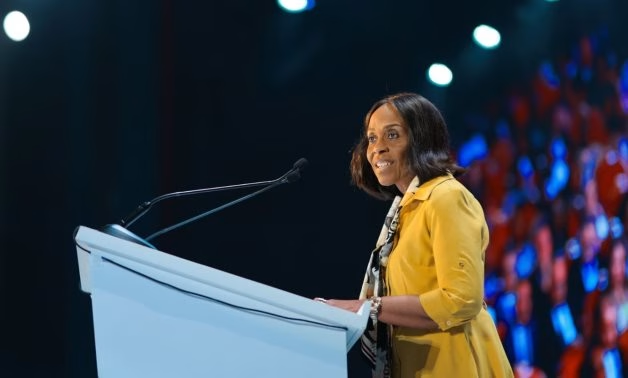
Afreximbank launches $1 billion Africa film fund to boost continent’s creative industry
The African Export-Import Bank (Afreximbank) has unveiled a $1 billion Africa Film Fund aimed at transforming Africa’s film and creative sectors. The fund, launched through Afreximbank’s development arm, the Fund for Export Development in Africa (FEDA), seeks to overcome persistent challenges such as inadequate infrastructure and limited access to long-term financing for film and TV production across the continent. The initiative is part of the Creative Africa Nexus (CANEX) Programme, which supports the growth of Africa’s creative economy by providing capital and resources to filmmakers and content creators. Afreximbank President Benedict Oramah described the fund as a “timely intervention” to address funding gaps and expand the global reach of African storytelling. “The Africa Film Fund will mobilize private equity to support the production and international distribution of high-quality African films and series,” Oramah said. “This is a major step toward unleashing the creative industry’s potential to drive economic growth across Africa.” Marlene Ngoyi, CEO of FEDA, emphasized that the fund goes beyond financing films. “It is about building a sustainable ecosystem that empowers African creative talent, fosters cultural exchange, and catalyzes economic transformation,” she said. The fund has drawn praise from prominent industry figures, including actor Boris Kodjoe and producer Viola Davis, who highlighted its potential to amplify authentic African stories on the global stage. Africa’s creative industries, including Nollywood and emerging film hubs in Ghana, South Africa, and Kenya, have grown rapidly but face challenges in accessing sustainable funding, quality infrastructure, and international distribution. Nollywood alone accounted for 39% of Nigeria’s 2024 box office revenue. By deploying long-term capital, Afreximbank hopes to bridge these gaps and help African filmmakers compete globally while leveraging the continent’s rich cultural heritage. This launch follows Afreximbank’s recent announcement to double CANEX funding to $2 billion over the next three years, reflecting growing demand across Africa’s creative sectors, including music, fashion, and sports.

Nasarawa lecturer Ochanya Lamai goes viral for dancing with students on TikTok
Ochanya Lamai, a lecturer in the Mass Communication Department at Nasarawa State University, has become an internet sensation after her TikTok videos dancing and participating in viral trends with students attracted widespread attention and sparked mixed reactions online. Lamai, who goes by @ochanyalamai on TikTok, has built a following of over 19,700 users. Her content, often humorous and relatable, offers a lighthearted glimpse into life on campus and has quickly become a source of entertainment for many Nigerians on the platform. Known as the self-styled “Mummy Gen-Z,” Lamai describes herself as a content creator, music enthusiast, broadcaster, entrepreneur, and lecturer. Her energetic online presence and friendly rapport with students have drawn both praise and criticism. While many commend her for breaking the stereotype of the conventional Nigerian lecturer and bringing joy to social media users, others argue that her approach deviates from expected academic decorum. Despite the mixed views, Lamai’s popularity continues to rise. Supporters say her creative use of social media helps inform, educate, and entertain, making her stand out in the academic community. In response to critics questioning her decision to become a content creator, Lamai posted a playful lip-sync to Afrobeat artist Ruger’s hit single “Giveaway,” signaling that she remains unbothered and confident in her unique style. “I am obsessed, I am so in love with myself. I dey burst my own brain, still impressed with myself. You cannot shame the shameless, you gats work on yourself…” Her frequent collaborations with students in TikTok videos have fueled even more discussion, with many Nigerians noting that such a close bond between lecturer and students is rare in academic circles. While some users wish they could study in her department, others express concern about the image her content portrays of lecturers. Regardless of the debate, Lamai’s vibrant approach to teaching and content creation has made her a notable figure both on campus and across Nigerian social media, where her energy and authenticity continue to inspire conversation.
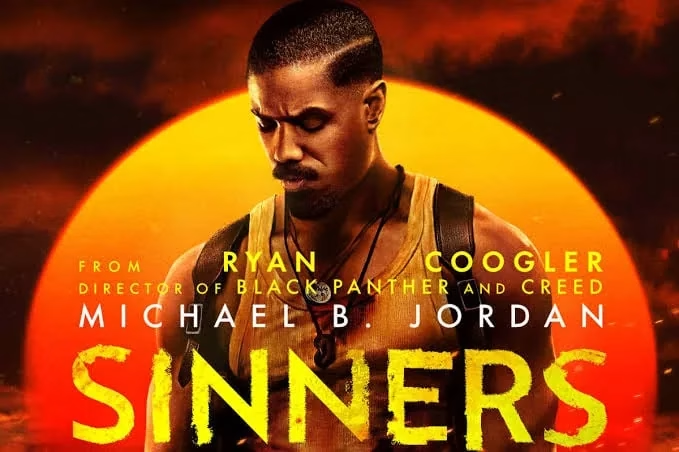
Ryan Coogler’s ‘Sinners’ takes Nigerian box office by storm, hits ₦269.9 million in nine days
Ryan Coogler’s supernatural thriller Sinners has become the talk of the town in Nigeria, smashing box office records with an eye-popping ₦269.9 million haul just nine days after its April 18 premiere. The film, starring Michael B. Jordan and distributed by Warner Bros, saw a remarkable 43% surge over the weekend of April 25–27, cementing its status as a local favorite and a global blockbuster. Sinners debuted in Nigerian cinemas with an impressive ₦79.6 million opening, quickly gaining momentum and outpacing expectations in one of Africa’s most vibrant theatrical markets. The film’s success in Nigeria echoes its strong international performance, where it has shown exceptional staying power. In North America, Sinners dropped only 6% from its $48 million opening to a $45 million second weekend-a rare feat for the horror-thriller genre, which typically sees steep declines after launch. Globally, the film’s earnings have soared to $161.6 million, with $122.5 million coming from the U.S. box office. This places Sinners among the most profitable releases of 2025, especially impressive for an original, non-franchise film with an R rating. Much of Sinners’ appeal lies in its rich storytelling, which draws deeply from Yoruba mythology. The film centers on the Smokestack Twins, characters inspired by Ìbejì-the sacred twin deities of the Yoruba Orisha spiritual tradition. This cultural grounding gives the movie a unique resonance, offering Nigerian audiences a blend of the familiar and the fantastical. Director Ryan Coogler and star Michael B. Jordan have spoken about the personal and spiritual themes that shaped the film. “We wanted to create a story that felt ancient and modern at the same time-a horror film with heart, rooted in something real,” Coogler explained in a recent interview. The journey to the big screen was not without challenges. Sinners was initially budgeted at $80 million, but production setbacks pushed the final cost to an estimated $100 million. Coogler personally absorbed $20 million in overages, sacrificing part of his fee and backend compensation to keep the project on track. Unlike other high-profile director-studio clashes, Coogler maintained a collaborative relationship with Warner Bros., incorporating feedback from test screenings into the final cut. Warner Bros. secured the rights to Sinners after a competitive bidding war, agreeing to Coogler’s demands for first-dollar gross, final cut, and a rare clause granting him ownership of the film 25 years after release. These terms reportedly caused other studios to bow out, but the gamble has paid off handsomely. Sinners currently boasts an IMDb rating of 8.2/10 and a stunning 98% on Rotten Tomatoes, reflecting widespread acclaim from critics and audiences alike. The film’s blend of supernatural thrills and cultural depth has resonated strongly, particularly in Nigeria, where moviegoers are increasingly embracing global blockbusters.
MultiChoice Launches Weekly DStv and GOtv Subscriptions in Uganda; Nigeria may be next
MultiChoice Uganda has unveiled a groundbreaking subscription option called “Ka Weekie,” allowing DStv and GOtv users to pay for their TV services on a weekly basis starting from as low as UGX 5,000 (approximately $1.35). This new flexible payment model aims to cater to customers with dynamic lifestyles, such as students, travelers, and those on tight budgets, who may find monthly subscriptions restrictive or unaffordable. The “Ka Weekie” initiative provides full access to all channels within a subscriber’s chosen package for seven days, maintaining the same quality and content range as traditional monthly plans. Existing subscribers can easily switch between weekly and monthly payments, while new customers must first activate a monthly subscription before opting for the weekly plan. Colin Asiimwe, Head of Marketing at MultiChoice Uganda, emphasized the customer-centric nature of the campaign: “This innovation is about giving our customers control, letting them choose how and when they pay without losing the content they value. It’s about variety, inclusion, and making our services work better for different lifestyles”. The weekly subscription packages cover a broad spectrum of budgets and preferences. For DStv, prices range from UGX 5,000 for the Lumba package to UGX 37,000 for the Compact package. GOtv weekly packages start at UGX 5,000 for Lite and go up to UGX 37,000 for Supa Plus. Subscribers can conveniently access these packages via the MyDStv and MyGOtv apps, USSD code *206#, mobile money platforms like Airtel Money and MTN MoMo, partner banks, and selected agents nationwide. The launch of “Ka Weekie” in Uganda has sparked discussions among Nigerian subscribers and industry watchers about the possibility of MultiChoice introducing a similar weekly subscription model in Nigeria. Nigeria, with its large DStv and GOtv user base, has recently experienced multiple subscription price hikes—up to 21% in early 2025—prompting calls for more flexible and affordable payment options. Many Nigerian viewers, facing economic challenges such as inflation and currency depreciation, have expressed interest in a weekly payment plan that better fits fluctuating incomes and financial realities. On social media platforms, users have questioned why MultiChoice Nigeria has not yet adopted the weekly subscription model, which could offer relief to budget-conscious customers. Industry analysts view the Ugandan rollout as a potential blueprint for Nigeria. Given Nigeria’s status as MultiChoice’s largest market in Africa, introducing a weekly plan could help the company retain subscribers amid rising competition from streaming platforms and changing consumer habits. MultiChoice Nigeria has not officially announced plans to launch weekly subscriptions, but the success of “Ka Weekie” in Uganda could influence future strategies aimed at enhancing customer flexibility and satisfaction. The introduction of weekly subscriptions marks a significant shift in the pay-TV industry’s approach to customer engagement. It reflects a broader trend of adapting to economic pressures and evolving viewer preferences by offering more accessible and customizable payment options.

Richard Mofe-Damijo’s “Radio Voice” makes a strong box office debut with N34.7 million
Nollywood veteran Richard Mofe-Damijo’s first outing as an executive producer is off to a flying start. His new film, “Radio Voice,” opened to an impressive N34.7 million at the Nigerian box office in its first week, according to official data tracked between April 11 and 17. The film, produced by RMD Productions in partnership with Blessing Jessica Obasi and Yolanda Okereke, signals a new chapter in Mofe-Damijo’s celebrated four-decade career. Directed by Isioma Osaje and co-written with Ufuoma Metitiri, “Radio Voice” tells the story of a former sex worker who seeks redemption and a new life as a radio presenter. The film explores themes of resilience, self-discovery, and women’s empowerment, set against the backdrop of a struggling Lagos radio station. Featuring a star-studded cast including Nse Ikpe-Etim, Nancy Isime, Deyemi Okanlawon, Damilola Adegbite, and Timini Egbuson, the movie has resonated with audiences and critics alike. Its commercial success is further boosted by institutional support from the Office of the Vice President, reflecting the government’s renewed commitment to Nigeria’s creative and digital economy. “Radio Voice” is also part of a major distribution deal with Nile Entertainment, ensuring its rollout across West African cinemas. Meanwhile, RMD Productions is preparing to premiere its next project, “Revelations,” at a major international film festival. Mofe-Damijo, known for iconic roles in “Ripples,” “Checkmate,” and recent hits like “The Black Book” and “Shanty Town,” continues to shape the industry both in front of and behind the camera. With “Radio Voice,” he delivers a story that is both timely and uplifting, solidifying his legacy as one of Nollywood’s most influential figures. “Radio Voice” stands out not just for its earnings, but for its powerful message and the promise of more ambitious projects to come.