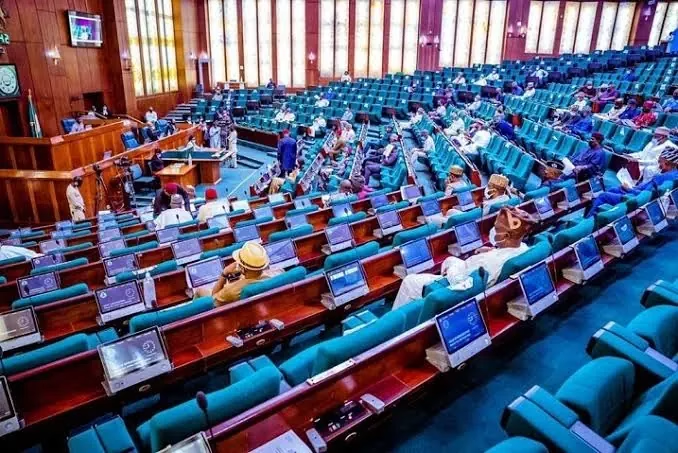
The Nigerian House of Representatives has directed Remita, the government’s main payment platform, to refund N182.77 billion to the Federal Government. This follows a forensic audit that uncovered significant transaction leakages from the Treasury Single Account (TSA) dating back to 2015. The order, issued by the Public Accounts Committee (PAC) after months of investigation, is based on findings from Seyi Katola & Company, a chartered accounting firm. The audit revealed that Remita was responsible for N3.42 billion in under-refunded processing fees, N101.85 million in unpaid acquirer fees, and N179.25 billion in unremitted collections. All amounts include interest, calculated at the Central Bank of Nigeria’s Monetary Policy Rate. Committee chairman Bamidele Salam emphasized that the decision was supported by evidence from Remita and other stakeholders. “This effort supports transparency and is significant for Nigeria’s fiscal accountability framework,” he said. Remita, operated by SystemSpecs Ltd, has served as the primary payment gateway for the government’s TSA since 2012, handling revenue collection and remittance for ministries and agencies. The government is now integrating Remita with the new Treasury Management and Revenue Assurance System (TMRAS) to improve transparency and efficiency. While Remita will continue as an approved payment gateway, TMRAS will allow multiple secure payment providers to operate, aiming to liberalize and strengthen revenue collection. Some commercial banks have already complied with similar refund orders, and the PAC has called on other service providers to do the same.
SERAP urges Senate to withdraw controversial bill targeting bloggers and social media platforms
The Socio-Economic Rights and Accountability Project (SERAP) has called on Nigeria’s Senate President, Godswill Akpabio, and Speaker of the House of Representatives, Tajudeen Abbas, to withdraw a proposed amendment to the Nigeria Data Protection Act 2023. The bill, which has already passed its first and second readings in the Senate, has sparked widespread criticism for its potential to curtail digital freedoms and stifle free expression. The proposed legislation, titled “A Bill for an Act to Amend the Nigeria Data Protection Act, 2023,” seeks to mandate social media platforms and bloggers operating in Nigeria to establish physical offices within the country’s borders. Failure to comply within 30 days could result in punitive measures, including outright bans. In a letter dated April 12, 2025, SERAP’s Deputy Director, Kolawole Oluwadare, described the bill as “repressive” and warned that it could be used to censor dissenting voices and punish individuals or organizations critical of government policies. According to SERAP, the legislation would impose mandatory registration requirements on bloggers and force them to join recognized national associations—measures it says are incompatible with the right to freedom of expression under Nigeria’s Constitution and international human rights treaties. “If passed, this bill would have a chilling effect on freedom of expression,” SERAP stated. “It could lead to censorship or restraint while undermining press freedom by forcing bloggers to disclose their sources.” The group also expressed concern that the bill could be exploited by authorities to block access to major social media platforms such as Facebook, Instagram, WhatsApp, TikTok, YouTube, and X (formerly Twitter). Beyond human rights implications, critics have highlighted the potential economic fallout of the proposed amendment. SERAP warned that requiring international tech companies to establish physical offices in Nigeria could lead many to exit the country’s digital space entirely. This would not only restrict Nigerians’ access to information but also disrupt businesses reliant on foreign digital tools and platforms. “The proposal fails to consider the borderless nature of digital communication,” SERAP said. “It risks undermining Nigeria’s digital economy at a time when global connectivity is essential for growth.” SERAP has vowed to challenge the bill in court if it becomes law. “Should this bill be signed into law by President Bola Tinubu, we will take appropriate legal action to ensure it is never implemented,” the organization said. Legislative Progress and Public BacklashThe controversial bill has moved swiftly through legislative processes, passing its first two readings in the Senate. While its proponents argue that it will strengthen data protection frameworks and enhance compliance with international standards, critics see it as an attempt to reintroduce previously rejected social media regulations through a back door.
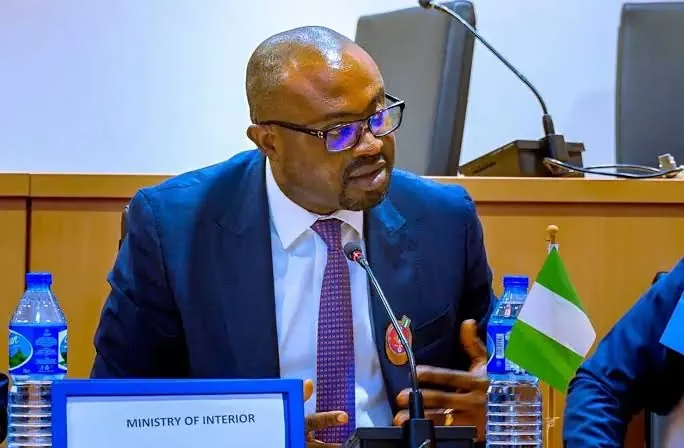
Nigeria announces stricter penalties for visa overstays starting August 2025
The Nigerian government has unveiled new immigration measures aimed at curbing visa overstays, set to take effect in May 2025, with enforcement beginning in August after a three-month grace period. Minister of Interior Olubunmi Tunji-Ojo announced the policy during a stakeholders’ meeting in Lagos, highlighting its role in promoting responsible migration and safeguarding national security. Under the revised Nigeria Visa Policy 2025: Daily fines: Foreign nationals who overstay their visas will incur a $15 fine for each day beyond their visa expiration. Entry bans: Overstays exceeding three months will result in a five-year ban, while overstays of one year or more will lead to a ten-year re-entry ban. The grace period until August allows visa holders to regularize their status without penalties. Tunji-Ojo emphasized that the policy is not punitive but aims to ensure compliance and transparency regarding foreign nationals residing in Nigeria. Additionally, the government plans to fully digitize the application process for the Combined Expatriate Residence Permit and Aliens Card (CERPAC), enabling online submissions and payments. This modernization effort seeks to streamline procedures and integrate security checks with global systems. The Nigeria Immigration Service will oversee enforcement of these reforms, marking a significant step toward improved migration governance.
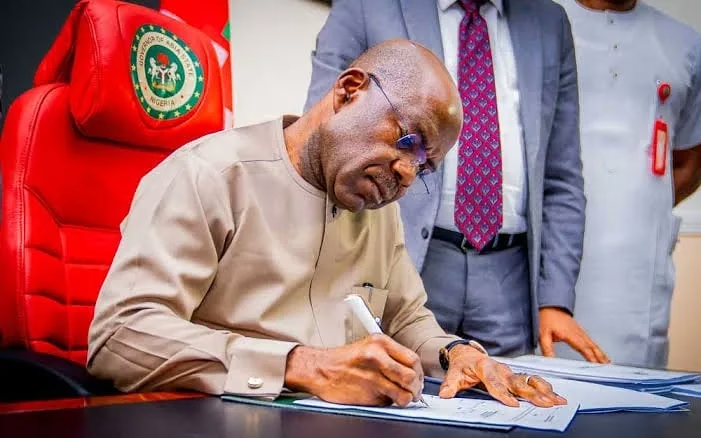
Court overrules blogger’s objection in Abia governor’s N5 billion defamation case
The Federal Capital Territory High Court in Wuse, Abuja, on Tuesday overruled an objection by blogger Sir Don Ubani in a N5 billion defamation suit filed by Abia State Governor Dr. Alex Otti. Justice N. K. Nwosu-Iheme dismissed the objection raised by the blogger’s lawyer, S. M. Oluebube, against documents presented by Dr. Sonny Ajala SAN, counsel to Governor Otti. The lawsuit stems from an online publication titled “Governor Alexander Otti Of Abia State Should Be Clapped For,” which Otti claims contained false and malicious statements about him. In his suit, Governor Otti is seeking N5 billion in damages for alleged harm to his reputation and character. He also requested the court to restrain the defendant from further publishing disparaging material and to order an apology in four national newspapers. During Tuesday’s hearing, Ajala presented Architect Uche Uche as the governor’s first witness. The court admitted two documents as evidence over the defense’s objections: The defendant’s October 6, 2024 online publication A lawyer’s response countering the blogger’s claim of not receiving a libel notice Justice Nwosu-Iheme adjourned the case to June 2, 2025, for continuation of the hearing.

Binance challenges Nigerian government’s $81 billion lawsuit over taxes and economic losses
Binance Holdings Limited, one of the world’s largest cryptocurrency exchanges, has asked the Federal High Court in Abuja to dismiss a lawsuit filed by the Nigerian government demanding $81 billion in damages and unpaid taxes. The case, brought by the Federal Inland Revenue Service (FIRS), accuses Binance of failing to register for tax compliance and causing significant economic losses during its operations in Nigeria. The lawsuit, marked FHC/ABJ/CS/1444/2024, seeks $79.5 billion for alleged economic damages and $2 billion in unpaid income taxes for 2022 and 2023. It also includes penalties such as a 10% fine for non-payment of taxes and a 26.75% annual interest rate based on the Central Bank of Nigeria’s lending rate. The government claims Binance deliberately concealed its business activities despite having a “significant economic presence” in the country. At the latest court hearing on Monday, Binance’s legal counsel, Chukwuka Ikwuazom SAN, argued that the substituted service used to deliver court documents was invalid. Substituted service is a legal method of delivering documents through alternative means when direct service fails. However, Ikwuazom contended that proper procedures for serving defendants outside jurisdiction were not followed, rendering the service invalid. He further noted that the email address provided by FIRS for substituted service did not belong to any Binance employee. The presiding judge, Justice Inyang Ekwo, adjourned the case to April 30 to allow FIRS time to respond to Binance’s motion. Meanwhile, FIRS has maintained its stance that Binance violated Nigerian laws by failing to register for tax purposes and contributing to economic instability. In addition to this lawsuit, Binance is facing separate charges of tax evasion, money laundering, and foreign exchange violations in Nigeria. These cases are being heard by Justice Emeka Nwite in another Federal High Court proceeding.

Trump extends TikTok deadline by 75 days
President Donald Trump has once again postponed the deadline for TikTok to be sold or face a ban in the United States. In a post on his Truth Social platform on Friday, Trump announced he was signing an executive order to extend the deadline by an additional 75 days. The decision comes just one day before the previous deadline was set to expire on April 5, 2025. This marks the second time Trump has delayed the ban, following an initial 75-day extension granted in January. “My Administration has been working very hard on a Deal to SAVE TIKTOK, and we have made tremendous progress,” Trump stated. “The Deal requires more work to ensure all necessary approvals are signed, which is why I am signing an Executive Order to keep TikTok up and running for an additional 75 days.” The extension allows more time for negotiations between ByteDance, TikTok’s Chinese parent company, and potential U.S. buyers. Several companies and consortiums have expressed interest in acquiring TikTok’s U.S. operations, including Amazon, AppLovin, and a group led by Oracle. Trump emphasized the importance of reaching a deal that addresses national security concerns while keeping the popular app available to millions of American users. “We do not want TikTok to ‘go dark.’ We look forward to working with TikTok and China to close the Deal,” he added. The president also linked the TikTok negotiations to broader trade discussions with China, mentioning reciprocal tariffs as a tool for achieving “Fair and Balanced Trade.” For now, TikTok’s 75 million American users can continue using the app while its fate remains uncertain.