The Nigerian government has rejected Meta’s warning that it may shut down Facebook and Instagram in the country, insisting the tech giant must pay more than $290 million in fines for alleged violations of local data protection and advertising laws. The dispute escalated after a federal tribunal upheld a $220 million fine imposed by the Federal Competition and Consumer Protection Commission (FCCPC) for what regulators described as repeated breaches of Nigeria’s competition and data privacy rules. Additional fines from the Nigeria Data Protection Commission (NDPC) and the Advertising Regulatory Council of Nigeria (ARCON) bring Meta’s total penalty to over $290 million. Meta, which also owns WhatsApp, has said it will appeal the fines and warned it may be forced to suspend Facebook and Instagram services in Nigeria to avoid enforcement measures. However, WhatsApp was not included in Meta’s court filings regarding the shutdown threat. According to regulators, Meta’s infractions include unauthorized transfer and sharing of Nigerian user data, discrimination against Nigerian users, and enforcing unfair privacy policies. The NDPC has also ordered Meta to seek approval before transferring user data abroad and to produce educational content on data privacy risks in partnership with local organizations. “The Commission found that Meta Parties engaged in multiple and repeated infringements,” said Ondaje Ijagwu, Director of Corporate Affairs at the FCCPC. “Threatening to leave Nigeria does not absolve Meta of liabilities for the outcome of a judicial process.” Officials emphasized that Meta has complied with similar penalties in other countries and accused the company of trying to pressure Nigerian authorities by threatening to exit the market. Meta has until the end of June to comply with the tribunal’s order. The government maintains that the company cannot avoid its obligations by leaving the country and remains committed to enforcing consumer protection and data privacy standards.
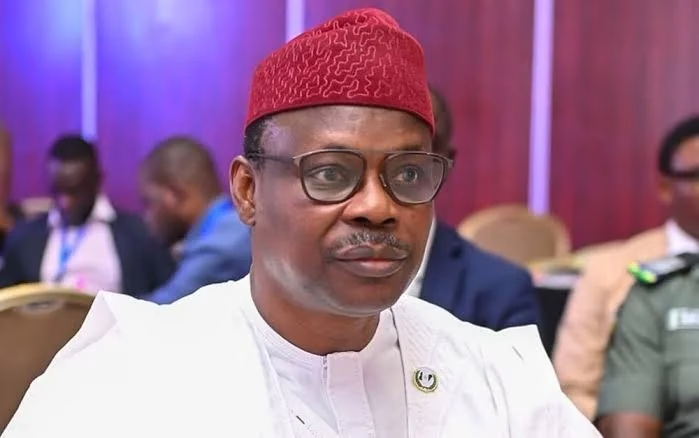
FG to launch electronic portal to fast-track health research in Nigeria by Q3 2025
The Federal Government has announced plans to roll out a groundbreaking electronic portal for health research proposal submission and approval before the end of 2025-a move set to transform Nigeria’s research landscape and align the country with international best practices. Speaking at a two-day workshop in Abuja, Minister of State for Health and Social Welfare, Dr. Iziaq Salako (represented by Dr. Kamil Shotirere), explained that the new e-portal will streamline the process for submitting, reviewing, and approving health research proposals. The system aims to eliminate bureaucratic delays, enhance transparency, and allow researchers to track their applications in real time, significantly improving efficiency and accountability. Members of the National Health Research Ethics Committee (NHREC) are being trained to use the platform, which will ensure that all research involving human participants adheres to strict ethical guidelines. Funded in part by the Gates Foundation and developed with technical support from the U.S. Centers for Disease Control and Prevention, the e-portal is expected to help Nigeria attract more international research collaborations and accelerate studies on national health priorities such as infectious diseases, maternal health, and non-communicable diseases. The government has set a target for the portal to be fully operational before the end of the third quarter of 2025, with pilot submissions starting earlier. Stakeholders believe this digital leap will not only boost Nigeria’s competitiveness in global health research but also ensure that ethical principles remain central to scientific innovation in the country.
FIRS urges court to dismiss Binance’s move in $79.5 billion tax dispute
The Federal Inland Revenue Service (FIRS) is pushing back against Binance Holdings Limited in a high-stakes legal battle over alleged tax evasion and economic losses totaling $79.5 billion. On Tuesday, FIRS asked the Federal High Court in Abuja to dismiss Binance’s application challenging an earlier court order that allowed the agency to serve legal documents via email. The court had granted this order in February, citing Binance’s lack of physical presence in Nigeria. Binance, a global cryptocurrency exchange registered in the Cayman Islands, argues that Nigerian law requires court documents for foreign companies to be served directly to a company director or at its registered office. Binance’s lawyer, Chukwuka Ikwuazom, said the FIRS did not follow proper procedures for serving a foreign entity and called for the electronic service to be invalidated. FIRS countered that Binance’s registration status is unclear and that the company has no office in the Cayman Islands, but maintains significant business activity in Nigeria. The agency noted that Binance’s General Counsel, Eleanor Hughes, who received the court documents by email, acts as a principal officer and has previously engaged with Nigerian authorities. FIRS also stated that attempts were made to serve Binance’s detained representative, Tigran Gambaryan, in person, but Binance directed that legal papers go through its law firm in Nigeria. The agency insists Binance is aware of the proceedings, as shown by its legal team’s court appearances. The court has set May 12 for the next hearing, when it will decide whether to uphold the substituted service order or grant Binance’s request to set it aside.
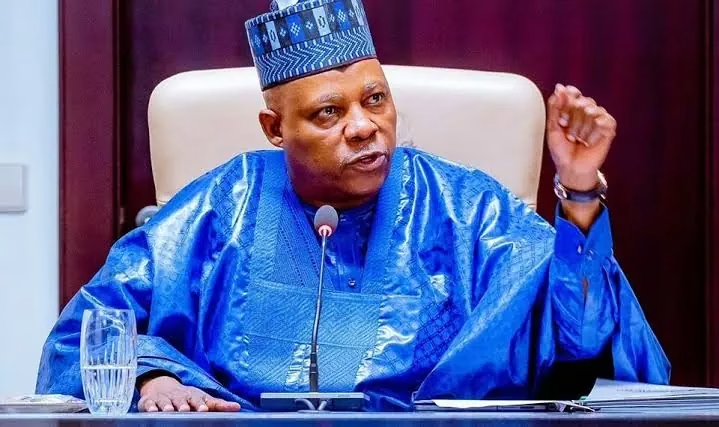
Nigeria, South Korea set sights on solar and electric vehicle manufacturing partnership
Nigeria is on track to deepen its industrial and clean energy ambitions, as Vice President Kashim Shettima has welcomed a major partnership proposal from South Korea’s Asia Economic Development Committee (AEDC). This aims to boost local manufacturing of solar equipment and electric vehicles (EVs), marking a significant step in the country’s push for sustainable development and technology transfer. The AEDC delegation, led by Chairman Yoon Suk-hun, met with Shettima at the Presidential Villa in Abuja on Tuesday. During the meeting, Shettima reaffirmed the Tinubu administration’s commitment to creating a business-friendly environment and facilitating investments that will transfer advanced technology and improve the lives of Nigerians. “This government wants to be the facilitator for businesses to thrive in Nigeria. We will create a safe passage and a conducive environment for private businesses like yours to thrive,” Shettima said, emphasizing Nigeria’s openness to collaborations that drive industrial growth. The proposed partnership goes beyond clean energy and electric vehicles. It also includes plans to support Nigeria’s security infrastructure with advanced information technology, reflecting a broader vision for a secure and innovation-driven economy. AEDC has pledged to prioritize technology transfer and capacity building, focusing on long-term benefits for both nations rather than short-term profits. If realized, the partnership could help reduce import dependence, create jobs, and position Nigeria as a regional leader in renewable energy and sustainable transportation. Shettima praised South Korea’s longstanding contributions to Africa’s development, especially in technology and human capital, and expressed optimism that this new collaboration would further strengthen ties between the two countries.
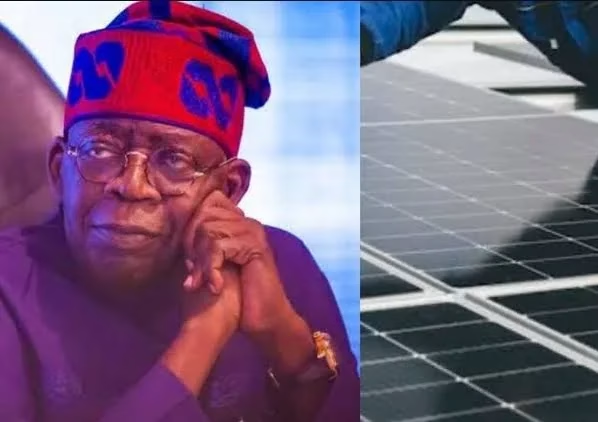
Nigerian government defends ₦10bn solar project for Aso Rock
The Federal Government has justified its decision to install a ₦10 billion solar power grid at the Aso Rock Presidential Villa, describing the move as necessary to curb what it calls an “unsustainable” annual electricity bill of ₦47 billion. The announcement was made Friday by Dr. Mustapha Abdullahi, Director-General of the Energy Commission of Nigeria (ECN), during a press briefing in Abuja. According to Abdullahi, the project-approved by President Bola Tinubu-aims to provide uninterrupted, clean energy to the seat of power, reduce the cost of governance, and lessen pressure on the national grid. “This project will not only ensure steady power supply at the Villa but also create jobs and foster innovation among Nigerian engineers and energy experts,” Abdullahi stated. Earlier this year, the Abuja Electricity Distribution Company (AEDC) threatened to disconnect the Presidential Villa and other government agencies over a collective ₦47.1 billion debt, with Aso Rock’s share initially reported as nearly ₦924 million. President Tinubu intervened, directing immediate settlement after a reconciliation process revealed the actual outstanding bill was ₦342 million. Government officials argue that the solar project aligns with Tinubu’s energy diversification agenda and could attract further investment in Nigeria’s power sector. Abdullahi revealed that development partners have earmarked about $5.3 billion for grid expansion and related initiatives. However, the decision has sparked debate among citizens and energy experts. Critics question the timing and cost of the project, especially as millions of Nigerians face high electricity tariffs and unreliable supply. Supporters, meanwhile, see it as a step toward sustainability and a model for other public institutions.

Niger State bans nighttime tricycle, motorcycle operations in Minna over insecurity
The Niger State Government has banned commercial motorcycles and tricycles from operating between 6 p.m. and 6 a.m. in Minna, the state capital. The announcement was made on Wednesday, April 23, 2025, following a high-level security meeting led by Governor Umaru Bago. The government says the night ban is a direct response to a surge in criminal activities linked to motorcycle and tricycle operators after dark. “We cannot allow criminals to continue terrorizing our residents,” Governor Bago stated, emphasizing that protecting lives and property remains a top priority. Local leaders have been instructed to document all residents in their communities. The government warned that any house found sheltering criminals or used for drug-related activities will be demolished without hesitation. Security agencies have also been directed to intensify intelligence gathering and conduct coordinated raids on criminal hideouts. Parents and guardians are urged to monitor their children closely, with the governor warning that anyone caught engaging in violence or crime will face prosecution. Governor Bago called on traditional leaders, youth groups, and all residents to work together with security agencies to restore peace in Minna. “The fight against insecurity is a collective responsibility,” he said. The ban takes effect immediately, with authorities promising strict enforcement to ensure the safety of all citizens.