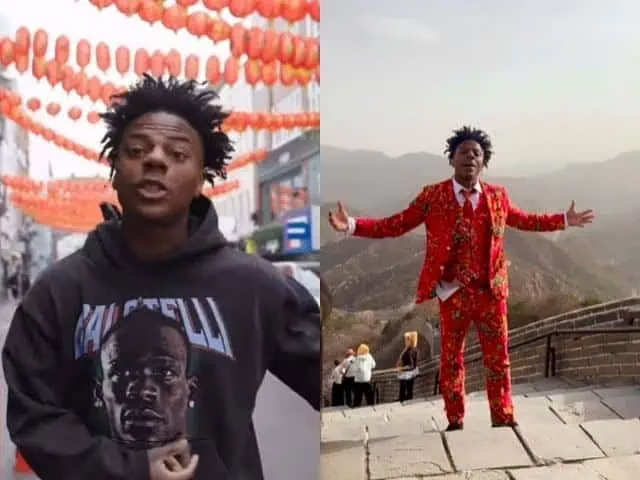
Darren Jason Watkins Jr., widely known as IShowSpeed, has become an unexpected voice in reshaping global perceptions of China. The 20-year-old American YouTuber, with over 37 million subscribers, has captivated millions worldwide through his unfiltered live streams documenting his travels across China. His spontaneous and authentic exploration of the country has brought attention to its technological advancements, cultural richness, and everyday life, challenging entrenched Western narratives. IShowSpeed’s journey began in Shanghai with a six-hour livestream that highlighted China’s technological prowess. From seamless 5G connectivity aboard high-speed trains to real-time translation glasses and cutting-edge electric vehicles like the SU7 Ultra, his experiences showcased a modern China far removed from outdated stereotypes. He also demonstrated the ubiquity of digital payment systems, contrasting sharply with the patchy infrastructure in many Western countries. However, Speed’s impact extended beyond technology. His travels revealed a culturally vibrant China steeped in tradition and artistry. In Chengdu, he expressed awe at Sichuan Opera performances featuring fire-spitting and face-changing stunts. He embraced local customs by donning traditional northeastern attire and participating in lion dances. His genuine curiosity resonated with viewers worldwide, fostering a deeper appreciation for Chinese heritage. Perhaps most striking was the warmth he encountered from locals. In Chongqing, Speed joined impromptu dance battles with strangers, while in Shanghai, he engaged with residents at a matchmaking corner. His livestreams were filled with laughter, shared meals, and spontaneous football matches, moments that painted a picture of an open and welcoming society. Viewers commented on how these interactions shattered preconceived notions about China’s people and culture. Despite criticism from some Western commentators accusing him of promoting propaganda, Speed’s team confirmed that his trip was entirely self-funded. His authenticity has been key to his success; his chaotic yet relatable energy has made him an appealing figure to audiences across generations. Chinese officials have praised his efforts for fostering cross-cultural understanding, noting that his livestreams achieved what traditional diplomacy often struggles to accomplish. Speed’s journey continued in Hong Kong, where he immersed himself in the city’s dynamic street culture. Donning a Hong Kong national team jersey in Causeway Bay, he explored Victoria Peak, marveled at Ocean Park’s pandas, and joined pickup sports games at local recreation grounds. His enthusiastic attempts at Cantonese phrases and spontaneous interactions further endeared him to locals and viewers alike. In an era where media narratives are often weaponized for geopolitical purposes, IShowSpeed’s honest portrayal of China offers a refreshing counterpoint. By documenting his experiences without artifice or agenda, he has exposed the gap between reality and perception.
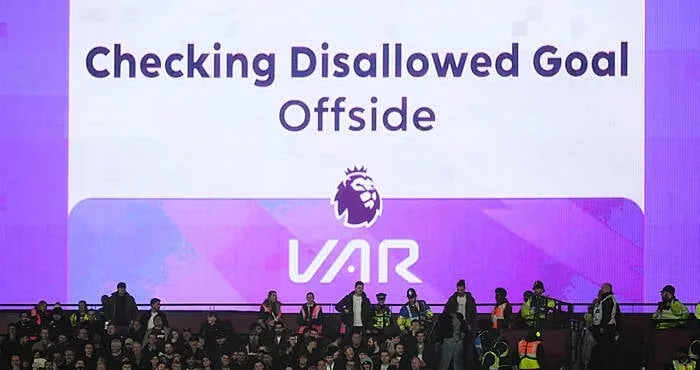
Premier league to launch semi-automated offside technology on April 12
The Premier League is set to revolutionize football officiating with the introduction of Semi-Automated Offside Technology (SAOT), starting April 12, 2025. This cutting-edge system promises to enhance the accuracy, speed, and consistency of offside decisions, delivering a better experience for fans and reducing controversies surrounding match officiating. SAOT uses state-of-the-art technology to streamline the process of determining offside calls during matches. The system relies on up to 30 high-performance cameras installed in stadiums, capturing footage at an impressive 100 frames per second. These cameras track over 10,000 data points per player and monitor the ball’s movement in real time. By automatically detecting the precise moment the ball is kicked, known as the “kick point”, and generating virtual offside lines, SAOT enables faster and more accurate decision-making. The Video Assistant Referee (VAR) team reviews these automated decisions, ensuring minimal delays compared to traditional methods. Additionally, fans will benefit from clear 3D animations displayed in stadiums and broadcasts, providing transparency and reducing confusion over contentious calls. The introduction of SAOT comes in response to widespread criticism of delays caused by VAR reviews in recent years. Premier League officials believe this new technology will significantly reduce the time required to make offside decisions, enhancing efficiency while maintaining the integrity of the game. “By automating key aspects of the process, the technology aims to minimize delays and improve decision-making efficiency,” said a league representative. SAOT has already demonstrated its effectiveness in major football competitions around the world. It was first tested during the FIFA Arab Cup in 2021 and later used at the FIFA Club World Cup in 2022. UEFA also adopted SAOT for Champions League matches starting in the 2022–23 season, further showcasing its reliability and impact. Building on these successes, the Premier League conducted extensive trials during domestic competitions like the FA Cup earlier this season. The results confirmed that SAOT could address longstanding concerns about VAR while improving accuracy and transparency. The implementation of SAOT marks a significant milestone for football officiating in England’s top league. By leveraging advanced technology, the Premier League aims to deliver a smoother experience for fans both in stadiums and watching from home while ensuring fairness on the pitch.Fans can look forward to faster decisions and fewer controversies when SAOT officially debuts on April 12.
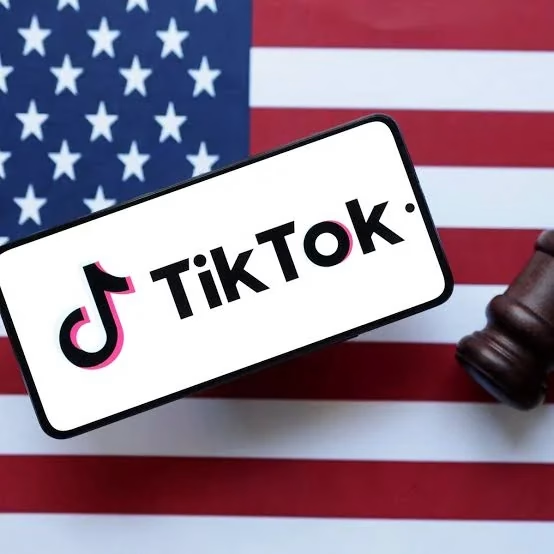
TikTok’s April 5 deadline nears will ByteDance sell or face a U.S. ban
As the April 5 deadline approaches for TikTok to divest its U.S. operations or face a nationwide ban, negotiations remain unresolved, leaving the future of the popular social media platform uncertain. The federal law requiring TikTok’s Chinese parent company, ByteDance, to sell its U.S. subsidiary stems from longstanding concerns about national security risks and data privacy. President Donald Trump, who extended the initial January deadline by 75 days, has hinted at a possible further extension if China shows interest in finalizing a deal. Trump remarked that TikTok is a platform with significant interest in the U.S., emphasizing the need for cooperation between the two nations. Despite this, ByteDance has resisted selling, and finding a qualified buyer remains challenging. Potential buyers include major American companies like Oracle and Microsoft, as well as private equity firms such as Blackstone. However, ByteDance has yet to confirm any acquisition plans. Legal experts anticipate that TikTok’s lawsuit against the U.S. government, citing free speech violations, may delay enforcement of the ban further.
Amazon photos app now lets you shop directly from your images
Amazon has launched a feature in its Photos app that allows users to shop directly from their stored images. The new tool, powered by artificial intelligence, enables customers to identify products captured in their photos and find similar items available for purchase on Amazon’s platform. Announcing the update on social media, Panos Panay, Senior Vice President of Amazon’s Devices and Services division, emphasized the convenience of the feature. “Awesome update to Amazon Photos – you can now search your photo library to find similar products on Amazon. Spot something you loved at a friend’s house or a toy your kid was obsessed with? Just search your photos and we’ll surface relevant items for you” – Panay The feature uses advanced AI technology to analyze images stored in the Amazon Photos app. Users simply select a photo containing a product they are interested in and tap the Lens icon within the app interface. The system scans the image, identifies recognizable items, and generates a list of visually similar products available on Amazon. Once the scan is complete, users are presented with direct shopping links that lead to Amazon’s retail app or website. From there, they can browse options, compare prices, and make purchases, all with just a few taps. Whether it’s stylish home decor, trendy outfits, or unique gadgets spotted in their photo collection, this tool streamlines the shopping experience by eliminating the need for manual searches. This latest addition is part of Amazon’s broader strategy to enhance customer engagement and boost sales through innovative features. Last month, the company began testing Native Commerce Advertising (NCA), an initiative designed to compensate media companies for directing traffic to its platform through product recommendations. Unlike traditional affiliate programs that pay commissions based on sales, NCA rewards publishers based on traffic volume alone. Major media companies like CNN and Vox Media have already begun testing NCA. While it offers new revenue streams for publishers amid declining advertising revenues, some have noted challenges such as fluctuating cost-per-click rates and potential impacts on editorial content. By integrating AI-powered tools like the Photos shopping feature and expanding advertising partnerships through programs like NCA, Amazon continues to solidify its position as a leader in e-commerce innovation.
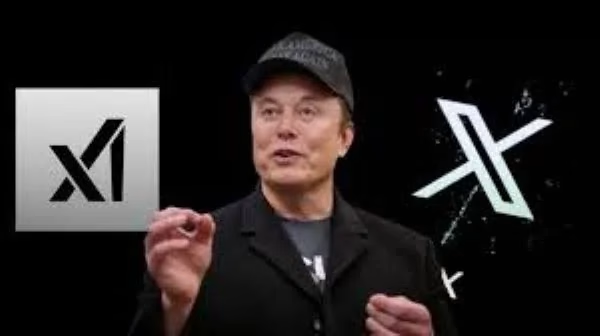
Elon Musk merges xAI and X in $33 billion deal to advance AI and social media integration
Billionaire entrepreneur Elon Musk has announced the merger of his artificial intelligence startup, xAI, with his social media platform, X, in a groundbreaking all-stock transaction valued at $33 billion. The deal not only consolidates Musk’s control over both companies but also sets the stage for a new era of AI-driven social media experiences. The merger values xAI at $80 billion, reflecting its rapid growth since its founding less than two years ago, while X is valued at $33 billion after accounting for $12 billion in debt. Both companies are privately held and share notable investors, including Andreessen Horowitz, Sequoia Capital, and Saudi Arabia’s Kingdom Holding Co. In a statement posted on X, Musk highlighted the strategic benefits of the merger “This combination will unlock immense potential by blending xAI’s advanced AI capability and expertise with X’s massive reach. Together, we aim to deliver smarter, more meaningful experiences to billions of people while staying true to our mission of seeking truth and advancing knowledge” – Musk Musk emphasized that the integration of xAI’s cutting-edge AI models and computing power with X’s global user base, currently exceeding 600 million active users, will create a platform capable of accelerating human progress. He described X as a “digital town square” that has been transformed into one of the most efficient companies in the world over the past two years. The merger is expected to leverage shared resources, including data, distribution networks, and talent, to develop innovative AI applications that enhance user engagement. Musk expressed optimism about the future of the combined entity, stating that it represents “just the beginning” of their efforts to redefine how technology serves humanity. Since its launch in 2023, xAI has emerged as a leading player in artificial intelligence, rivaling industry giants like OpenAI. The company has focused on building large language models and advanced AI tools aimed at understanding complex systems and phenomena. In 2024, xAI began constructing a supercomputer named Colossus in Memphis, Tennessee, to support its AI chatbot, Grok. Part of this facility is already operational. However, xAI’s rapid growth has not been without controversy. Environmental advocates have raised concerns about the Memphis project’s reliance on natural gas turbines and its potential impact on local communities. For X, formerly known as Twitter before its rebranding under Musk’s leadership in 2023, this merger marks another step in its evolution. The platform has undergone significant changes over the past two years to improve efficiency and scalability.
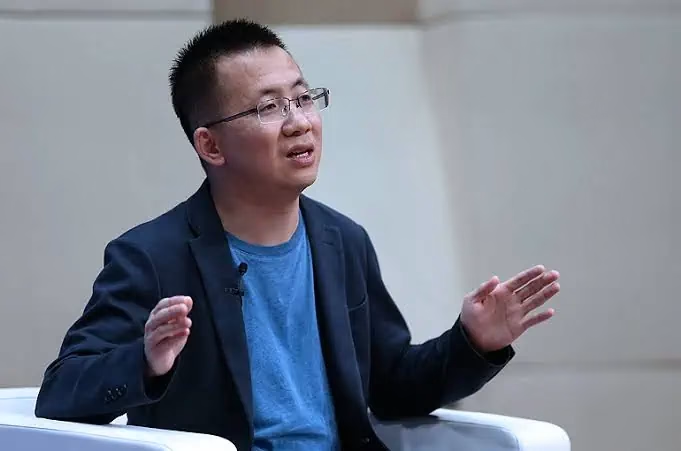
TikTok founder Zhang Yiming becomes China’s richest person
Zhang Yiming, the founder of ByteDance, the parent company of TikTok, has emerged as the country’s richest person. His net worth is now estimated at $57.5 billion, according to the Bloomberg Billionaires Index. This milestone marks a notable achievement for Zhang, who has surpassed Zhong Shanshan and Ma Huateng to claim the top spot. Zhang’s success is largely attributed to ByteDance’s substantial growth, particularly with TikTok’s global popularity. Despite ongoing challenges in the U.S. over national security concerns, TikTok continues to thrive, contributing to Zhang’s wealth. ByteDance’s global revenue increased by 30% last year, reaching $110 billion, further solidifying Zhang’s position as a leading figure in the tech industry. Zhang’s journey from founding ByteDance in 2012 to becoming China’s richest person is a testament to the power of strategic vision and technological innovation.