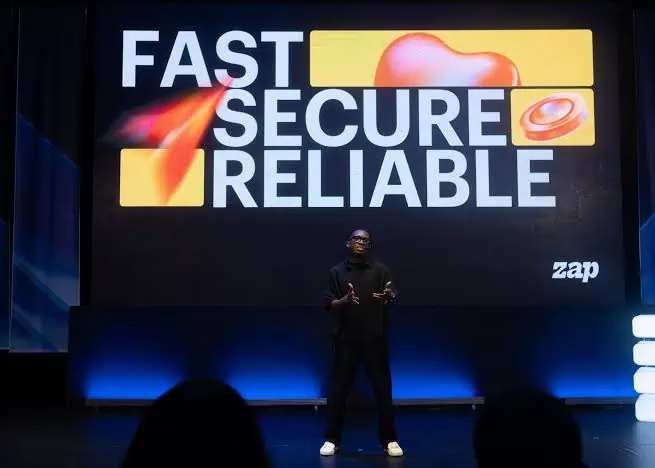
Nigeria’s Central Bank has fined fintech giant Paystack ₦250 million for allegedly operating its new peer-to-peer payment app, Zap, without the proper licence. The penalty, issued in late April, is the largest regulatory fine Paystack has faced since receiving approval to operate in 2016. According to sources familiar with the matter, the Central Bank claims Zap functions as a digital wallet-a service that requires a microfinance or banking licence because it involves holding customer funds. Paystack, however, only holds a switching and processing licence, which allows it to route transactions but not to store money on behalf of users. Zap, launched in March, was designed to help Nigerians send and receive money easily. While Paystack says the app does not directly hold customer funds and instead partners with Titan Trust Bank to manage deposits, the Central Bank maintains that the product’s features cross the line into regulated territory. A Paystack spokesperson said, “Paystack is working closely with the regulator as they further review Zap, and out of respect for the process, we won’t be making any public comments at this time.” In 2024, Moniepoint and OPay were each fined ₦1 billion over compliance issues, signaling a tougher stance on digital finance. Zap’s launch has also sparked a legal dispute, with crypto startup Zap Africa accusing Paystack of trademark infringement-a case that remains unresolved.
Nigeria to launch Africa’s first open banking system in August 2025
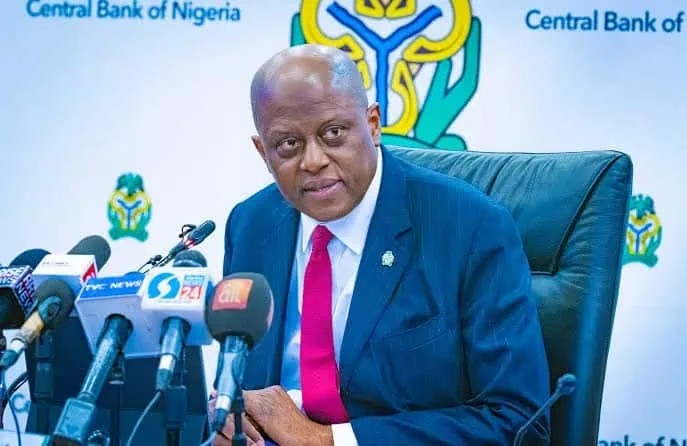
Nigeria is set to become the first African country to implement open banking, following the Central Bank of Nigeria’s (CBN) approval for a nationwide rollout beginning August 2025. This landmark move will require banks to securely share customer data-such as account balances, transaction histories, and spending patterns-with other regulated financial institutions, but only with the customer’s explicit consent. The open banking system will operate through standardized APIs, ensuring secure and consistent data access across all participating banks and fintechs. A central registry will authenticate participants, while a consent management framework tied to customers’ Bank Verification Numbers (BVNs) will give users full control over who accesses their data and for what purpose. CBN revised its approach after industry pushback against centralizing control under the Nigerian Interbank Settlement System (NIBSS). Instead, independent committees made up of financial professionals will oversee the system, without direct CBN control. Industry analysts say the new system could transform Nigeria’s financial landscape, especially lending. With access to richer customer data, lenders can better assess creditworthiness, potentially creating Nigeria’s first reliable credit scoring system and making credit more accessible to the country’s 120 million bank customers. Banks and fintechs are now preparing to integrate with the new system, which is expected to drive innovation, improve financial inclusion, and offer consumers more personalized financial products in the years ahead.

Nigeria Police launches seamless online tinted glass permit system: Here’s how to apply
The Nigeria Police Force has officially resumed the issuance of tinted glass permits, rolling out a fully digital application process to make things easier and more transparent for motorists nationwide. This move, announced by Force Public Relations Officer Olumuyiwa Adejobi, follows public complaints about harassment of vehicle owners with factory-fitted tinted windows. The new process is designed to cut out middlemen, speed up approvals, and restore public trust in police services. How to Apply for Your Tinted Glass Permit Online Visit the Portal: Go to the Police Specialised Services Automation Project (POSSAP) website at www.possap.gov.ng[1]. Create an Account: Register using your National Identification Number (NIN), Bank Verification Number (BVN), or Tax Identification Number (TIN), and verify your email. Log In: Use your email and password to access the portal. Start Your Application: Select “Tinted Glass Permit,” enter your vehicle details, and upload all required documents (such as vehicle registration, proof of ownership, valid ID, insurance, and a passport photo). Payment: Pay the processing fee online as displayed on the portal. Inspection and Biometric Capture: Book a date for your vehicle inspection and biometric data capture at a designated Police Intelligence Department location. The police have introduced a 30-day grace period starting May 1, 2025, to allow all vehicle owners with tinted windows to comply before enforcement begins. The entire process, from registration to permit issuance, is expected to take just 72 hours, with digital QR-coded permits provided for added security and ease of verification. Driving with tinted glass without a valid permit remains illegal in Nigeria and can lead to fines or your vehicle being impounded. The permit helps law enforcement distinguish between legitimate users and those using tinted glass for criminal activities, while also ensuring motorists can enjoy privacy and protection from harsh sunlight without fear of harassment.

Lagos unveils overhaul of waste management with GPS tracking, and digital payments system
The Lagos State Government has announced a sweeping transformation of its waste management system, rolling out mandatory GPS tracking for all waste disposal trucks and shifting all payments by Private Sector Participants (PSPs) to digital platforms. This bold initiative is designed to improve transparency, efficiency, and real-time monitoring in the state’s bustling waste sector, which manages over 13,000 tonnes of solid waste every day. Commissioner for the Environment and Water Resources, Tokunbo Wahab, revealed the reforms after a strategic meeting with the Association of Waste Managers of Nigeria and the Lagos Waste Management Authority (LAWMA). “Lagos cannot achieve a cleaner, more sustainable environment without greater efficiency, transparency, and innovation in PSP operations,” Wahab stated, emphasizing the need for real-time data and digital integration across all waste trucks. Key Features of the New Waste Management Policy: GPS Tracking: Every waste truck in Lagos will be equipped with GPS devices, allowing authorities and PSPs to monitor operations in real time and improve accountability. Digital Payments: All cash transactions for waste services will be replaced by digital payments, making the process more transparent and easier to track. Support for PSPs: LAWMA will lease new compactor trucks to PSP operators, helping them cope with rising operational costs and fuel price volatility. Circular Economy Drive: The state is prioritizing recycling and reuse, aiming to divert up to 10,000 tonnes of waste daily from landfills and potentially generate $2.5 billion annually by embracing a circular economy model. Community Recycling: LAWMA is establishing recycling centers where residents can exchange materials like plastics, paper, and metals for incentives, encouraging waste sorting at the source. The reforms also include partnerships for new waste-to-energy plants and the introduction of eco-friendly, compressed natural gas (CNG) waste trucks, all aimed at reducing environmental impact and creating economic opportunities.

REA clears abandoned electricity projects, targets universal access
The Rural Electrification Agency (REA) has announced the successful mobilization of contractors to complete previously abandoned electricity projects across Nigeria, marking a significant milestone in the country’s push for improved energy access. Speaking in Lagos on Wednesday, REA Managing Director Abba Aliyu revealed that since taking office, the agency has resolved numerous stalled projects by settling outstanding debts and returning contractors to their sites. “One by one, we paid all outstanding debts to contractors, mobilized them back to their sites, and ensured completion. If any remains incomplete, it’s likely due to insufficient budget provision, not abandonment,” Aliyu said. Aliyu emphasized that there are currently no abandoned projects under REA supervision. The agency is now focused on closing Nigeria’s energy access gap, especially in rural and underserved communities. Key initiatives include the launch of the Renewable Energy Asset Management Company, which will help raise substantial financing for large-scale projects. In addition, REA is working on the creation of a Renewable Energy University to build local technical capacity. Under the Energising Education Programme, the agency is electrifying eight federal universities, with plans to expand to eight more in the next phase. Aliyu also highlighted REA’s support for local solar panel manufacturing, following a recent visit to a 100-megawatt photovoltaic plant in Lagos. The agency is championing the localization of solar energy solutions to boost domestic industry. Earlier this week, the REA signed agreements with nine renewable energy firms to provide electricity access to 17.5 million Nigerians through the deployment of mini-grids and solar home systems. With a funding target close to ₦1 trillion, the REA aims to accelerate electrification efforts and ensure sustainable energy for millions of Nigerians.

Nigeria and UK launch joint case team to tackle cybercrime
The Federal Government of Nigeria has officially launched the Joint Case Team on Cybercrimes (JCTC), a multi-agency initiative designed to revolutionize the country’s response to digital crime, to combat the rising threat of cybercrime. The launch, held at the Federal Ministry of Justice in Abuja, also marked the signing of a Memorandum of Understanding (MoU) with the United Kingdom, strengthening international collaboration in the fight against cybercriminals. Attorney General of the Federation and Minister of Justice, Lateef Fagbemi SAN, described the JCTC as a “bold and transformative stride” in Nigeria’s criminal justice system. “We are building a system that will protect you, defend your rights, and bring cybercriminals to book,” Fagbemi declared, emphasizing that the initiative is rooted in synergy, coordination, and mutual respect among key institutions. The JCTC brings together representatives from several critical agencies, including: Nigeria Police Force National Cybercrimes Centre (NPFNCCC) Economic and Financial Crimes Commission (EFCC) Nigeria Financial Intelligence Unit (NFIU) National Agency for the Prohibition of Trafficking in Persons (NAPTIP) Nigeria Computer Emergency Response Team (NgCERT), Office of the National Security Adviser Federal Ministry of Justice Federal High Court The new team aims to address the complexity of cybercrime by fostering intelligence sharing, reducing bureaucratic bottlenecks, and ensuring that investigators and prosecutors work side by side from the outset of each case. According to Fagbemi, “An effective criminal justice response requires seamless cooperation between relevant actors-namely, investigators and prosecutors. Cybercriminals may exploit a lack of coordination.” The UK’s Minister of State for Home Affairs, Lord David Hanson, who attended the launch, called the event a “historic moment” for both nations. He highlighted the importance of international cooperation in tackling cybercrime, which is increasingly transnational in nature. International partners, including the UK National Crime Agency, the Foreign, Commonwealth & Development Office, and the Commonwealth Secretariat, have already provided IT equipment and foundational training to support the JCTC’s work. The launch of the JCTC comes as Nigeria faces mounting cyber threats, with the country recently ranked among the top five global sources of cybercrime activity. Officials hope that this coordinated, multi-agency approach will not only bring more offenders to justice but also restore public confidence and foster economic growth by making Nigeria’s digital space safer for all. Stakeholders from government, law enforcement, and the judiciary are united in their commitment to act together, innovate, and ensure that Nigeria’s response to cybercrime is both effective and enduring.