
The National Information Technology Development Agency (NITDA) has officially launched the Startup Consultative Forum (SCF), marking a pivotal moment for Nigeria’s rapidly expanding technology and startup landscape. Held on Monday, April 28, the inaugural meeting brought together startup founders, innovators, venture capitalists, angel investors, and ecosystem enablers from across the country. The SCF is a core initiative under the Nigeria Startup Act (NSA), which was signed into law in 2022 to provide a robust legal framework for the nation’s tech-enabled startups and position Nigeria as a leading hub for digital innovation in Africa. According to NITDA, the SCF is designed to deepen stakeholder engagement and ensure that those driving innovation in Nigeria have a direct role in shaping national policies. The forum will serve as an interactive platform where key players can collaboratively address challenges, identify opportunities, and help steer the direction of the country’s digital economy. “This milestone event marks a significant step in ensuring that startups are not just stakeholders but key contributors in building an enabling environment for innovation,” NITDA said in a statement. A major highlight of the meeting was the nomination and selection of representatives for the National Council for Digital Innovation and Entrepreneurship, commonly known as the Startup Council. This council will act as the highest advisory body for Nigeria’s startup ecosystem, influencing decisions that affect the future of innovation and entrepreneurship nationwide. Speaking at the event, NITDA’s Director-General, Malam Kashifu Inuwa, reaffirmed the government’s commitment to making startups “core architects of our economic future.” He emphasized that the NSA is more than just legislation-it is a new social compact designed to ensure policy evolves alongside technological advancement, rather than lagging behind. Inuwa also highlighted the critical role of the digital economy as a driver of job creation, global competitiveness, and youth empowerment. He noted that over the past eight months, NITDA has conducted nationwide awareness campaigns to prepare for the forum’s launch, underscoring the agency’s dedication to transparency and inclusion. NITDA has extended an open invitation to all labeled startups, verified entrepreneurship support organizations, angel investors, venture capitalists, and other stakeholders to participate in the SCF and the ongoing nomination process for the Startup Council. The agency believes that inclusive policy development and collaborative dialogue are essential to building a thriving, innovative ecosystem. “This is a unique opportunity to shape the future of digital innovation in Nigeria,” NITDA said, encouraging active participation from all corners of the tech community. The forum is expected to play a vital role in identifying regulatory barriers, mapping investment pathways, and fostering partnerships that will strengthen the country’s digital future.

Access bank fires staff over secret restroom filming scandal
Access Bank has dismissed Stephen Ifeanyichukwu Ejezie, a former quality assurance specialist at its Oniru, Lagos contact centre, after he was caught secretly filming female colleagues in the bank’s restrooms. The incident, which occurred around 1:30 a.m. last Wednesday, has sparked outrage among staff and the public after reports revealed Ejezie had recorded hundreds of videos without his colleagues’ knowledge. According to multiple sources, a female staff member discovered a phone camera pointed at her from a toilet cubicle while she was bathing. She raised the alarm, leading colleagues to confront Ejezie, who was found hiding in the cubicle. Subsequent investigations uncovered over 400 explicit videos on his devices, many allegedly shared or sold online. Access Bank responded by immediately terminating Ejezie’s employment and reporting the matter to law enforcement. The bank stated it is fully cooperating with authorities and providing support to affected employees. In an official statement, management reiterated a zero-tolerance policy for harassment and privacy violations, assuring that employee safety and dignity remain top priorities. Despite the swift dismissal, some staff have expressed concerns about the pace of the investigation and whether justice will be served, especially as Ejezie has reportedly been released from police custody.

MTN Nigeria Shares Surge as Investors Bet on Profit Comeback
MTN Nigeria, the country’s largest telecom operator, sees a dramatic surge in share trading and price gains. This renewed interest comes ahead of the company’s Q1 2025 financial results, set to be published on April 29, with many betting that MTN will finally return to profitability after two tough years. MTN’s stock has been on a tear since the start of the year. As of April 25, the share price climbed to ₦255.50, up 27.8% year-to-date, and recorded a 4.3% jump in a single day. Trading volumes have also soared, with over 11 million shares changing hands on April 15-the highest single-day volume for MTN on the Nigerian Exchange this year. Analysts point to a recent 50% hike in call and data tariffs, approved by the government, as a major driver behind the bullish sentiment. The price increase is expected to strengthen MTN’s margins and start reflecting in its earnings from this quarter. “If MTN’s Q1 numbers show a profit, it would be their first profitable first quarter since the naira’s steep devaluation in 2023,” said one market analyst. The devaluation, coupled with record inflation, had wiped out earnings and led to heavy losses in 2023 and 2024, despite strong demand for data and digital services. MTN’s performance is closely watched as a barometer for Nigeria’s digital economy. With over 50% market share, the company connects tens of millions of Nigerians to essential voice, data, and digital services, and its stock performance influences investor sentiment across the entire telecom sector. The company has also rebranded its home broadband service to FibreX, signaling a renewed push for growth in the home internet market. MTN is preparing a second public share offering, aiming to boost local ownership from 24% to 35% and further restore investor confidence. The company’s management is optimistic, citing recent economic reforms and improved dollar availability as reasons to expect a “V-shaped” recovery in Nigeria’s telecom sector. However, challenges remain. Inflation is still high, and many Nigerians are grappling with reduced spending power. But for now, investors appear confident that MTN Nigeria is on the cusp of a major turnaround, with its Q1 results likely to set the tone for the rest of the year. MTN Nigeria’s Q1 2025 financial results will be released on April 29, one day before its annual general meeting.
YouTube turns 20: From humble beginnings to a global video powerhouse
YouTube, the world’s largest video-sharing platform, is celebrating its 20th anniversary-a milestone that marks not just two decades of digital innovation, but a revolution in how people across the globe create, share, and consume content. From a 19-Second Clip to 20 Billion VideosLaunched in 2005 by Steve Chen, Chad Hurley, and Jawed Karim, YouTube started with a simple mission: to let anyone upload and share videos with the world. The very first upload, a 19-second clip titled “Me at the Zoo,” featured co-founder Jawed Karim at the San Diego Zoo and quietly kicked off a digital revolution. Fast forward to 2025, and YouTube’s growth is nothing short of staggering. The platform now hosts over 20 billion videos, with more than 20 million new uploads every single day. In 2024 alone, users posted an average of 100 million comments daily, and creators responded to about 10 million of those comments each day. The engagement is massive, with videos racking up more than 3.5 billion likes per day. What began as a simple video-sharing website has evolved into a cultural phenomenon. YouTube is now a launchpad for careers, a platform for activism, and a global stage for education, entertainment, and creativity. It has blurred the lines between traditional media and personal expression, giving rise to a new era of digital storytelling. “YouTube has grown into a force, driving culture and fundamentally reshaping how we watch and create entertainment,” said Neil Mohan, CEO of YouTube, as the company marked its 20th birthday on April 23, 2025. To mark its 20th anniversary, YouTube has rolled out new features, shared fresh statistics, and hidden playful “Easter eggs” across the platform for users to discover. These touches are designed to celebrate not just YouTube’s longevity, but the vibrant community that powers it every day. YouTube’s impact goes far beyond numbers. The platform has empowered millions of creators worldwide to build audiences, launch businesses, and share voices that might otherwise go unheard. In Africa, for example, YouTube has become a major economic driver, offering new income streams and reshaping digital culture as internet access expands across the continent. From viral music videos to educational channels, comedy skits to podcasts, YouTube continues to be a dynamic hub for creativity, connection, and opportunity, YouTube remains at the heart of the world’s digital conversation-a testament to the power of sharing stories, one video at a time.
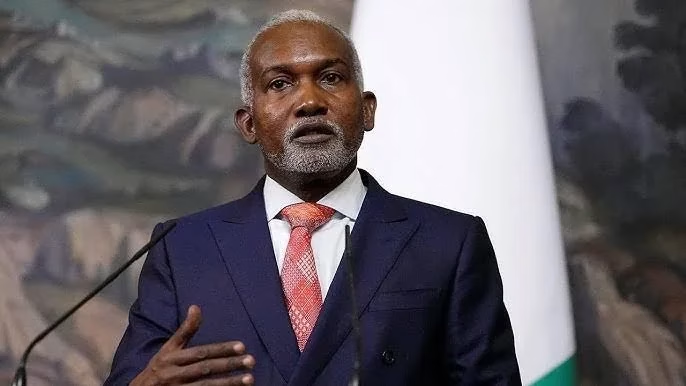
Nigerian government raises alarm over cyber-slavery targeting youths
The Federal Government has sounded a strong warning about a disturbing rise in cyber-slavery targeting young Nigerians across West Africa. Authorities say criminal syndicates are luring teenagers and youths with fake promises of high-paying jobs-especially in the booming cryptocurrency sector-only to traffic them into what are now being called “419 cyber-scam factories”. According to the Ministry of Foreign Affairs, victims, some of them minors, are deceived into traveling abroad for supposed employment. Instead, they end up trapped in criminal call centres, where they are forced under harsh and inhumane conditions to send thousands of fraudulent emails, texts, and calls to scam people worldwide. A recent rescue operation in Accra, Ghana, brought the crisis into sharp focus: over 200 Nigerians were freed from such cybercrime rings, where they had been held captive and compelled to commit online fraud. “This incident highlights the severe exploitation and abuse associated with cybercrime operations,” said Foreign Affairs Minister Yusuf Tuggar. “It underscores the urgent need to dismantle these multibillion-dollar criminal networks and reduce the vulnerability of potential victims”. The government is urging Nigerians-especially young people and their families-to be extremely cautious about job offers that promise easy money, overseas travel, or remote work involving cryptocurrencies. Officials stress the importance of verifying any employment opportunity through official channels and reporting suspicious offers to the authorities. The Ministry of Foreign Affairs reaffirmed its commitment to working with regional and international partners to combat cyber-slavery, rescue victims, and bring perpetrators to justice. Awareness campaigns are being intensified to protect Nigerian citizens at home and abroad from falling prey to these sophisticated scams.

Nigerian experts call for stronger digital security as new law tightens market oversight
Nigerian financial market experts are sounding the alarm on the urgent need for advanced security measures to protect the country’s increasingly digital trading and settlement platforms. Their recommendations come as the government ushers in sweeping regulatory reforms, including the landmark Investment and Securities Act (ISA) 2025, which brings digital assets firmly under regulatory control. At the recent African and Middle East Depositories Association (AMEDA) conference in Lagos, industry leaders highlighted the growing risks facing Nigeria’s capital markets. Stuart Turner, CEO of Avenir Technology Limited, emphasized that resilient system architecture and cutting-edge security models are now essential. “The key is to prioritize a resilient architecture spread across data centers. Specifically, the zero-security model, where individuals can access trading and settlement systems but must verify every action they take, makes it much harder for breaches to occur,” Turner said. Experts are urging the adoption of “zero trust” security frameworks, which require continuous verification of every user action, and advanced reCAPTCHA technologies that analyze human behaviors-such as the way passwords are entered-to identify imposters and block unauthorized access. These measures are seen as crucial in an era where artificial intelligence can now bypass traditional security tools like Google’s reCAPTCHA v2 with near-perfect accuracy. Jim Micklethwaite, Managing Director of Financial Markets at Thomas Murray, added that Central Securities Depositories (CSDs) should run breach simulations to detect lingering threats, rather than simply patching vulnerabilities and moving on. Regulatory Shake-Up: Digital Assets Now Under SEC OversightThe push for stronger digital security comes as Nigeria’s regulatory landscape undergoes its most significant transformation in years. The newly signed ISA 2025 formally recognizes digital assets-including cryptocurrencies and tokenized securities-as regulated financial instruments. This ends years of legal ambiguity and brings all digital asset operators under the direct supervision of the Securities and Exchange Commission (SEC). Previously, the Central Bank of Nigeria (CBN) had imposed restrictions on crypto-related transactions, and digital asset activities operated in a legal grey area. Now, Virtual Asset Service Providers (VASPs), exchanges, and related platforms must comply with SEC rules, aligning Nigeria’s market with international standards and boosting investor confidence. ISA 2025 also introduces clearer classifications for securities exchanges, separating them into composite (all asset classes) and non-composite (specialized) categories, making it easier for investors and companies to navigate the market. Nigeria’s fintech sector continues to evolve rapidly, with regulators balancing innovation and consumer protection. The Central Bank, SEC, and Nigeria Data Protection Commission have all stepped up oversight, especially as AI adoption surges in the industry. Nearly 30% of fintech firms now use generative AI for content creation, and new regulations are being introduced to ensure safe and ethical use of emerging technologies. Analysts predict that by 2030, fintechs could dominate Nigeria’s lending market unless traditional banks accelerate their digital transformation. Regulatory bodies are expected to develop a comprehensive framework for fintech and digital assets, moving from outright bans to controlled engagement, and possibly introducing incentives for banks investing in advanced technologies. The message from industry leaders and regulators is clear; innovation and security must go hand in hand to build trust and resilience in Nigeria’s digital financial ecosystem.