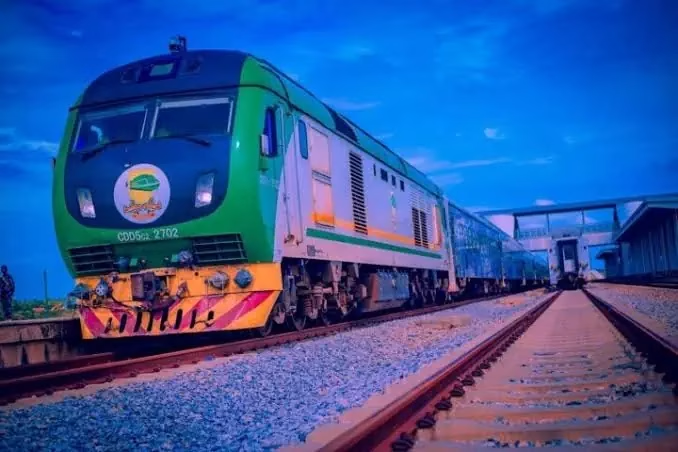
Enugu State has announced plans to construct a 135.5km standard gauge railway connecting key South-East cities to Rivers State’s Onne Port, aiming to transform the region into a logistics and export hub. The project, confirmed by Transport Commissioner Dr. Obi Ozor, follows a completed feasibility study and ongoing negotiations with Chinese firms and the Nigerian Railway Corporation. The rail line will run from Enugu through Ugwuoba (Anambra), linking Awka, Onitsha, Ebonyi, Umuahia (Abia), and Owerri (Imo) before terminating at Onne Port. It will support cargo and passenger services, targeting agro-commodities like coal and easing reliance on congested Lagos ports. The project aligns with Enugu’s push to unlock mineral resources and boost cross-state trade. An inland container port in Enugu and a new market station at Holy Ghost Transport Terminal are also underway to streamline cargo handling. While the federal government works on extending its narrow-gauge line from Aba to Enugu, this state-owned initiative operates independently. Experts emphasize the need for regional coordination to maximize impact, as neighboring states have yet to announce similar rail plans. China’s involvement through partnerships with Enugu reflects its expanding subnational infrastructure focus in Africa, coinciding with global trade shifts. Success here could model decentralized rail development for other states. Despite Enugu’s resolve, analysts warn that disjointed regional efforts and funding constraints could hinder seamless connectivity. The project’s timeline remains undisclosed, with financing talks still ongoing.

FG targets 4,000MW grid expansion by 2026 amid persistent power challenges
The Federal Government has announced a bold plan to expand Nigeria’s electricity grid by an additional 4,000 megawatts (MW) by the end of 2026. This move comes as part of renewed efforts to tackle the country’s long-standing power supply issues and is being driven by partnerships with reputable Engineering, Procurement and Construction (EPC) companies. Despite over $3 billion in loans from international partners like the World Bank and African Development Bank in recent years, Nigeria’s electricity generation has remained stagnant, averaging around 4,500MW for a population exceeding 200 million. Many communities still experience frequent blackouts, and the gap between power generation and actual supply to consumers remains wide. The new expansion plan is anchored on the Presidential Power Initiative (PPI), a collaboration between Nigeria and Germany’s Siemens AG. The PPI aims to overhaul and expand the nation’s transmission and distribution infrastructure in three phases, ultimately targeting a grid capacity of 25,000MW in the coming years. The first phase focuses on quick upgrades to increase operational grid capacity, with subsequent phases set to boost both generation and last-mile distribution. Already, the government has commissioned 10 new power transformers and 10 mobile substations as part of the pilot phase, completed in October 2023. These upgrades are expected to improve electricity delivery to industrial areas, universities, and homes nationwide. However, experts caution that while these targets are ambitious, Nigeria’s power sector faces deep-rooted challenges. Despite having over 13,000MW of installed generation capacity, only about 3,400MW reliably reaches end users due to bottlenecks in transmission and distribution. Addressing these issues will be crucial for the government to meet its 2026 goals and provide more reliable power for Nigerians.
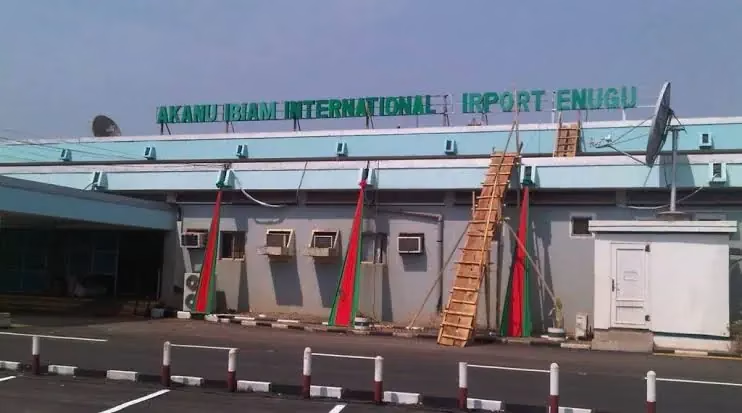
Enugu airport concession nears completion, state prepares to launch Enugu air
The concession process for Akanu Ibiam International Airport in Enugu has crossed a major milestone, with over 70% of the work completed and the final agreement expected by the second quarter of 2025. This ambitious move, led by the Federal Government in partnership with Aero Alliance Consortium, will see the airport handed over for an initial 80-year term, with a possible 20-year extension based on performance. Under the draft agreement, all current staff of the Federal Airports Authority of Nigeria (FAAN) at the airport will be transferred to the new operator for two years with full benefits. No forced layoffs are planned, and any redundant staff after that period will be reabsorbed by the federal government, which remains responsible for their pensions and gratuities. The concessionaire is required to carry out major upgrades, including runway rehabilitation, terminal expansion, installation of advanced navigation and communication systems, and improvements to baggage handling and passenger facilities. These upgrades are designed to meet international standards set by ICAO and IATA, ensuring the airport is equipped for modern aviation demands. Financially, Aero Alliance will manage non-aeronautical revenue streams like cargo, parking, and retail, while aeronautical tariffs such as landing fees will still require government approval. The agreement mandates quarterly financial reporting and gives the government audit rights, with a compliance team monitoring all contract obligations. Meanwhile, the Enugu State government is pushing forward with plans for its own airline, Enugu Air, which is set to launch in 2025. The state’s 2025 budget allocates ₦41.1 billion to the transportation sector, including the acquisition of four new aircraft for the airline and support for the airport concession and cargo terminal development. Enugu Air aims to boost connectivity and investment in the region, with initial routes targeting key Nigerian cities and plans for regional expansion.

Lightning strike electrocutes University of Ilesa student while playing game on charging phone
A first-year student at the University of Ilesa, Osun State, lost his life on Friday evening after being electrocuted during a thunderstorm. Gbolahan Ojolo, a 100-level Business Administration student, was in his private hostel near the Prototype Engineering Development Institute junction when the incident occurred. According to university officials, Ojolo was playing a game on his mobile phone while it was plugged in and charging. A sudden lightning strike during the storm reportedly triggered the fatal electrocution. The university’s registrar, Funso Ojo, confirmed the tragedy in a statement, expressing deep regret over the loss. “The entire University community mourns this painful loss and prays for the repose of Gbolahan’s soul. Our thoughts and prayers are with his family, friends, classmates, and the Department of Business Administration,” Ojo said. Authorities have begun investigating the circumstances surrounding the incident. After police clearance, Ojolo’s remains were transferred to the Wesley Guild Hospital morgue in Ilesa. The university has pledged support to the bereaved family during this difficult period. This incident serves as a somber reminder of the dangers posed by electrical devices during thunderstorms and highlights the importance of safety precautions in such conditions.

MTN Nigeria rebrands fibre broadband service to FibreX
MTN Nigeria has announced the rebranding of its fibre broadband service, previously known as MTN Fibre Broadband, to FibreX. The move is part of MTN’s broader push to deliver faster, more reliable, and accessible internet to Nigerians, aligning with the country’s National Broadband Plan to achieve 70% broadband penetration by 2025. According to Egerton Idehen, MTN Nigeria’s Chief Broadband Officer, the new FibreX brand is designed to be more modern and relatable, aiming to connect with customers on a personal level. “The launch of FibreX reiterates our dedication to supporting Nigeria’s digital transformation journey. By enhancing our infrastructure and services, we aim to bridge the digital divide and foster inclusive growth,” Idehen said. FibreX will continue to use MTN’s robust Fibre to the Home (FTTH) infrastructure, offering ultra-fast internet speeds, at least 25 Mbps in cities and 10 Mbps in rural areas. The company also plans to support the federal government’s initiative to expand Nigeria’s fibre-optic network from 35,000 km to 125,000 km, ensuring more homes and businesses can access high-speed connectivity. The rebrand is not just cosmetic. MTN wants to educate and excite users in “home-passed locations”, areas where homes are eligible for FTTH connections, about the benefits of FibreX. The new identity reflects MTN’s commitment to digital inclusion and a better customer experience for all Nigerians.

Starlink gains green light in India as Jio and Airtel power nationwide satellite internet rollout.
Elon Musk’s Starlink, the satellite internet service by SpaceX, is gearing up for a landmark launch in India as early as January 2025, pending final government approvals. The move is expected to transform internet access across the country, especially in rural and remote regions where traditional broadband has struggled to reach. Starlink delivers high-speed internet via a network of thousands of low-Earth orbit satellites, bypassing the need for extensive ground infrastructure. This makes it ideal for India’s vast and diverse terrain, where laying fiber or building towers is often impractical or too expensive. With speeds ranging from 25 to 220 Mbps and low latency, Starlink aims to support everything from online education and telemedicine to streaming and business needs, even in the country’s most isolated corners. Starlink’s entry comes through a partnership with telecom giant Bharti Airtel, which will help distribute the service and equipment across India. The rollout will begin in areas with low internet penetration, such as hilly, border, and rural regions, before expanding nationwide. Users will need to purchase a Starlink kit (including a satellite dish and Wi-Fi router) and set it up with a clear view of the sky to get connected. Starlink has cleared several regulatory milestones and is now awaiting final licenses from India’s Department of Telecommunications and space regulator. Once approved, it will become the third company after Jio Satellite Communications and OneWeb to offer satellite-based broadband in India. What Can Users Expect?High-speed internet: Download speeds of 25–220 Mbps, suitable for streaming, video calls, gaming, and more. Low latency: Typically 25–50 milliseconds, enabling real-time online activities. Wider reach: Coverage in remote and underserved areas, helping bridge the digital divide. Direct-to-mobile: New satellites will soon allow direct connectivity to mobile phones, further expanding access. Starlink’s launch is set to be a game-changer for India’s digital landscape, supporting the government’s Digital India initiative and opening new opportunities for millions who have long been left offline. While pricing details are yet to be announced, the service is expected to particularly benefit rural households, schools, and businesses seeking reliable internet for the first time.