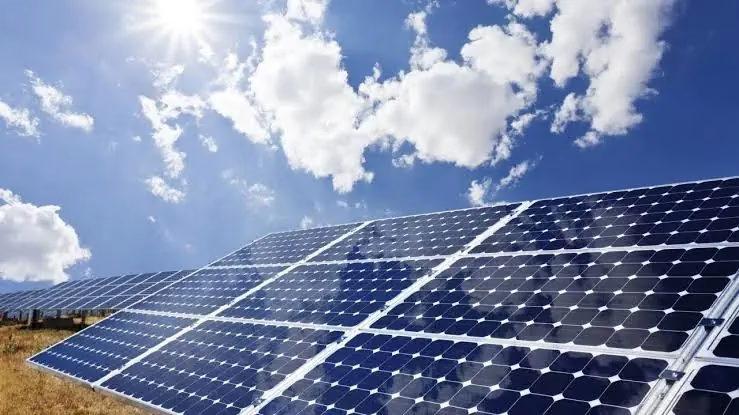
The Nigerian Federal Government has reiterated its commitment to banning the importation of photovoltaic (PV) solar panels, a move aimed at stimulating local manufacturing and reducing the country’s estimated N200 billion annual expenditure on imported solar equipment. At a recent roundtable in Victoria Island, Lagos, between the Rural Electrification Agency (REA) and the Lagos State Government, REA Managing Director Abba Aliyu emphasized the government’s resolve to domesticate renewable energy equipment production. Aliyu highlighted Lagos as the “centre of excellence” poised to lead this industrial transformation, citing the expansion of a PV panel assembly plant in Ikotun from 10 megawatts to 100 megawatts capacity with REA’s collaboration. Supporting this local manufacturing drive, the Minister of Science and Technology, Uche Nnaji, pointed to the National Agency for Science and Engineering Infrastructure (NASENI), which operates a solar panel manufacturing facility in Abuja. NASENI’s plant, upgraded to a 50-megawatt capacity in 2024 with plans to exceed 100 megawatts in 2025, produces high-quality monocrystalline solar panels certified by the Standards Organisation of Nigeria. Nnaji affirmed the government’s intention to enforce the ban on imports through Presidential Executive Order No. 5, aiming to nurture indigenous industries. However, the policy has drawn criticism from industry experts who caution that Nigeria currently lacks the technological infrastructure to fully manufacture critical solar panel components such as solar wafers and cells. Theophilus Nweke, CEO of Cloud Energy, expressed skepticism at the 2025 Lagos Energy Summit, noting that local companies assemble panels using imported cells rather than manufacturing from raw wafers. He questioned the feasibility of enforcing an import ban without existing factories capable of producing these essential components. Nweke urged the government to prioritize creating a supportive ecosystem for private-sector growth in renewable energy. He proposed establishing a renewable energy intervention fund to provide low-interest financing, akin to the agricultural intervention fund, to empower operators and citizens in adopting solar solutions. The debate unfolds amid Nigeria’s growing renewable energy ambitions, including a recent Memorandum of Understanding between the Energy Commission of Nigeria, China Energy Engineering Corporation, and the Nigerian Governors’ Forum to establish the Nigeria-China Renewable Energy Research Centre. This initiative aims to boost technological innovation and human capacity development in the sector. While the government’s push to localize solar panel manufacturing signals a strategic commitment to industrialization and energy independence, experts emphasize the need for phased implementation, technological investment, and collaborative frameworks to avoid disrupting the expanding solar market and financing startups that currently rely heavily on imports. The success of the solar import ban will depend on how effectively local manufacturing capacity can be scaled without stalling the progress of solar energy deployment across the country.

EFCC, INTERPOL launch global manhunt after CBEX trading platform collapses
The Economic and Financial Crimes Commission (EFCC) has teamed up with INTERPOL to investigate the dramatic collapse of CryptoBank Exchange (CBEX), a digital trading platform accused of vanishing with over ₦1.3 trillion in investor funds. The move comes after thousands of Nigerians were left stranded, unable to access their savings, and widespread outrage erupted both online and at CBEX’s abandoned offices across the country. CBEX, operated by foreign nationals alongside Nigerian collaborators, abruptly shut down on Monday, April 14, 2025. Many investors woke up to find their account balances wiped out, with the platform demanding additional deposits before granting access, a tactic now seen as a final ploy before the crash. The EFCC revealed that it had begun investigating CBEX before its collapse, acting on credible intelligence reports. EFCC spokesperson Dele Oyewale confirmed ongoing efforts to arrest both local and international perpetrators. “We are on the local collaborators while we are partnering with INTERPOL to trace the foreign operators. Where recovery is possible, we will recover; where prosecution is possible, we will prosecute,” Oyewale stated. The Securities and Exchange Commission (SEC) has also warned Nigerians to avoid unregistered trading platforms and Ponzi schemes, reminding the public that operating such platforms without proper registration is now a criminal offense under the new Investment and Securities Act, 2025. As the investigation unfolds, the EFCC urges Nigerians to verify investment opportunities with regulatory bodies like the Central Bank of Nigeria and the SEC before committing funds. The commission has not yet released details of arrests or asset recoveries, but assures the public that it is committed to dismantling fraudulent schemes and protecting investors nationwide.
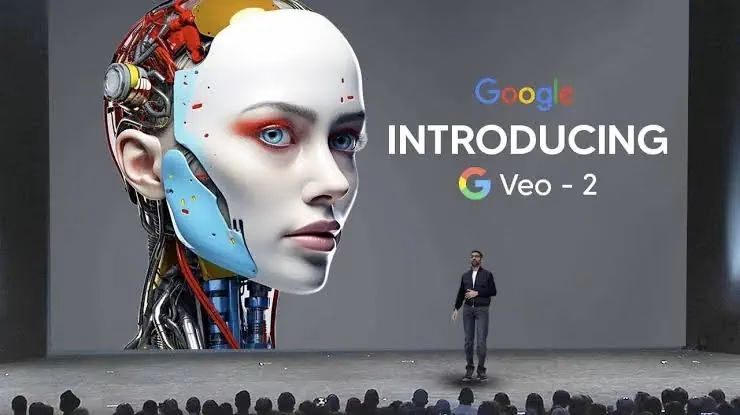
Google unveils Veo 2, a next-gen AI video generator that sets a new benchmark for creativity
Google has officially launched Veo 2, its most advanced AI video generator yet, raising the bar for what’s possible in text-to-video creation. Developed by Google DeepMind, Veo 2 transforms simple text prompts or reference images into high-quality, lifelike video clips, opening up new creative frontiers for marketers, filmmakers, educators, and content creators worldwide. Veo 2 produces videos with stunning realism, accurately simulating real-world physics, natural motion, and cinematic effects. Users can specify camera angles, lens types, special effects, and even exclude unwanted elements, ensuring videos match their creative vision down to the finest detail. The model supports resolutions up to 4K, though most users will currently see 720p output, with the potential for even higher quality as the technology matures. Creating a video with Veo 2 is as simple as describing your idea in detail. The AI interprets both simple and complex instructions, generating eight-second clips that can be further refined or downloaded in MP4 format. For developers and advanced users, Veo 2 is accessible via Google AI Studio and the Gemini API, allowing seamless integration into apps and creative workflows. Veo 2’s versatility shines across industries, from cinematic storytelling and advertising to scientific visualization and education. Its ability to handle intricate prompts and deliver consistent, visually appealing results makes it a favorite among professionals and hobbyists alike. Pre-designed templates and real-time adjustments for pacing, tone, and transitions further expand its creative potential. Currently, Veo 2 is available through a waitlist, with broader rollout expected soon. While it excels in realism and creative flexibility, users may still encounter minor glitches in complex scenes or rapid motion, a reminder that the technology, though groundbreaking, is still evolving. Google isn’t just keeping pace with competitors like OpenAI’s Sora, it’s setting a new standard for AI-driven video creation. As access expands, Veo 2 is poised to revolutionize how we bring ideas to life on screen, making professional-quality video production more accessible than ever before.
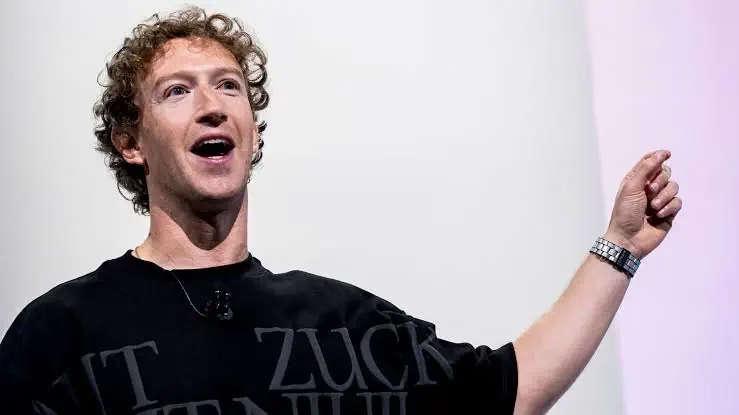
Zuckerberg defends Meta’s Instagram, WhatsApp acquisitions in antitrust trial
Meta CEO Mark Zuckerberg defended the company’s acquisitions of Instagram and WhatsApp during a high-profile antitrust trial in Washington, D.C., pushing back against U.S. government claims that these deals were meant to squash competition. The Federal Trade Commission (FTC) argues that Meta’s purchases of Instagram in 2012 and WhatsApp in 2014 were strategic moves to maintain its dominance in social media by eliminating potential rivals. The agency is seeking a court order that could force Meta to sell one or both platforms, which would significantly reshape the tech giant’s business. Zuckerberg testified that the acquisitions were part of Meta’s efforts to adapt to changing social media trends, not to stifle competition. He acknowledged that user behavior shifted over time, with people sharing less publicly on Facebook and more privately through messages, a change Meta initially misunderstood. The FTC pointed to internal emails suggesting Meta saw Instagram and WhatsApp as threats that needed to be neutralized. However, Meta counters that the social media landscape has evolved, with new competitors like TikTok, YouTube, and Apple’s messaging app offering strong alternatives. The trial also highlights the challenge regulators face in defining the relevant market. The FTC focuses on platforms where users share content with friends and family, such as Snapchat and MeWe, while Meta argues that broader platforms like TikTok compete directly for users’ attention. If the FTC prevails, forcing Meta to divest Instagram or WhatsApp could have major financial consequences. Instagram is a core part of Meta’s advertising revenue, and WhatsApp holds the company’s largest daily user base, playing a key role in future business messaging and monetization plans. This case is part of a wider push by U.S. regulators to hold Big Tech accountable for anti-competitive practices, a movement that has gained momentum over recent years. The trial is expected to continue through July, with a final decision that could reshape the social media industry.
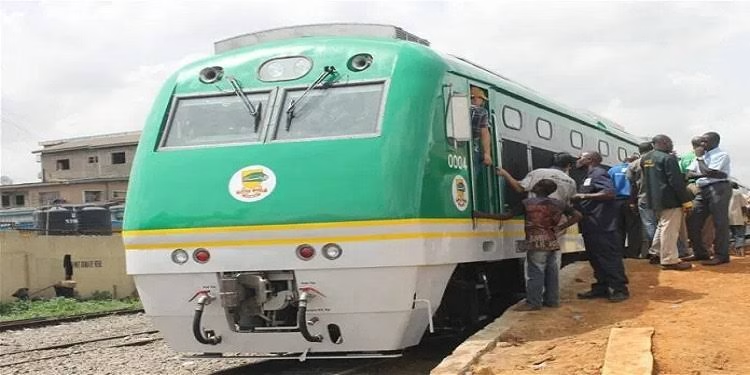
FG urges Rivers State to join Port Harcourt–Aba rail operations, to boost regional transport
The Federal Government is calling on the Rivers State Government to take an active role in running the Port Harcourt–Aba railway, aiming to strengthen rail transport and boost economic activity in the region. During an inspection at the Port Harcourt railway station on Tuesday, Dr. Kayode Opeifa, Managing Director of the Nigerian Railway Corporation (NRC), highlighted the importance of state and private sector involvement in revitalizing Nigeria’s railways. “The narrow-gauge tracks pass through Port Harcourt to Aba, so the state government can also participate by operating the rail route from Port Harcourt to Aba,” Opeifa said. The Port Harcourt–Aba rail segment is already fully operational, providing a faster and more affordable travel option for thousands of commuters. The NRC reported moving over 675,000 passengers and generating N1.42 billion in the first quarter of 2024, signaling strong demand on the route. Opeifa pointed to Plateau State’s successful “Rail on the Plateau” initiative as a model, encouraging Rivers State and private investors to help expand services by investing in coaches and locomotives. He also revealed plans to connect the Eastern and Western rail corridors through inland waterways, creating a multimodal transport network that links rail and maritime routes. Construction on the Enugu–Maiduguri section of the Eastern corridor is set to begin soon, with the government promising accelerated work to ensure the entire corridor becomes operational. With the Federal Government’s push for collaboration, officials hope the Port Harcourt–Aba corridor will become a cornerstone of regional development, making rail travel a preferred choice for Nigerians once again.
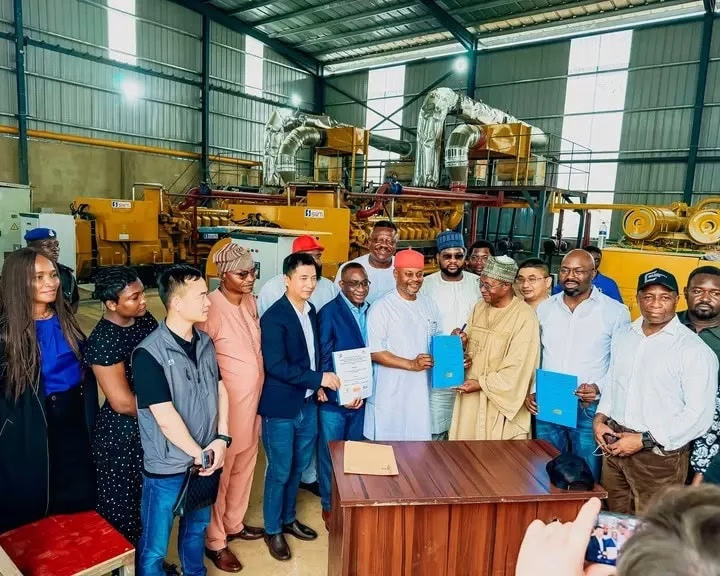
Nigeria launches nationwide clean energy push with 30MW Shagamu power plant
The Federal Government has kickstarted a major clean energy initiative, commissioning a 30MW power facility in Shagamu, Ogun State, as the first step in delivering 5MW of decentralized renewable energy to each of Nigeria’s 774 local government areas. Announced by Minister of Innovation, Science and Technology Uche Geoffrey Nnaji, the Sustainable Energy Access Projects (SEAP) aims to tackle energy poverty, reduce emissions, and boost rural livelihoods. Key Components Mini-grids: Solar and gas-powered systems for off-grid communities. E-tricycles: Conversion of 1,000 petrol tricycles per LGA to electric models. Clean cooking: LPG/CNG cylinders for 20,000 households per LGA to curb indoor pollution. A tripartite agreement between the Association of Local Governments (ALGON), Data Analytics & Solutions International Ltd, and CCK Electric Power Technology Company will drive implementation. The project aligns with President Tinubu’s Renewed Hope Agenda and targets job creation, healthcare improvements, and SME growth through reliable energy access. The government has urged partners like the United Nations Development Programme (UNDP) to help scale the initiative, particularly for women and youth. SEAP’s nationwide rollout aims to advance Nigeria’s Sustainable Development Goals on energy, health, and gender equity. Minister Nnaji described SEAP as a “transformative solution” to Nigeria’s energy crisis, combining innovation and inclusion to bridge the urban-rural divide.