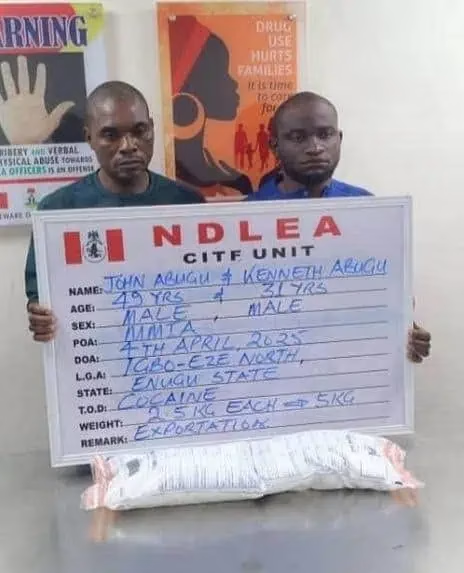
The National Drug Law Enforcement Agency (NDLEA) has apprehended two brothers, John Abugu, 43, and Kenneth Abugu, 31, for attempting to smuggle five kilograms of cocaine through the Murtala Muhammed International Airport (MMIA) in Lagos. The arrest took place on Thursday, April 3, following a proactive operation based on credible intelligence. According to a statement released on Sunday by Femi Babafemi, NDLEA’s Director of Media and Advocacy, the suspects were intercepted while trying to board a flight to India. A thorough search of their luggage revealed the illicit substance concealed within the walls of their suitcases. Laboratory tests later confirmed the substance to be cocaine. The brothers claimed they were traveling to India for medical treatment. However, NDLEA operatives uncovered their attempt to traffic drugs through meticulous security checks. In a related operation on the same day, NDLEA officers also arrested Parker Osei, a 20-year-old Ghanaian-British national, at the airport. Osei was found in possession of 19.4 kilograms of cannabis, popularly known as “Loud,” neatly packed in a large traveling bag. He was apprehended during passenger clearance at the E-arrival hall after arriving on an Ethiopian Airlines flight from Bangkok, Thailand. Osei, who identified himself as a Computer Science student at East London University in the UK, admitted to collecting the drug consignment during his trip to Bangkok. He disclosed that he was meant to deliver it in Nigeria before his arrest. The NDLEA emphasized that these arrests reflect its unwavering commitment to curbing drug trafficking and dismantling international drug networks operating through Nigeria’s airports. The agency praised its operatives for their diligence and reiterated its zero-tolerance policy toward drug-related crimes. Femi Babafemi commended the vigilance of the officers involved and assured that traffickers would face the full weight of the law regardless of their background or methods. He also urged members of the public to remain vigilant and report any suspicious activities to support the agency’s efforts. These recent successes add to NDLEA’s growing list of high-profile arrests and drug seizures at MMIA, a known hub for international drug trafficking due to its strategic location and global connections.
FCT residents decry discrimination in electricity supply, call for reform
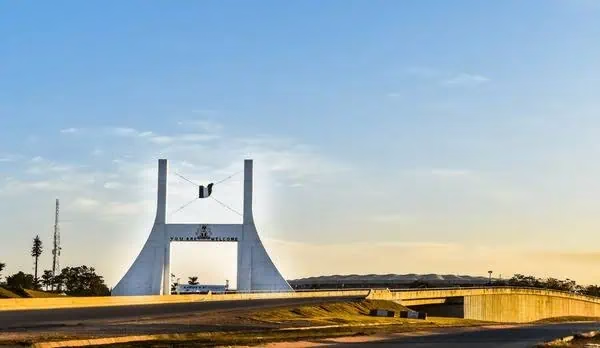
Residents of Nigeria’s Federal Capital Territory (FCT) have expressed frustration over what they describe as discriminatory treatment in electricity distribution under the Abuja Electricity Distribution Company (AEDC). Many accuse authorities of favoring customers in Band A, who enjoy up to 20 hours of power daily, while those in Bands B to E endure erratic supply despite being billed. Residents criticized the current electricity framework, which they claim creates inequality. According to the Nigerian Electricity Regulatory Commission (NERC), Band A customers are charged N209.5 per kilowatt-hour (kWh), while Band B customers pay N63/kWh. However, residents argue that the disparity in supply hours far outweighs the difference in tariffs. Mr. Moses Omoruyi, a resident of Kuje under Band B, described the situation as unfair. “Those on Band A are enjoying regular power supply, while we are left in the dark. Are we not Nigerians like them?” he asked. Omoruyi called for a billing system based on actual consumption rather than hours of supply and urged the federal government to prioritize stable electricity nationwide instead of selective distribution. Similarly, Mrs. Ufuoma Ifeta from Kubwa emphasized the need for a more equitable tariff structure. “If we place everyone on an equal and affordable rate, people will still pay according to what they use,” she said. She added that it is unjust for some residents to have 20 hours of power daily while others manage with just two to five hours. The issue goes beyond pricing, according to Mr. Joseph Akhere, a civil servant in Kubwa. He noted that reliability and availability are key concerns for most consumers. “People are not against paying for power, but the electricity has to be available in the first place,” he said, urging the government to invest in infrastructure that ensures equitable distribution across all zones. Mrs. Titilayo Olowu from Dutse argued that efforts to move more consumers into Band A must be accompanied by consistent supply rather than simply higher tariffs. Another resident, Mr. Gilbert Akpan, called for an end to preferential treatment for Band A customers and advocated for a uniform tariff system that guarantees power for all citizens regardless of location or socioeconomic status. Under the current system, Band A customers, largely concentrated in high-density commercial areas, government institutions, and elite neighborhoods, represent a small percentage of electricity users nationwide. Meanwhile, the majority of Nigerians fall into Bands B to E and are consistently underserved despite ongoing reforms in the power sector. Efforts by the federal government to address these issues have yet to yield significant results. In 2024, Minister of Power Adebayo Adelabu announced plans to remove subsidies for Band A customers due to mounting debts of N1.3 trillion owed to generating companies (GenCos) and $1.3 billion owed to gas suppliers. However, residents argue that deeper structural reforms are needed to address fairness and accessibility in electricity distribution. Residents are calling on NERC and AEDC to overhaul the band system and adopt policies that reflect fairness and accessibility for all electricity users across Nigeria. They also urge the government to prioritize investments in infrastructure that can support stable and equitable power supply nationwide.

Facebook marketplace scammers pose as customs officers, duping Nigerians with fake auctions
A disturbing scam has emerged on Facebook Marketplace, where fraudsters impersonating Nigeria Customs Service (NCS) officers lure unsuspecting buyers with fake auction deals on seized goods, exploiting their trust and financial vulnerability. These scammers advertise items like electronics and household appliances at prices far below market value, claiming they are auctioned goods seized at border points such as the Seme Border. Victims are asked to pay a registration fee and additional charges for delivery, only to realize later that the goods never existed. Victims report being contacted by a woman using the name Adeyemi Christiana on Facebook, who speaks in Pidgin English and reassures buyers of the availability of items. A ₦7,500 registration fee is required to join the auction. After payment, victims are further pressured by a supposed delivery driver to pay additional fees for logistics and vehicle repairs, leading to losses of up to ₦32,500 in documented cases. The Nigeria Customs Service has repeatedly warned the public about such fraudulent schemes, emphasizing that legitimate auctions are conducted solely through their official e-Auction platform and never via social media or WhatsApp. They urge individuals to verify auction details through their website or help desk and report suspicious activities immediately.

YouTube increases premium subscription prices in Nigeria and South Africa
YouTube, owned by tech giant Google, has announced a significant price hike for its YouTube Premium service in Nigeria and South Africa, sparking reactions from subscribers. The ad-free streaming service now costs ₦1,700 per month for individual plans in Nigeria, a 54% increase from the previous ₦1,100. Family plans saw an even steeper rise of over 64%, jumping from ₦1,700 to ₦2,800. In an email sent to Nigerian subscribers on April 4, 2025, YouTube explained the decision: “To continue delivering great service and features, we’re increasing your price to ₦1,700.00/month. We don’t make these decisions lightly, but this update will allow us to continue to improve YouTube Premium and support the creators and artists you watch on YouTube.” The new pricing will take effect from users’ next billing cycle. South African subscribers will also experience price adjustments starting mid-year. The individual plan will increase from R71.99 to R81.99 per month, while the family plan will rise from R109.99 to R149.99. YouTube Music subscribers in South Africa will now pay R64.99 instead of R59.99. This trend extends beyond Africa. Early adopters of YouTube Premium in the United States, who have been paying $7.99 since its predecessor Music Key launched in 2014, are also seeing their first price increase in a decade. The price changes come amid broader hikes across Google’s services globally. Earlier this year, Google raised prices for its Google One cloud storage service in several African countries, including Nigeria and Ghana. Other global platforms like Netflix and Microsoft have similarly adjusted prices across the continent since 2024.

Trump extends TikTok deadline by 75 days
President Donald Trump has once again postponed the deadline for TikTok to be sold or face a ban in the United States. In a post on his Truth Social platform on Friday, Trump announced he was signing an executive order to extend the deadline by an additional 75 days. The decision comes just one day before the previous deadline was set to expire on April 5, 2025. This marks the second time Trump has delayed the ban, following an initial 75-day extension granted in January. “My Administration has been working very hard on a Deal to SAVE TIKTOK, and we have made tremendous progress,” Trump stated. “The Deal requires more work to ensure all necessary approvals are signed, which is why I am signing an Executive Order to keep TikTok up and running for an additional 75 days.” The extension allows more time for negotiations between ByteDance, TikTok’s Chinese parent company, and potential U.S. buyers. Several companies and consortiums have expressed interest in acquiring TikTok’s U.S. operations, including Amazon, AppLovin, and a group led by Oracle. Trump emphasized the importance of reaching a deal that addresses national security concerns while keeping the popular app available to millions of American users. “We do not want TikTok to ‘go dark.’ We look forward to working with TikTok and China to close the Deal,” he added. The president also linked the TikTok negotiations to broader trade discussions with China, mentioning reciprocal tariffs as a tool for achieving “Fair and Balanced Trade.” For now, TikTok’s 75 million American users can continue using the app while its fate remains uncertain.
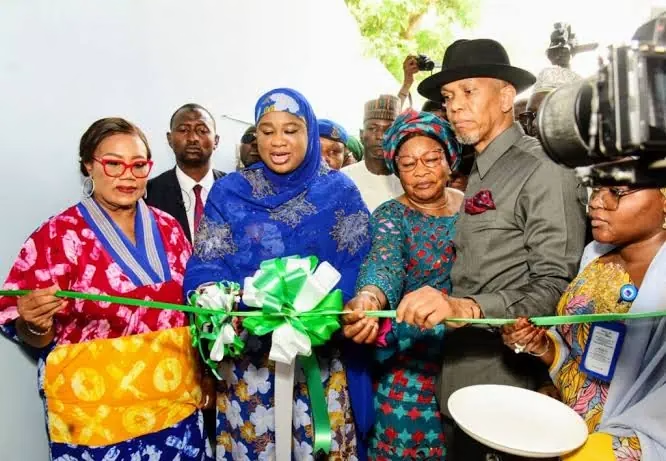
FCT minister unveils Nigeria’s first solar-powered farmers’ market in Abuja
Abuja has taken a bold step toward sustainability and economic empowerment with the inauguration of the first-ever solar-powered farmers’ market in the Federal Capital Territory (FCT). The market, located in Utako, was officially opened on Friday by the Minister of State for the FCT, Dr. Mariya Mahmoud. Spanning 3,000 square meters, this state-of-the-art facility was developed by Abuja Investment Company Limited (AICL) and features 50 lockup shops, 40 informal stalls, and seven warehouses. The project is designed to revolutionize agricultural commerce in the region by providing farmers with a platform to sell directly to consumers, eliminating middlemen, reducing post-harvest losses, and boosting rural incomes. Speaking at the inauguration ceremony, Dr. Mahmoud highlighted the market’s potential as a hub for economic growth and agricultural excellence. “This market will provide a platform for farmers to sell directly to buyers, eliminating middlemen, reducing post-harvest losses, and boosting rural incomes,” she said. She added that the initiative reflects the FCT Administration’s commitment to people-centered, impactful, and sustainable development under the leadership of Mr. Nyesom Wike. A Model of Public-Private CollaborationThe minister praised AICL’s visionary leadership in executing the project and emphasized the importance of public-private partnerships in driving community-focused development. She urged farmers, traders, and entrepreneurs to take full ownership of the facility and use it as a catalyst for economic growth. “This market is not just a facility; it is an opportunity for us to build a sustainable, inclusive economy that empowers small-scale agribusinesses and ensures quality produce is accessible to every resident of the territory,” Mahmoud stated. The minister also commended President Bola Tinubu for his support toward developing Abuja as a world-class city. Ambassador Maureen Tamuno, Group Managing Director/CEO of AICL, described the Utako farmers’ market as Nigeria’s first green market powered entirely by solar energy. She noted that this innovation aligns with Sustainable Development Goal (SDG) 11, which focuses on sustainable urban development. “The reliable and clean power supply in this market will enable traders to operate for extended hours and preserve perishable goods, thereby boosting their income,” Tamuno explained. She emphasized that the project demonstrates AICL’s commitment to tackling climate change challenges while supporting economic growth. The solar-powered market is expected to play a significant role in advancing food security policies under President Tinubu’s Renewed Hope Agenda. It serves as an example of how sustainability can intersect with economic empowerment to create lasting benefits for local communities. Dr. Mahmoud concluded her remarks by encouraging residents to embrace this development as an opportunity to build a resilient economy that supports local farmers and improves livelihoods across the territory.