
Drivers under the Lagos government-backed ride-hailing platform, LagRide, are threatening to boycott operations and stage protests following accusations of misconduct and alleged harassment by the platform’s management. The dispute highlights growing tensions between drivers and the new operators, CIG Motors Co. Ltd, barely a month after they assumed control of the service. The Amalgamated Union of App-Based Transporters of Nigeria (AUATON), representing the drivers, revealed that frustrations stem from several operational challenges: App Issues: The new LagRide app, introduced by CIG Motors, has been criticized for being user-unfriendly, draining phone batteries, and complicating trip navigation. Cash Payment Ban: Drivers claim LagRide disabled the in-app cash payment option to enforce weekly remittance of earnings, which they find unfavorable. High Levies: Drivers report multiple charges for insurance, communication devices, dashcams, and phones without support for vehicle maintenance or repairs. LagRide management accuses drivers of violating policies by: Discouraging riders from using the LagRide app while promoting rival platforms like Bolt and InDrive. Refusing trips without valid reasons and accepting cash payments instead of processing fares through the app. In response to these violations, LagRide warned of strict disciplinary measures, including arrests by Lagos State Task Force officials, vehicle impoundment, and legal actions. AUATON’s Public Relations Officer, Steven Iwindoye, criticized management’s threats as escalating tensions rather than addressing systemic issues. He warned that unresolved concerns could lead to protests at the Lagos State Secretariat in Alausa and a complete shutdown of LagRide operations. LagRide was initially managed through a partnership between Lagos State Government and Zenolynk Technology Ltd. After Zenolynk exited in March 2025, CIG Motors, a Chinese state-owned automaker, took over operations. Despite promises of modernization with electric vehicles and improved services, drivers argue that operational inefficiencies have led to income losses and frustration. Drivers plan to take their grievances directly to the Lagos State Government to demand urgent intervention. AUATON has warned that failure to address their concerns could result in widespread protests and service disruptions.

TCN arrests suspected vandals in Enugu as power infrastructure sabotage persists
Three suspected vandals have been arrested in connection with the destruction of critical power installations in Agbogugu, Enugu State, marking the latest effort by the Transmission Company of Nigeria (TCN) to combat rampant vandalism of electricity infrastructure. The suspects were apprehended on March 24 during a joint operation involving community members and law enforcement agencies, according to TCN’s General Manager of Public Affairs, Ndidi Mbah. They are currently in custody pending trial, highlighting the growing challenge of safeguarding Nigeria’s power grid amid frequent sabotage incidents. Vandalism has become a persistent issue for TCN, with several transmission towers and cables targeted across the country. Earlier this year, over 18 towers were damaged in Rivers, Abia, and Kano States, while underground cables were stolen in Abuja, causing widespread outages. These acts not only disrupt electricity supply but also hinder efforts to stabilize the national grid. Mbah emphasized the importance of community vigilance and collaboration with security agencies to protect infrastructure. “By working together, we can ensure a robust transmission network and prevent such incidents,” she stated. The Federal Government has also announced plans to engage communities nationwide to address this menace. The Ministry of Power is working closely with security agencies and the Office of the National Security Adviser to explore strategies for curbing vandalism.
Nigeria Customs introduces electronic cash declaration system to combat money laundering
The Nigeria Customs Service (NCS) is set to launch an electronic cash declaration system. This initiative aims to enhance compliance with financial regulations for travelers carrying cash into or out of Nigeria. According to Abdullahi Maiwada, NCS spokesperson, travelers can now scan a QR code, access the declaration form, and submit their details even before departing from their point of origin. The system is designed to improve monitoring and facilitate information sharing with relevant authorities. Under the Anti-Money Laundering Act 2022 and the NCS Act 2023, travelers must declare amounts exceeding $10,000 or its equivalent. The NCS is collaborating with airlines to raise awareness through onboard announcements and signage at airports and border points. This move follows a recent case where $578,000 was seized from a passenger at the Murtala Muhammed International Airport for false currency declaration. The electronic system is part of broader efforts to bolster Nigeria’s fight against illicit financial flows.
Court reserves judgment in MultiChoice, FCCPC price hike dispute
The Federal High Court in Abuja has fixed May 8, 2025, for judgment in the legal battle between MultiChoice Nigeria and the Federal Competition and Consumer Protection Commission (FCCPC) over the recent hike in subscription fees for DStv and GOtv services. Justice James Omotosho set the date after hearing arguments from both parties on whether the FCCPC has the authority to regulate MultiChoice’s pricing decisions. MultiChoice, represented by Moyosore Onigbanjo SAN, argued that Nigeria operates a free-market economy where service providers are not required to seek regulatory approval before adjusting prices. The company contended that the FCCPC Act does not empower the Commission to regulate prices, asserting that only the President of Nigeria holds such authority. MultiChoice had earlier filed a suit challenging FCCPC’s directive to suspend its price increase, claiming it was unfairly targeted. On the other hand, FCCPC’s counsel, Prof. Joe Agbugu SAN, maintained that the Commission acted within its mandate to protect consumers from exploitative pricing practices. He argued that while FCCPC does not fix prices, it has the authority to investigate price hikes by dominant market players to prevent abuse. Agbugu emphasized that MultiChoice failed to justify its price increases during an investigative hearing. The court had previously issued a restraining order barring FCCPC from taking administrative steps against MultiChoice pending the resolution of the case.

Crypto pioneer Zap Africa challenges Paystack over use of “Zap” name
Zap Africa, a cryptocurrency exchange specializing in converting digital assets to Naira, has issued a legal threat to fintech giant Paystack over the use of the brand name “Zap.” The conflict arose after Paystack recently launched a mobile app called “Zap,” designed to simplify and speed up bank transfers. Shola Akinlade, CEO of Paystack, described the app as a tool to make money transfers more reliable, emphasizing that it is not a banking service. However, Zap Africa insists that the name “Zap” is trademarked and claims the new app infringes on its intellectual property. Tobi Asu-Johnson, CEO of Zap Africa, announced the company’s intent to take legal action via social media. “Our name is trademarked, and we’re on it. Zap’s legal team will be reaching out to Paystack shortly. Huge shoutout to everyone who brought this to our attention. Your support is invaluable!” he wrote on X (formerly Twitter). The company further asserted on its official handle, “There is only one ZAP in Nigeria and Africa.” Zap Africa operates as a non-custodial wallet that allows users to seamlessly swap and send cryptocurrency for Naira at competitive rates. The platform supports global transactions and has positioned itself as a key player in Nigeria’s cryptocurrency landscape. Paystack has yet to issue a public statement addressing the allegations or the potential lawsuit. For now, all eyes are on how this legal battle unfolds and whether it will set a precedent for intellectual property enforcement in Nigeria’s tech ecosystem.
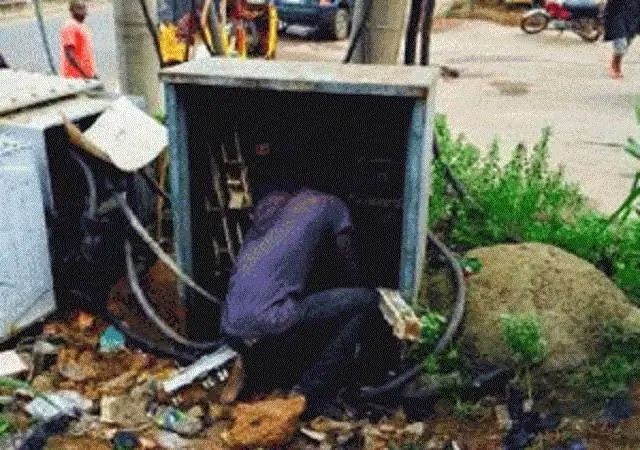
‘E no go beta for vandals and meter bypassers,’ – BEDC rains curses, sparks public debate over service failures
The Benin Electricity Distribution Company (BEDC) has taken an unconventional approach to addressing the issues of transformer vandalism and meter bypassing, publicly cursing offenders in a post shared on its official X (formerly Twitter) account. The message, written in Pidgin English, reads: “E no go beta for who dey vandalize transformer and who dey bypass.” The post, shared on Thursday morning, has sparked widespread reactions online, with many Nigerians expressing surprise at the tone used by the electricity provider. While some supported BEDC’s frustration over the challenges posed by vandals and bypassers, others criticized the company for what they described as an unprofessional response. Several users on X highlighted longstanding grievances with BEDC’s operations, including poor service delivery, exorbitant costs of prepaid meters, and community-funded transformer repairs. One user commented, “Transformers una no dey buy; na community dey contribute money to take buy am. Una go still bill dem after installation.” Others pointed out that BEDC’s inability to provide consistent electricity supply contributes to the vandalism problem. “If una dey give light steady, nobody go near high voltage transformer to vandalize am,” another user remarked. BEDC is responsible for electricity distribution in Delta, Edo, Ekiti, and Ondo states. However, residents in these areas have frequently accused the company of neglecting its responsibilities. Protests against prolonged power outages have become common in recent years. In April 2024, over 20,000 Edo residents petitioned the House of Representatives over a nine-month blackout in their communities. Similarly, Ondo residents staged demonstrations last July over BEDC’s failure to restore power after years of darkness. In response to widespread electricity theft and tampering across Nigeria, the Nigerian Electricity Regulatory Commission (NERC) issued new penalties earlier this year. The regulations impose fines ranging from N100,000 for first-time offenders with single-phase meters to 600% of a customer’s last bill for repeat offenses involving maximum demand users. NERC aims to curb illegal connections and ensure fair metering practices across the country. BEDC’s social media post may have been intended as a deterrent against vandalism and meter bypassing, it has instead reignited public frustrations over the company’s performance. Many Nigerians are calling for improved service delivery rather than emotional outbursts from a critical utility provider.