
MTN Nigeria has announced the rebranding of its fibre broadband service, previously known as MTN Fibre Broadband, to FibreX. The move is part of MTN’s broader push to deliver faster, more reliable, and accessible internet to Nigerians, aligning with the country’s National Broadband Plan to achieve 70% broadband penetration by 2025. According to Egerton Idehen, MTN Nigeria’s Chief Broadband Officer, the new FibreX brand is designed to be more modern and relatable, aiming to connect with customers on a personal level. “The launch of FibreX reiterates our dedication to supporting Nigeria’s digital transformation journey. By enhancing our infrastructure and services, we aim to bridge the digital divide and foster inclusive growth,” Idehen said. FibreX will continue to use MTN’s robust Fibre to the Home (FTTH) infrastructure, offering ultra-fast internet speeds, at least 25 Mbps in cities and 10 Mbps in rural areas. The company also plans to support the federal government’s initiative to expand Nigeria’s fibre-optic network from 35,000 km to 125,000 km, ensuring more homes and businesses can access high-speed connectivity. The rebrand is not just cosmetic. MTN wants to educate and excite users in “home-passed locations”, areas where homes are eligible for FTTH connections, about the benefits of FibreX. The new identity reflects MTN’s commitment to digital inclusion and a better customer experience for all Nigerians.

Nigeria launches initiative to expand digital services across Africa
The Nigerian government has unveiled an initiative aimed at enabling local digital service providers to expand their operations across Africa. Announced by Dr. Jumoke Oduwole, Minister of Industry, Trade, and Investment, the program seeks to simplify market entry for Nigerian tech companies and position Nigeria as a leader in the continent’s digital economy. The initiative will create a comprehensive database of Nigerian digital businesses, detailing their expansion plans and challenges. This data will guide trade negotiations with specific African countries, ensuring smoother access for Nigerian companies. The program also aims to establish a clear framework for digital services, addressing regulatory confusion often faced by businesses entering foreign markets. Digital services are crucial in modern trade but often lack standardized regulations compared to physical goods. By pioneering a straightforward framework, Nigeria hopes to unlock new markets and strengthen its leadership in Africa’s tech ecosystem. Companies like Flutterwave, Paystack, and Interswitch have already expanded across Africa but have faced licensing hurdles, highlighting the need for such an initiative. This effort aligns with Nigeria’s broader digital transformation goals under the African Continental Free Trade Area (AfCFTA). With ICT contributing 20% to Nigeria’s GDP in 2024, the country is leveraging its robust tech sector to diversify its economy away from oil dependency. Investments in broadband infrastructure and digital skills training further support this vision. By championing digital trade services, Nigeria is not only empowering its businesses but also shaping the future of Africa’s digital economy.
NCC proposes 12-month window for subscribers to reclaim unused airtime
The Nigerian Communications Commission (NCC) has proposed a 12-month grace period for subscribers to reclaim unused prepaid credits on inactive lines. This initiative aims to address long-standing concerns about unclaimed and unutilized recharge balances. During a recent stakeholder engagement forum, Dr. Aminu Maida, Executive Vice-Chairman of NCC, emphasized the need for a balanced approach between safeguarding consumer rights and ensuring industry sustainability. The proposed guidelines allow subscribers to reclaim their unused credits within a year, provided they can verify ownership of the line. Operators are barred from monetizing unclaimed airtime and must instead offer service-based alternatives such as data or voice bundles. The NCC has given telecommunications operators a 90-day compliance window to implement these new guidelines, with penalties for non-compliance.
MTN challenges Netflix with new streaming service tailored for African audiences
MTN Group, Africa’s largest mobile network operator, has announced plans to launch a new streaming platform tailored for mobile and broadband users across the continent. The move is part of MTN’s strategy to accelerate Africa’s digital economy and compete with established players like Netflix, Amazon Prime Video, and Showmax. The platform will be developed in collaboration with Synamedia, a UK-based video software provider. Leveraging Synamedia’s advanced cloud-based technologies, the service will offer live TV and video-on-demand content. It will feature diverse monetization models, including subscriptions, ad-supported content, and free streaming channels with targeted advertising. MTN aims to deliver culturally relevant content by curating offerings based on local languages, viewing habits, and preferences. This approach seeks to enhance audience engagement and accessibility across its footprint in 16 African markets. Selorm Adadevoh, MTN’s Group Chief Commercial Officer, emphasized the platform’s potential to transform video consumption in Africa. “We see a unique opportunity to provide high-quality, accessible content while driving digital inclusion,” he said. The initiative places MTN in direct competition with global platforms like Netflix and Disney+, as well as regional services such as Showmax. By capitalizing on Africa’s growing smartphone adoption and improving connectivity infrastructure, MTN hopes to establish itself as a key player in the continent’s streaming space.
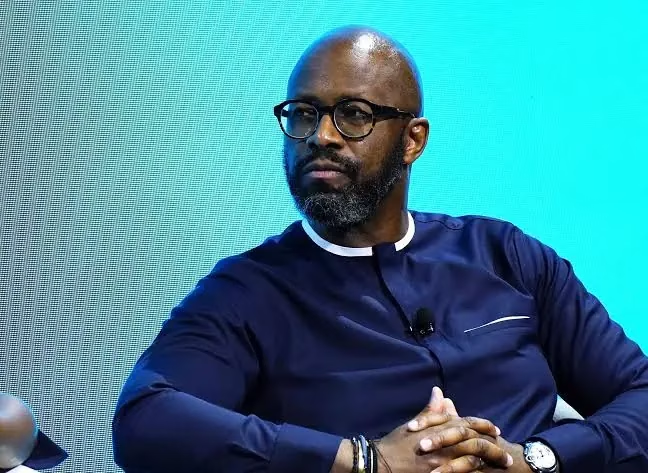
MTN group CEO Ralph Mupita appointed deputy chair of GSMA board
Ralph Mupita, President and CEO of MTN Group, has been elected as the Deputy Chair of the GSMA Board of Directors. His appointment is effective immediately and will extend until the end of 2026. In this role, Mupita will assist the GSMA Chair in steering the strategic direction of the global organization, which represents mobile operators and companies within the broader mobile ecosystem. Expressing his gratitude, Mupita stated, “This appointment is a great honor, especially during a time of rapid technological advancements and increasing digital adoption across Africa. Mobile technology will play a pivotal role in addressing critical challenges and unlocking the full potential of Africa and the Global South.” Vivek Badrinath, Director General of GSMA, praised Mupita’s extensive experience, noting it would be invaluable in navigating the dynamic telecommunications landscape. “I look forward to working closely with him and the Board,” Badrinath added. Mupita has led MTN Group since September 2020, previously serving as its Chief Financial Officer. Under his leadership, MTN subsidiaries in Ghana, Nigeria, Rwanda, and Uganda were successfully listed. Before joining MTN, he was CEO of Old Mutual Emerging Markets, overseeing operations across 19 countries in Africa, Latin America, and Asia. With a BSc. Engineering (Hons) and MBA from the University of Cape Town, along with advanced management training at Harvard Business School, Mupita brings a wealth of expertise to his new role at GSMA.
Nigerian telecom operators unite to protect infrastructure amid rising vandalism
Telecom operators in Nigeria have launched an Industry Working Group to safeguard critical telecommunications infrastructure across the country. This move comes in response to escalating cases of fiber cuts, equipment theft, and vandalism, which have significantly disrupted services and increased operational costs. The Working Group was established during a high-level meeting hosted by IHS Nigeria in Lagos, bringing together industry leaders, regulators, and law enforcement agencies under the Association of Licensed Telecom Operators of Nigeria (ALTON). Recognizing telecom infrastructure as vital for national security, economic growth, and social cohesion, stakeholders emphasized the urgency of collaborative solutions to address these challenges. Key Objectives of the Working Group:Real-time Monitoring: Leveraging advanced technology to monitor and protect telecom sites. Enhanced Security: Strengthening physical security measures around installations. Collaboration: Partnering with regulatory and security agencies to tackle vandalism and theft. Public Awareness Campaigns: Educating communities on the importance of safeguarding telecom assets. Dapo Otunla, Senior Vice President at IHS Nigeria, highlighted the daily losses faced by operators due to vandalism, stressing that protecting Critical National Information Infrastructure (CNII) is essential for sustaining Nigeria’s digital ecosystem. This initiative aligns with the government’s CNII policy. In August 2024, President Bola Tinubu signed an order designating telecom infrastructure as critical national assets and criminalizing their destruction. However, previous efforts to enforce similar protections have struggled to curb widespread vandalism.