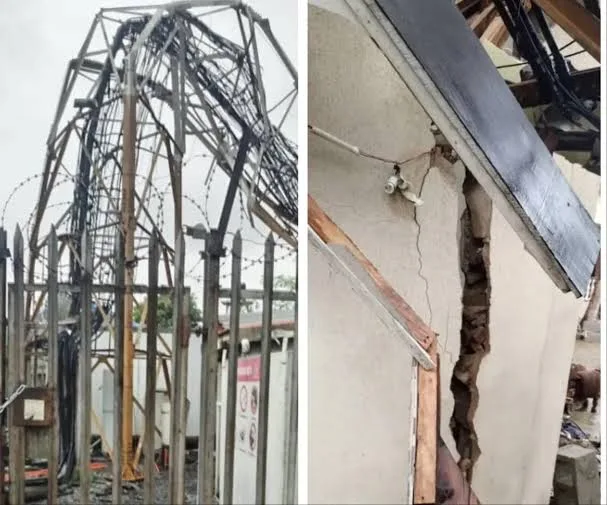
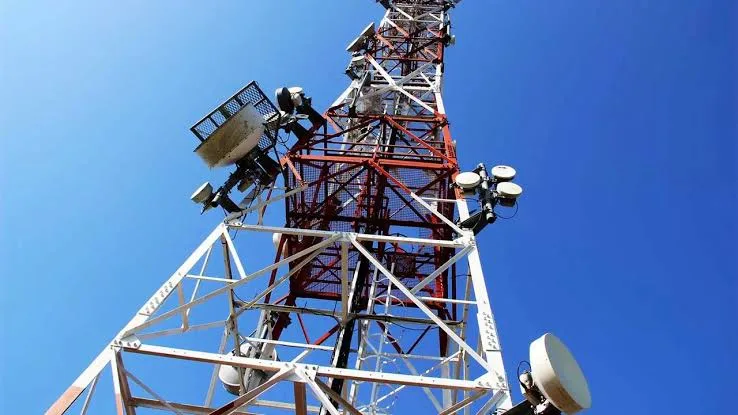
A landlord in Unity Estate, Alagbole-Akute, Ogun State, narrowly escaped serious injury on Tuesday after a telecommunication mast crashed onto his building during a heavy rainstorm. The incident occurred around 2:39 p.m., when severe weather caused a mast belonging to IHS Company, located in Ajuwon, Akute, to collapse. The structure fell directly onto the residential property, damaging several sections of the house. Despite being inside at the time, the landlord suffered only minor injuries and is now in stable condition after receiving prompt medical attention. Ogun State Police Command spokesperson, CSP Omolola Odutola, confirmed the incident in a statement released Wednesday. “According to an eyewitness account, a communication mast belonging to IHS Company collapsed due to the severe weather conditions. The mast fell on a residential building in Unity Estate, Alagbole. Fortunately, the landlord, who was inside the house at the time of the incident, survived with minor bruises. He was promptly attended to by medical personnel and is confirmed to be in stable condition,” Odutola stated. Following the event, the state’s Commissioner of Police, Lanre Ogunlowo, directed area commanders to engage with companies owning masts near residential areas. The goal is to assess the structural integrity of these installations and ensure the safety of residents. The police have also launched a preliminary investigation and promised to keep the public informed of any developments. Residents are urged to remain vigilant, especially during adverse weather, and to report any structures that appear unstable. The police command emphasized its commitment to public safety and called for cooperation from both telecom companies and the community. No fatalities were reported, but the incident has raised concerns about the safety of masts located close to homes, particularly during Nigeria’s rainy season.
NCC implements new USSD billing model – charges shift from bank accounts to mobile airtime starting June 3, 2025
Effective June 3, 2025, the Nigerian Communications Commission (NCC) has mandated an important change in the billing process for USSD banking transactions across Nigeria. Charges for USSD services will no longer be deducted directly from customers’ bank accounts again but will instead be debited from their mobile airtime balances, marking the official start of the End-User Billing (EUB) model with the aim of resolving a long-standing dispute between banks and telecom operators. The directive follows years of unresolved disagreements between Deposit Money Banks (DMBs) and Mobile Network Operators (MNOs) over the payment for USSD services used in banking transactions. Telecom companies had accused banks of deducting USSD fees from customers but failing to remit payments, leading to a debt estimated at over N250 billion. The Central Bank of Nigeria (CBN) and NCC jointly intervened, issuing directives to settle outstanding debts and streamline billing processes. Under the new EUB framework, customers will be charged ₦6.98 for every 120 seconds of USSD session time, with airtime deductions made only after user consent is obtained at the start of each session. This change ensures transparency and gives users control over their USSD transactions. Banks like United Bank for Africa (UBA) have already informed customers about the transition and reassured them of the availability of alternative digital banking channels such as mobile apps and internet banking. The NCC and CBN’s joint circular also introduced the “10-second rule,” stipulating that USSD sessions lasting less than ten seconds will not be billable, a measure designed to prevent unfair charges and enhance consumer trust. Furthermore, banks and telecom operators have been instructed to discontinue all ongoing litigation related to the USSD debt dispute and to comply fully with payment schedules set by regulators, with sanctions threatened for non-compliance. Gbenga Adebayo, Chairman of the Association of Licensed Telecommunications Operators of Nigeria (ALTON), outlined the significance of this move, noting that the dispute has persisted since 2019 and that the adoption of the EUB model represents a critical step toward resolving billing conflicts and ensuring sector stability. The USSD billing conflict has affected millions of Nigerians relying on mobile banking, with telecom operators threatening to disconnect banks from USSD services due to unpaid fees. The NCC and CBN’s coordinated approach seeks to balance the interests of telecom operators, banks, and consumers while safeguarding uninterrupted access to essential financial services. The transition to EUB is contingent on banks settling a significant portion of outstanding debts by set deadlines, with 85% of post-API invoices due by the end of 2024 and 60% of pre-API invoices required as full settlement. As the new USSD billing process takes effect, consumers are advised to monitor their airtime balances and consent to charges consciously. The NCC and CBN have pledged ongoing public enlightenment efforts to support a smooth transition. Meanwhile, Daily Tech Nigeria recently reported that NCC orders telecom operators to notify consumers ahead of service disruptions.
ARCON launches probe into 9mobile over alleged ₦1 billion advertising debt
The Advertising Regulatory Council of Nigeria (ARCON) has initiated a comprehensive investigation into 9mobile, one of Nigeria’s major telecommunications providers, over an alleged ₦1 billion debt owed to advertising agencies and third-party vendors. In a statement released on May 30, 2025, ARCON disclosed that it received two formal petitions accusing 9mobile, officially registered as Emerging Markets Telecommunications Services Limited, of failing to settle longstanding advertising bills. The council noted that despite these unresolved debts, 9mobile has continued to engage new advertising agencies, leaving those owed “in limbo”. ARCON’s Director-General emphasized that the council will scrutinize the movement of 9mobile’s advertising accounts from the agencies owed to new ones, with a focus on whether proper disengagement protocols and ethical standards were followed. The council warned that such practices not only disadvantage the affected agencies but also have a ripple effect on media houses and suppliers, potentially disrupting cash flow and operations across the wider advertising ecosystem. “ARCON will work with relevant anti-graft and other government agencies to ensure a detailed investigation is conducted and the debt resolved or paid. This is economic sabotage capable of inhibiting the Federal Government’s policy of inclusive industry growth and development of the Nigerian advertising industry,” the statement read. ARCON reiterated that the payment threshold for advertising services in Nigeria remains 45 days, and warned it will take all necessary steps to eliminate unfair practices, unethical competition, and protect intellectual property rights within the industry. The company has faced years of service disruptions and a dramatic decline in its customer base, dropping from over 22 million subscribers at its peak in 2016 to just 3.2 million as of January 2025, according to the Nigerian Communications Commission (NCC). In July 2024, 9mobile was acquired by LH Telecommunication Limited, which injected fresh capital and installed a new board in a bid to revive the company. However, customers are still waiting for noticeable improvements in service quality. The council has pledged to collaborate with anti-corruption agencies to ensure that outstanding debts are paid and industry standards upheld.
9mobile set to launch national roaming on MTN Network in June 2025, following NCC approval
9mobile has received official approval from the Nigerian Communications Commission (NCC) to commence national roaming services using MTN Nigeria’s infrastructure starting June 2025. This development comes after nearly five years of regulatory delays and is poised to significantly enhance 9mobile’s network coverage and service reliability across Nigeria. The national roaming initiative allows 9mobile subscribers to access MTN’s expansive network in areas where 9mobile’s own infrastructure is limited or absent. This means users will be able to make calls, send SMS, and use mobile data seamlessly by connecting to MTN’s network, thereby addressing the chronic service disruptions that have contributed to 9mobile’s decline in market share – from 6.6% in 2020 to just 1.72% in April 2025. The agreement between 9mobile and MTN, originally established in August 2020, includes spectrum sharing in the 900 MHz, 1800 MHz, and 2100 MHz bands. This spectrum access is expected to benefit MTN by improving its network capacity and reducing congestion, especially in urban areas, while helping 9mobile avoid the high costs of building out nationwide infrastructure. Industry experts see this as a strategic move that could help 9mobile regain competitive ground in Nigeria’s telecom market, particularly as rival operator Globacom experiences subscriber losses. “The number three spot is still very much in play,” noted a telecom executive, emphasizing that 9mobile’s success will depend on how well it markets its enhanced services. The NCC’s endorsement of this national roaming deal aligns with its broader policy to encourage infrastructure sharing and optimize spectrum use to reduce operational costs and improve service quality across the sector. National roaming is increasingly recognized as a practical solution to expand network reach and improve connectivity in underserved areas without duplicating expensive infrastructure. As 9mobile prepares for the rollout, the telecom industry will be closely watching to see if this partnership can deliver better network experiences for millions of Nigerian users and potentially serve as a model for future collaborations among operators. Neither MTN nor 9mobile has publicly commented on the launch as of now, and the NCC has not issued a statement beyond the approval notice.
NCC order telecom operators to notify consumers of service disruptions
The Nigerian Communications Commission (NCC) has issued a new directive requiring telecom operators to inform consumers about major service disruptions, marking a step toward greater transparency and accountability in Nigeria’s telecommunications sector. The announcement, made on Sunday by Nnenna Ukoha, the acting head of Public Affairs at the NCC, stipulates that operators must disclose the cause of the outage, affected areas, and estimated resolution times via media channels. In cases of planned service disruptions, consumers must be notified at least one week in advance. Telecom service outages have become a persistent issue in Nigeria, disrupting daily life and business operations. Common causes include infrastructure deficiencies, fibre optic cable damage, overloaded networks, and environmental factors. The NCC’s directive aims to enhance customer experience and facilitate quicker resolution of such outages. Further reinforcing consumer rights, the directive requires mobile network operators and internet service providers to compensate affected users when an outage lasts more than 24 hours. Compensation may include validity extensions or other measures in line with consumer protection regulations. The NCC has also launched a Major Outage Reporting Portal, enabling public access to real-time outage information while identifying entities responsible for network disruptions. Edoyemi Ogor, the Director of Technical Standards and Network Integrity at NCC, emphasised that this initiative aligns with President Bola Ahmed Tinubu’s Executive Order designating telecommunications infrastructure as Critical National Information Infrastructure (CNII). “This step ensures accountability and safeguards vital telecom assets that are central to Nigeria’s economy and security,” Ogor stated. The NCC’s latest mandate underscores its commitment to improving service reliability while keeping consumers informed and empowered.
Nigeria’s telecom networks hit by record outages in May 2025
Nigeria’s telecommunications sector experienced an unprecedented surge in network outages in May 2025, with 9mobile and MTN Nigeria bearing the brunt of service disruptions caused primarily by fibre cuts and power failures. From January 1 to May 19, 9mobile reported 31 major outages across several states, while MTN Nigeria recorded 25 incidents, according to data from Uptime, a network monitoring platform. Approximately 70% of these outages were linked to fibre cuts resulting from roadworks or vandalism, severely affecting millions of subscribers nationwide. These outages led to complete shutdowns of critical services such as voice calls, SMS, mobile data, and USSD for hours at a time. Notably, 9mobile suffered the longest service restoration times, including an eight-hour power outage in Lagos on May 14 that impacted multiple local government areas. MTN Nigeria, despite a high number of outages, generally restored services faster. The company is investing heavily in infrastructure improvements, pledging ₦800 billion for network upgrades in 2025, with ₦200 billion already spent in the first quarter. Part of this effort includes deploying motorcycles to help engineers navigate urban traffic and conduct daily fibre inspections to detect issues early. However, MTN also faced regulatory challenges. In April, the Kogi State government sealed 16 MTN sites, disrupting access to 155 additional connected sites. The standoff lasted nearly 23 days before resolution in early May. 9mobile’s performance remains a concern as its subscriber base dwindled to 2.96 million in March 2025 from over 20 million in 2015. Frequent and prolonged outages continue to damage customer trust and hinder recovery efforts. The rising frequency and duration of outages highlight Nigeria’s infrastructure gaps, power instability, and regulatory hurdles. As connectivity becomes vital for banking, education, and emergency services, the reliability of telecom networks is crucial for the country’s digital economy. Ugonwa Nwoye, MTN Nigeria’s Chief Customer and Experience Officer, said the investments aim to “translate this into better customer experience, reduced congestion, faster internet speeds, and wider network reach.” With over 140 million Nigerians relying on mobile networks, the pressure is on operators and regulators to strengthen infrastructure and ensure more resilient service delivery.