
The Federal Executive Council (FEC) has approved the construction of 7,000 new telecom towers across rural Nigeria in a bold move to bridge the country’s connectivity gap. This announcement was made by Bosun Tijani, Minister of Communications, Innovation, and Digital Economy, following a meeting with President Bola Tinubu at the Presidential Villa in Abuja on Thursday. The approval comes alongside significant private sector support, with Airtel pledging $500 million to bolster Nigeria’s telecom infrastructure. Sunil Bharti Mittal, Founder and Chairman of Airtel, revealed the investment plans during the meeting. The funds will be directed toward expanding radio networks, building a new data center, and acquiring additional spectrum to enhance urban and suburban connectivity. The initiative aims to address Nigeria’s persistent connectivity challenges, particularly in underserved rural areas. Minister Tijani emphasized that the government is committed to ensuring that Nigerians not only have access to telecom services but also enjoy high-quality connectivity. “We want Nigerians to have meaningful access, not just service,” Tijani said. He also highlighted the Nigerian Communications Commission’s shift toward prioritizing “quality of experience” metrics for telecom users. In addition to the towers, the government is deploying 90,000 kilometers of fiber-optic cables nationwide to further expand coverage. Tijani described this as a collaborative effort requiring strong public-private partnerships. The announcement comes amid a recent 50% hike in telecom tariffs, which has stirred mixed reactions among consumers grappling with inflation and rising costs. Defending the decision, Tijani explained that the increase was necessary to sustain the telecom industry and prevent job losses. “If we refused the increase, we risked losing jobs. It was a tough but necessary call,” he said, citing a KPMG study that found the adjustment essential for balancing operator viability with consumer affordability. Mittal echoed these sentiments, attributing rising operational costs to inflation, currency devaluation, and increased expenses for diesel, electricity, and imported equipment. Despite these challenges, he reaffirmed Airtel’s commitment to Nigeria as a key market. “Nigeria is the heart of our African strategy,” Mittal said. “We’ve invested $200 million last year and plan another $200 million by year-end.” Airtel’s planned $500 million investment includes $250 million for radio network expansion and $140 million for a new data center. The company also announced scholarships for 10 Nigerian students annually to pursue engineering degrees in India as part of its broader social impact initiatives. This aligns with President Tinubu’s “3 Million Technical Talent” program aimed at developing skilled professionals for Nigeria’s digital economy. Mittal praised recent economic reforms by President Tinubu’s administration, such as subsidy cuts and foreign exchange unification, as steps that encourage foreign investment. He expressed optimism about Nigeria’s potential for digital innovation and financial inclusion. The combination of government-led infrastructure projects and Airtel’s substantial investment signals a major push to modernize Nigeria’s telecom sector. While these efforts promise improved connectivity and digital transformation, their success will depend on effective execution and public acceptance of higher costs in exchange for better service.
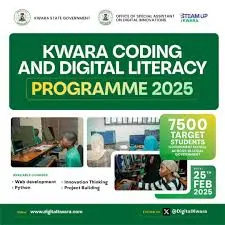
Kwara state embarks on ambitious digital literacy drive
The Kwara State Government has launched a comprehensive coding and digital literacy training program, to equip its youth with essential digital skills. This initiative, which targets at least 50 public primary and junior secondary schools across the state, aims to impact over 150 students per school in its pilot phase. The program, organized by the Office of the Special Assistant to the Governor on Digital and Innovation, Mr. Ishola Kayode, is part of a broader strategy to strengthen the education sector and prepare Kwara’s children for global competitiveness. As Governor Abdulrahman Abdulrazaq’s administration emphasizes embracing the digital revolution, this initiative seeks to lay the foundation for a digital society. Selected schools include Bishop’s Smith Junior Secondary School, Ilorin Grammar School, and Sheikh Alimi L.G.E.A Primary School. The program will undergo a data-driven assessment to guide its expansion in subsequent phases. By equipping students with digital literacy, Kwara State aims to empower them to solve community problems using technology. Mrs. Akanbi Janet Ayoola, Principal of Bishop Smith College, praised the initiative as a significant step in preparing students for the era of technology and artificial intelligence. Students like Opadili Boluwatife and Akinola Abdulrahman have expressed their appreciation and commitment to making the most of this opportunity. Adopting a forward-thinking approach to education, Kwara State’s digital literacy initiative marks a significant step towards creating a more technologically adept and globally competitive generation

NAICOM calls on insurers to introduce cyber insurance amid growing digital risks
The National Insurance Commission (NAICOM) has urged insurance companies to develop and roll out cyber insurance products. This call to action comes at a time when digital transactions are becoming increasingly prevalent in the country, with e-payments reaching unprecedented levels. During a recent Insurers’ Committee Meeting in Lagos, NAICOM emphasized the need for insurers to adapt to the changing digital landscape. Mrs. Ebelechukwu Nwachukwu, Head of the Communication and Stakeholders Management Sub-committee, highlighted the importance of compliance with Nigeria’s Data Protection Regulations. She noted that insurance practitioners are being encouraged to undergo training on data protection measures to better equip them for this new frontier. NAICOM is working closely with the National Information Technology Development Agency (NITDA) and the Nigeria Data Protection Commission to advance this initiative. The collaboration aims to enhance Nigeria’s digital infrastructure and promote awareness about the importance of cyber insurance. Cyber insurance policies will provide crucial financial protection against losses resulting from cyberattacks, covering costs associated with investigations, crisis communication, and legal services. This move is part of a broader effort to align Nigeria’s digital economy with global standards, ensuring that businesses and individuals are better equipped to navigate the risks associated with digital transactions. In addition to the push for cyber insurance, NAICOM is also focusing on sanitizing the insurance sector. The commission has directed insurance companies to settle all resolved claims promptly, aiming to reduce complaints from policyholders and promote accountability among insurers. This initiative is designed to boost confidence in the insurance industry and improve overall customer satisfaction. Furthermore, NAICOM is addressing risks in the aviation sector by enhancing insurance coverage and emphasizing the need for better security measures. The commission is also urging support for enforcing third-party motor insurance and collaborating on its innovation lab.

Nigerian edtech startup Edukoya shuts down after three years, plans to refund investors
Nigerian education technology startup, Edukoya, has officially closed its doors after three years of operation. The company, which aimed to revolutionize online learning for African students, cited a combination of market challenges and economic pressures as the reasons behind its decision to wind down. In a statement shared with stakeholders, Edukoya explained that it faced significant hurdles in scaling its synchronous learning model. These challenges included limited internet connectivity, restricted access to devices, and broader macroeconomic headwinds that made it difficult to sustain operations. Founded in 2021 by Honey Ogundeyi, Edukoya quickly gained attention for its ambitious mission to make high-quality educational content more accessible and affordable for African students. The platform offered real-time online learning through a digital curriculum and on-demand teachers. During its debut week, the Edukoya app became the second most downloaded education app in Nigeria, signaling strong initial interest. The startup also achieved notable milestones, including serving over 80,000 students, hosting thousands of live classes daily, and facilitating over 15 million answered questions on its platform. However, despite these successes, the company struggled to scale in a market it described as not yet ready for its innovative approach. Edukoya’s closure comes as a surprise given its impressive start. In 2021, the company raised $3.5 million in pre-seed funding, the largest pre-seed round for an African edtech at the time. The funding round was led by Target Global and included prominent angel investors such as Shola Akinlade (CEO of Paystack), Babs Ogundeyi and Musty Mustapha (founders of Kuda), and Brandon Krieg and Ed Robinson (founders of Stash). Despite these resources, Edukoya ultimately decided that continuing operations would deplete resources without achieving meaningful scale. Instead, the company has opted to return funds to its investors, a rare move in the startup world but one that has been praised for demonstrating integrity. One investor commended founder Honey Ogundeyi’s decision, noting that it reflects her ability to recognize when market conditions make large-scale success unviable. The sector holds immense potential, with projections suggesting it could reach $57 billion by 2030 as internet connectivity and digital infrastructure improve across the continent. Analysts believe that Edukoya’s experience offers valuable lessons for future innovators navigating the intersection of technology, market readiness, and economic realities in Africa.

UK updates visa processing times for 2025: what applicants need to know
The UK Visas and Immigration (UKVI) department has announced updated visa processing times for 2025, offering clearer timelines to help applicants better plan their travel and visa applications. These updates apply to various visa categories, including visit, study, work, and family visas, providing essential guidance for those applying from outside the UK. Updated Processing Times by Visa CategoryVisit Visas: Standard Visitor, Marriage Visitor, Chinese Tour Group, and Transit visas: 3 weeks. Study Visas: Student, Child Student, and Short-term English Language visas: 3 weeks. Work Visas: Skilled Worker, Health and Care Worker, Temporary Worker, and Work Visas without a job offer: 3 weeks. Family Visas: Partner, Parent, Child, and Adult Dependent visas: 12 weeks. Other Specific Visas: British National (Overseas) visas: Up to 12 weeks. Specialized visas like International Sportsperson or Minister of Religion: 3 weeks. Applicants who need faster decisions can opt for priority or super-priority services at an additional cost. These services significantly reduce wait times but are not available for all visa categories. Key Considerations for ApplicantsDo Not Book Travel in Advance: Applicants are advised to wait for their visa decision before booking flights or making travel arrangements. Non-Refundable Fees: Visa application fees are non-refundable once processing begins. Refunds are only possible if no processing has occurred. Accurate Documentation is Crucial: Delays may occur if applications are incomplete, inaccurate, or require additional documentation or interviews. Factors That Can Cause DelaysProcessing times may be extended due to: Missing or incorrect information in the application. High application volumes. Technical issues affecting UKVI systems. The need for further verification of documents or interviews. Visa processing begins once applicants verify their identity and submit required documents. This can be done via the UK Immigration: ID Check app (if eligible) or by attending a Visa Application Centre (VAC) to provide biometric information. The standard processing time for most visa categories remains at 3 weeks, though family visas and some specialized categories may take up to 12 weeks. Applicants are encouraged to ensure their applications are complete and accurate to avoid unnecessary delays. For those requiring urgent decisions, priority services remain an option where available.

Nigeria’s ICT sector boosts GDP with 17% contribution in Q4 2024, growth slows year-on-year
The Information and Communication Technology (ICT) sector continues to play a vital role in Nigeria’s economy, contributing 17% to the country’s real Gross Domestic Product (GDP) in the fourth quarter of 2024. This marks an improvement from the 16.66% recorded during the same period in 2023 and 16.35% in Q3 2024, according to new data from the National Bureau of Statistics (NBS). Despite this solid performance, the sector experienced a slowdown in growth compared to previous years. In nominal terms, ICT grew by 11.57% year-on-year in Q4 2024, a sharp decline from the remarkable 39.57% growth recorded in Q4 2023. For the full year, ICT contributed 12.48% to nominal GDP, slightly down from 12.95% in 2023. In real terms, the sector grew by 5.90% year-on-year in Q4 2024, a modest drop from the 6.32% growth seen in Q4 2023. However, quarter-on-quarter growth was stronger at 16.81%. Overall, the ICT sector’s real GDP growth for 2024 stood at 5.42%, lower than the impressive 7.91% recorded in 2023. The telecom sub-sector remains the backbone of ICT growth in Nigeria, contributing a significant 14.40% to GDP in Q4 2024. Telecommunications also emerged as the third-largest contributor to Nigeria’s real GDP during this period, trailing only crop production (23.42%) and trade (15.1%). The industry is dominated by major players such as MTN, Globacom, Airtel, and 9mobile, alongside numerous Internet Service Providers (ISPs). While the ICT sector continues to drive economic activity across various industries, challenges persist. The Nigerian Communications Commission (NCC) has expressed its commitment to boosting the telecom sector’s contribution to GDP from its current level of around 14% to an ambitious target of 25%. According to Dr. Aminu Maida, Executive Vice Chairman of the NCC, achieving this goal will require addressing existing hurdles through strategic policies and investments. The ICT sector remains a cornerstone of Nigeria’s economic diversification efforts, with its steady contributions underscoring its potential for further growth despite current challenges.