
Gmail is set to replace SMS-based authentication with a QR code system. This change is part of Google’s broader strategy to enhance user safety by moving away from traditional two-factor authentication methods that have proven vulnerable to phishing and fraud. For years, Gmail has relied on SMS codes to verify user identities and prevent abuse. However, this method has been exploited by cybercriminals, who can intercept or manipulate these codes, especially if they can trick mobile carriers into transferring phone numbers. The rise of scams like traffic pumping, where fraudsters generate revenue by triggering mass authentication messages, has further highlighted the need for more secure alternatives. Gmail’s new QR code system aims to reduce these risks by eliminating the need for users to receive and enter security codes. Instead, users will see a QR code on their screen during authentication, which they can scan using their phone’s camera. This approach not only reduces the risk of phishing but also removes the reliance on mobile carriers for security. While Google has not announced a specific rollout date, users can expect to stop receiving six-digit SMS verification codes in the coming months. The shift aligns with the industry’s move towards more secure authentication methods, such as passkeys, which offer a biometric approach to logging in. As technology evolves, so do the threats to our digital security. Gmail’s transition to QR codes is a step forward in protecting users from increasingly sophisticated cyber threats. With this change, Gmail users can look forward to a safer and more secure experience online.

NIGCOMSAT empowers North-East youths with space-tech hackathon
The Nigerian Communications Satellite (NIGCOMSAT) Limited has launched a regional Space-Tech Hackathon in the North-East region. The event, themed “Building Grassroots Innovation in Satellite Technology,” is being held from February 24 to 28 in Yola, Adamawa State. This empowering program is designed to engage and empower university students, local innovators, and young professionals from six states in the region, including Borno, Taraba, Bauchi, Gombe, Yobe, and Adamawa. Participants will undergo comprehensive training in Very Small Aperture Terminal (V-SAT) technology and work on identifying community challenges that can be addressed using space technology, leveraging NIGCOMSAT’s communication satellites and the National Space Research and Development Agency’s (NASRDA) satellites. The hackathon is co-hosted by the Adamawa State Government in collaboration with NIGCOMSAT Ltd. Winning teams will transition into the NIGCOMSAT Accelerator Programme 2025, where they will refine their solutions and receive mentorship to bring their products to market. This initiative aims to drive sectoral growth, promote satellite technology awareness, and create economic and social impact by equipping young Nigerians with skills to address community challenges and reduce youth unemployment
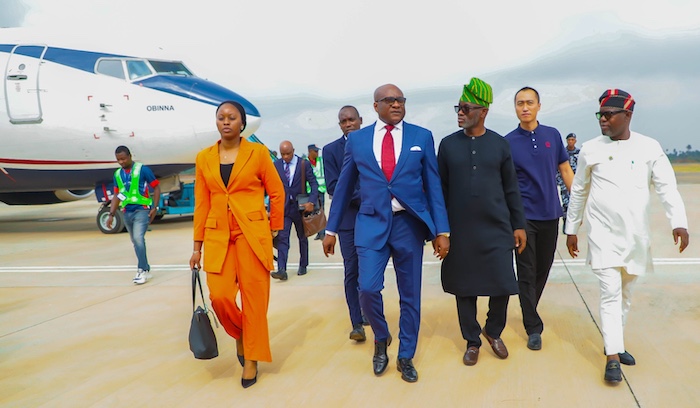
Ekiti Airport recognized as world-class facility by Air Peace CEO Allen Onyema
The Chief Executive Officer of Air Peace, Dr. Allen Onyema, has described the Ekiti State Agro-Allied International Cargo Airport as a world-class facility capable of handling large aircraft, including the Boeing 777. Onyema made the remarks on Saturday after arriving at the airport aboard a Boeing 737, marking the first time such an aircraft had landed at the new facility. Speaking to journalists after his arrival, Onyema commended the airport’s infrastructure, including its runway, apron, and terminal, which he described as “highly functional” and “aesthetically pleasing.” According to him, the airport is not only ready for domestic operations but also equipped to handle international flights. “This is one of the best airports in the world,” Onyema stated. “The pilot was communicating with me during the landing and confirmed that this is one of the best runways he has ever seen. A Boeing 777 can land here without any issues. I am confident that in no time, Ekiti pilgrims and other travelers will start flying from here.” Onyema highlighted the facility’s potential to serve as a hub for major aviation activities in Nigeria, emphasizing its importance for economic and social development in Ekiti State and beyond. The successful landing of the Boeing 737 was hailed as a significant milestone by AVM Sunday Makinde (rtd), Technical Adviser to the Governor on Airport Projects. Makinde noted that the event demonstrated the airport’s capability to handle large aircraft seamlessly. “This airport is not just operational; it is built to global standards,” Makinde said. “The infrastructure here is solid and ready to support both cargo and passenger flights.” Rt. Hon. Taiwo Olatunbosun, Commissioner for Information, described the project as transformative, underscoring its potential to boost economic growth through improved connectivity and agricultural exports. He credited Governor Biodun Oyebanji’s administration for prioritizing infrastructure development aimed at positioning Ekiti as an economic hub. The Ekiti Agro-Allied International Cargo Airport is expected to play a key role in facilitating trade and tourism while enhancing access to global markets for agricultural products from the region.
Starlink becomes Nigeria’s second-largest ISP, displacing FiberOne
Elon Musk’s Starlink has achieved a significant milestone in Nigeria, emerging as the country’s second-largest Internet Service Provider (ISP) by subscriber count as of Q3 2024. According to data from the Nigerian Communications Commission (NCC), Starlink now boasts 65,564 active customers, surpassing FiberOne, which fell to third place with 33,010 subscribers. This growth is remarkable for a service that launched in January 2023. Starlink added 41,667 new users in the first nine months of 2024, a sharp increase from its December 2023 total of 23,897 subscribers. Spectranet remains the market leader with 105,441 active users but has seen a decline from its previous total of 113,869 at the end of 2023. Starlink’s satellite-based internet service is particularly appealing in areas where traditional ISPs struggle to provide reliable connectivity. Its ability to deliver high-speed internet even in remote regions has made it a popular choice despite higher costs. The service also benefits from its independence from ground infrastructure, making it less vulnerable to disruptions like cable cuts. However, affordability remains a challenge. Starlink’s hardware costs around ₦440,000 (down from ₦800,000), and its monthly subscription fee recently increased to ₦75,000. Despite this, demand remains strong, with Starlink temporarily halting new orders in major cities like Lagos and Abuja due to capacity constraints. While traditional ISPs like Spectranet and FiberOne face declining customer bases, Starlink’s rapid growth signals a shift in Nigeria’s internet landscape. The NCC reports that only 124 of the country’s 241 licensed ISPs currently have active customers, totaling about 307,946 users—far fewer than the 132.4 million internet subscriptions held by mobile network operators like MTN and Airtel.

Warri-Itakpe train service resumes operations after two-day suspension
The Nigerian Railway Corporation (NRC) has resumed passenger operations on the Warri-Itakpe Train Service after a two-day suspension caused by a technical glitch. The service, which connects Warri in Delta State to Itakpe in Kogi State, was halted on Thursday and Friday, February 20 and 21, 2025, to allow for essential maintenance aimed at ensuring passenger safety and operational efficiency. In a statement released by the NRC, the management explained that the suspension was a proactive measure to address technical issues and prevent further disruptions. Normal operations resumed on Saturday, February 22, 2025. The corporation also apologized for any inconvenience caused during the downtime. The decision to suspend operations followed an incident on Tuesday, February 18, when a technical fault stranded passengers overnight at the Ajaokuta Train Station. The train had stopped around 6:00 PM and only resumed its journey the next morning. In response to the incident, the NRC announced a full refund for affected passengers and directed its ticket concessionaire to notify them about reimbursement procedures. The Warri-Itakpe Train Service is a vital transportation link for communities in Delta and Kogi states, facilitating both passenger movement and commercial activities. However, this latest disruption is not an isolated case. In July 2024, several coaches derailed near Ujevwu in Delta State, while other incidents, such as derailments and locomotive failures, have been reported on other NRC-operated lines. For instance, a train derailed on the Abuja-Kaduna route at Jeremy Station in May 2024. Despite these setbacks, the NRC remains committed to enhancing its services to ensure safer and more reliable train operations nationwide.

EFCC arraigns 17 Chinese nationals over alleged cryptocurrency fraud
The Economic and Financial Crimes Commission (EFCC) has arraigned 17 Chinese nationals and a company, Genting International Co. Ltd, before two Federal High Court judges in Lagos on charges of alleged cryptocurrency fraud, cyber-terrorism, and identity theft. The arraignment took place on Friday, February 21, 2025. The accused individuals, Mao Bu Yi, Li Xiang Long, Dai Li, Yu Hai Qing, Jia Yang, Jia Zhi, Hao Tao Kun, Liu Chuang, Zhao Xiao Liang, Ziao Zi Cheng, Zhang San Feng, Li Zhong Chan, Chen Gui Ping, Su Jan Fu, Su Zong Gen, Wang Jie (also known as Xu Zhong Xiang), and Zeng Zerong, were brought before Justice Musa Kakaki and Justice Daniel Osiagor. They are among 792 suspects arrested during the EFCC’s “Eagle Flush Operation” conducted on December 10, 2024. According to the EFCC’s statement on its X (formerly Twitter) handle, the defendants face multiple charges ranging from cybercrime to possession of documents containing false pretenses. Specific allegations include using computer systems to destabilize Nigeria’s economic and social structures and employing Nigerian youths to carry out identity theft and other fraudulent activities. One of the charges against Mao Bu Yi reads:“That you, Mao Bu Yi and Genting International Co. Ltd., in December 2024, within the jurisdiction of this Honourable Court, willfully accessed a computer system to destabilize and destroy the economy and social structure of Nigeria, thereby committing an offence contrary to and punishable under Section 18 of the Cybercrime (Prohibition, Prevention, Etc.) Act, 2015 (as amended in 2024).” Similarly, Wang Jie is accused of organizing schemes to destabilize Nigeria by recruiting locals for fraudulent activities. All defendants pleaded “not guilty” to the charges. Justice Kakaki adjourned the trial for Mao Bu Yi and Zeng Zerong to March 20, 2025. Meanwhile, Justice Osiagor set June 11, 2025, as the trial date for the remaining defendants. Both judges ordered that all suspects be remanded in a correctional facility pending their court appearances. In a related development on Thursday, February 20, 2025, the EFCC also arraigned another group of 18 Chinese nationals before Justice Osiagor. These individuals face similar charges stemming from their alleged involvement in cybercrimes during the “Eagle Flush Operation.” The “Eagle Flush Operation” was a large-scale crackdown by the EFCC targeting cryptocurrency investment scams and romance fraud schemes. The operation led to the arrest of hundreds of suspects accused of exploiting digital platforms to defraud victims globally. The EFCC has reaffirmed its commitment to prosecuting all individuals involved in cyber-related crimes as part of its broader efforts to combat financial fraud in Nigeria. The trials are expected to shed more light on the scope of these alleged crimes and their impact on Nigeria’s economy.