
The 11th edition of the Africa Magic Viewers’ Choice Awards (AMVCA) delivered a night of glamour, celebration, and major wins for Nollywood’s finest, with Femi Adebayo’s Seven Doors and Lateef Adedimeji’s Lisabi: The Uprising taking center stage as the most decorated films of the evening. Seven Doors, a Yoruba-language drama led by Femi Adebayo and Chioma Chukwuka, emerged as one of the night’s biggest winners. The film clinched three major awards: Best Music Score, Best Lead Actor, and Best Lead Actress. Femi Adebayo’s compelling portrayal of Adedunjoye, a reluctant king facing turmoil and personal tragedy, earned him the Best Lead Actor trophy, while Chioma Chukwuka’s performance as Queen Amaka was lauded for its emotional depth and authenticity-even more impressive given her Igbo heritage and her delivery in Yoruba. Composer Tolu Obanro was recognized with the Best Music Score award for his work on the film’s evocative soundtrack. Seven Doors had led the nominations with eleven nods, underscoring its critical and popular acclaim. Meanwhile, Lisabi: The Uprising also enjoyed a triumphant night, securing the award for Best Indigenous Language Film (West Africa), among other honors. The film, starring Adedimeji Lateef, stood out for its storytelling and cultural resonance, closely following Seven Doors in total nominations. The AMVCA 2025, hosted in Lagos, attracted stars and industry leaders from across Africa, celebrating achievements across 27 categories. The event, organized by MultiChoice Africa, continues to be a premier platform for recognizing excellence in African film and television, with both jury-decided and audience-voted awards. Other notable winners included Leo Purman’s The Legend of The Vagabond (Queen Of Lagos) for Best Cinematography and Ifeoluwa’s Mai DùnDún for Best Documentary. The ceremony also honored industry veterans Nkem Owoh and Sani Mu’azu with the Industry Merit Award for their outstanding contributions to African cinema.

NIMC hikes NIN date of birth modification fee by 75%, other changes follow
The National Identity Management Commission (NIMC) has increased the fee for modifying the Date of Birth (DOB) on the National Identification Number (NIN) database to N28,750, up 75% from the previous N16,340. Other data changes, such as corrections to names, addresses, and phone numbers, have seen a 31% increase, now costing N2,000 per transaction, up from N1,522. While the initial enrollment and issuance of the NIN slip remain free, re-issuance fees have risen slightly to N600 from N500. Additionally, the premium (VIP) NIN enrollment service, available at licensed premium lounges and visa processing centres, now costs N20,000. The re-issuance of NIN slips under this service has increased to N3,500. For Nigerians living abroad in Africa, new adult enrollments attract a $50 fee, with $30 for children. Re-issuance of NIN slips in the diaspora costs $6. Data modifications outside Africa include a $55 fee for DOB corrections and $10 for other changes. NIMC’s Head of Corporate Communications, Kayode Adegoke, explained the fee adjustments are necessary after a decade without changes to keep pace with rising operational costs and inflation, which currently stands at 32.7%. The commission emphasized that the new pricing structure aims to maintain service quality while ensuring affordability and accessibility for Nigerians. The fee revision also aligns with charges by sister agencies, such as those for passports and driver’s licenses, and supports NIMC’s goals of revenue enhancement, tax net broadening, social intervention, and product expansion. NIMC has mandated all Front-End Partners to strictly adhere to the new prices, which took effect immediately. In related developments, NIMC recently launched the NIN Authentication (NINAuth) platform, a secure identity verification system designed to enhance data security and simplify access to government services. This initiative supports the federal government’s directive to use NIN for verification across ministries and agencies. As of March 2025, NIN enrollment has reached 118.4 million Nigerians, marking a 1.19% increase from the previous month.
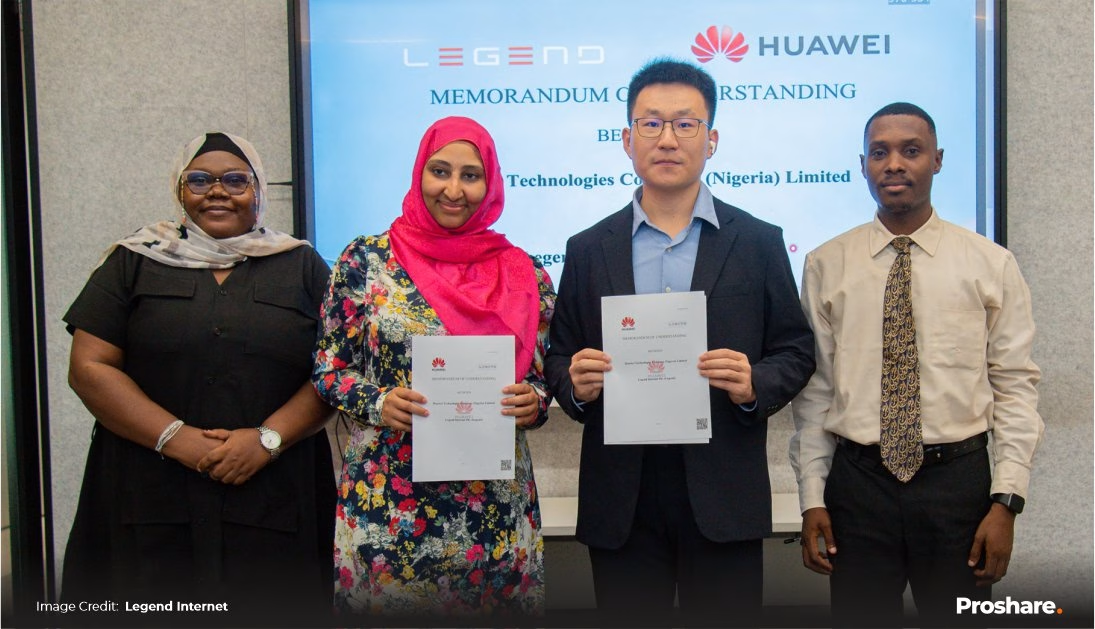
Legend internet PLC launches Nigeria’s first fibre-to-the-room service
Legend Internet PLC has unveiled Nigeria’s first Fibre-to-the-Room (FTTR) broadband service, promising ultra-high-speed internet connectivity directly to every room in homes and businesses. The launch, announced on May 9, 2025, marks a significant milestone in Nigeria’s digital infrastructure development. Unlike traditional broadband that delivers fibre only up to the router, FTTR by Legend extends pure fibre optic connections into every room, ensuring zero lag and full-house coverage. This innovation targets high-end residences initially, with plans to expand access to a broader market over time. “Our collaboration with Huawei reflects our commitment to global standards and local innovation,” said Aisha Abdulaziz, CEO of Legend Internet PLC. “With FTTR by Legend, we are building the infrastructure of the future, today – not just to improve connectivity, but to transform how people live, work, and create.” The service is supported by Huawei Technologies, a global leader in telecommunications, which brings decades of research and development in fibre optic and smart home technology to the partnership. This collaboration aims to accelerate broadband infrastructure growth and position Nigeria as a digital leader in Africa. Legend Internet, which recently became the first internet service provider listed on the Nigerian Exchange Limited (NGX), plans to scale its fibre network beyond Abuja to Lagos and other states. The company’s broader mission includes closing Nigeria’s digital divide by offering reliable, high-speed internet and expanding fintech solutions like digital payments and wallets. “FTTR by Legend delivers gigabit-speed internet seamlessly throughout buildings, meeting the demands of smart homes, remote work, and tech-forward enterprises,” Abdulaziz added. Legend Internet PLC is a digital infrastructure company focused on broadband and fintech markets in Nigeria. It provides ultra-high-speed fibre-optic internet and last-mile digital payment solutions designed to empower residential and business users.
Nigeria’s power sector faces critical overhaul amid persistent challenges
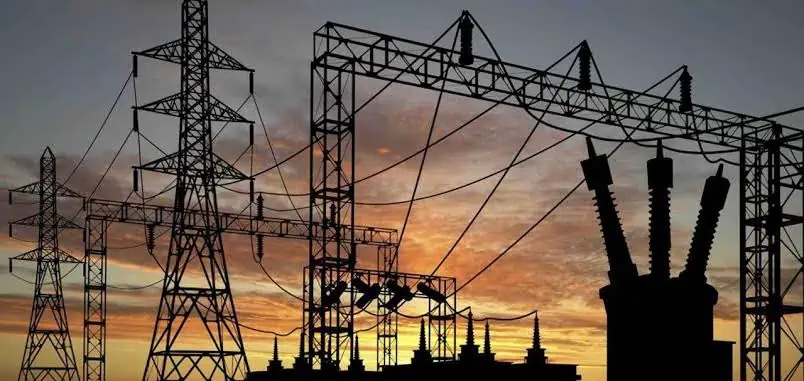
Nigeria’s power sector stands at a pivotal crossroads as the government unveils a $122 billion plan to revamp the industry, aiming to close the vast gap between current electricity generation and the nation’s growing demand. Despite recent improvements, experts warn that deep-rooted challenges continue to hamper progress, necessitating urgent reforms and strategic investments. Former Minister of Power, Professor Barth Nnaji, recently highlighted that Nigeria requires at least 100,000 megawatts (MW) of installed power capacity to meet its population and economic demands. Currently, peak generation barely exceeds 5,700 MW, a fraction of what is needed to power Africa’s largest economy reliably. Nnaji stressed that without aggressive infrastructure upgrades and investments-particularly in substations and distribution networks-the country will continue to suffer from load shedding and unreliable supply. The sector’s challenges are compounded by frequent grid collapses, vandalism of transmission infrastructure, and liquidity constraints. In 2024 alone, Nigeria experienced over a dozen national grid collapses and widespread vandalism of transmission towers, severely disrupting power supply. President Bola Tinubu’s administration has unveiled a comprehensive $122 billion blueprint to overhaul the power sector, focusing on expanding generation capacity, modernizing transmission and distribution infrastructure, and fostering renewable energy adoption. This plan aligns with the recently approved National Integrated Electricity Policy (NIEP), which aims to enhance governance and attract private investment across the electricity value chain. The government also plans a gradual shift towards cost-reflective tariffs to improve revenue generation for distribution companies (Discos), which have struggled with financial viability and infrastructure investment. This tariff reform is expected to roll out over the next three years, helping stabilize the sector’s finances and encourage efficiency. Nigeria is pushing to diversify its energy mix by leveraging abundant natural gas, hydropower, and solar resources. However, experts caution against abrupt policies such as banning solar panel imports without adequate local manufacturing capacity, suggesting transitional measures to support domestic production growth. The African Development Bank’s planned $1 billion support and USAID’s funding for clean energy projects are expected to boost solar hybrid mini-grids and standalone systems, especially in underserved rural areas. The distribution segment remains the sector’s weakest link, with large Discos covering multiple states, making targeted investment difficult. Experts advocate for breaking these into smaller franchises to improve operational focus and attract investment. Meanwhile, consumers continue to face erratic supply and high electricity bills, exacerbated by estimated billing practices and inadequate metering-about 55% of households still lack meters, fueling billing disputes and dissatisfaction. The government’s tariff hikes in 2024, which saw electricity prices rise by over 200%, have been controversial but deemed necessary to sustain the sector financially. Despite opposition, these increases aim to support infrastructure investments and reduce subsidy burdens, which were cut by 35% recently. While reforms and investments offer hope for gradual improvement, industry analysts warn that Nigeria’s power sector will face a dual reality in 2025: progress in generation capacity and renewable energy integration alongside persistent challenges in gas supply, distribution inefficiencies, and infrastructure maintenance. The success of state-led electricity solutions and decentralization efforts will depend heavily on investor confidence and regulatory oversight. Achieving reliable, affordable, and sustainable electricity supply will require coordinated efforts across government, private sector, and communities to overcome entrenched problems and realize the ambitious vision laid out for the next decade.
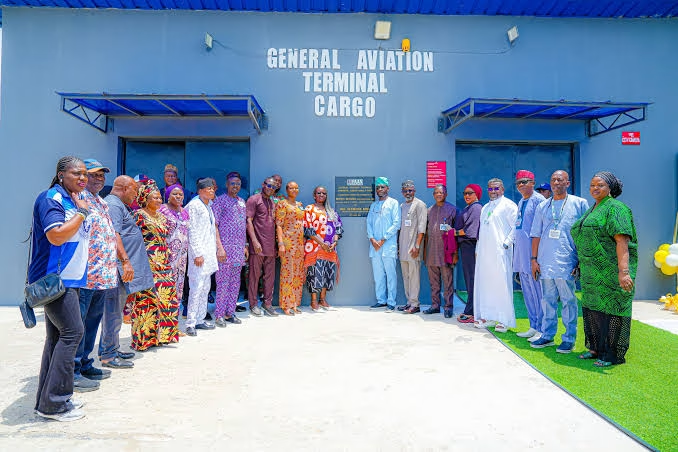
FAAN launches new cargo terminal at Lagos general aviation terminal to boost domestic air freight
The Federal Airports Authority of Nigeria (FAAN) has officially opened a new domestic cargo processing terminal at the General Aviation Terminal (GAT) in Lagos, marking a major step forward in modernizing Nigeria’s air cargo infrastructure. The inauguration ceremony, held on Friday and presided over by FAAN’s Managing Director/Chief Executive, Mrs. Olubunmi Kuku, was represented by the Director of Commercial and Business Development, Ms. Joy Agunbiade. The new facility is designed to enhance the efficiency, scalability, and security of cargo operations within Nigeria’s domestic air freight sector. “The new terminal will address longstanding bottlenecks in cargo handling, particularly for agricultural produce and e-commerce goods, providing reliable and secure logistics solutions for businesses across the country,” FAAN stated in an official release. With Nigeria’s growing e-commerce market and agricultural exports, the terminal aims to improve the speed and reliability of cargo movement, easing pressure on existing infrastructure and supporting producers, exporters, and logistics providers. The project is part of a broader initiative led by the Honourable Minister of Aviation and Aerospace Development, Festus Keyamo, and implemented through the Directorate of Cargo Development and Services under Mr. Lekan Thomas. FAAN plans to replicate the model in other strategic cities, including Abuja, Kano, Jos, Niger, and Port Harcourt, to build a robust nationwide air cargo network. “This development reinforces Lagos’ position as a vital hub in Nigeria’s expanding air freight ecosystem,” the Authority added, emphasizing the terminal’s role in strengthening supply chains amid rising demand for faster logistics.

PalmPay partners with Sochitel to offer users up to 5% instant discounts on gift cards
PalmPay, one of Nigeria’s leading fintech platforms, has teamed up with Sochitel to launch a new promotion giving users up to 5% instant discounts on gift card purchases through the PalmPay app. The offer, running from April through June 2025, aims to provide millions of users with a faster, smarter, and more rewarding way to shop for gift cards from popular global and local brands. Users can choose from a wide variety of gift cards including Apple, Amazon, SPAR, PlayStation, Steam, Walmart, Adidas, and Oriki, among others. The promotion is designed to enhance the user experience by adding value to PalmPay’s digital banking and lifestyle services. Femi Hanson, Head of Marketing & Communications at PalmPay, said, “We are constantly exploring innovative ways to enhance user experience. This gift card feature adds even more value to our platform, which already serves as a one-stop hub for digital banking and lifestyle services. We are excited to reward our users with instant savings on their favorite brands.” Abiodun Odelola, Head of Marketing at Sochitel, added, “We are proud to collaborate with PalmPay to bring this offer to millions of Nigerians. As a leading aggregator and reseller of premium digital products focused on Africa, we empower partners like PalmPay to deliver seamless, top-tier services to customers. Our global network of retailers and brands makes every transaction effortless and rewarding.” To participate, users simply log into the PalmPay app, navigate to the “Gift Cards” section, select their preferred brand and amount, and complete the purchase to enjoy instant discounts.