
A Bell 212 helicopter of the Sri Lanka Air Force crashed into the Maduru Oya reservoir in central Sri Lanka during a grappling drill linked to a passing-out parade, resulting in the deaths of six military personnel. The aircraft was carrying twelve personnel, including four special forces soldiers and two Air Force gunmen, all of whom were rescued and hospitalized, but six succumbed to their injuries, according to Sri Lanka Air Force spokesman Group Captain Eranda Geeganage. The helicopter had taken off from Hingurakgoda Air Force Base en route to the Maduru Oya area for the exercise when the incident occurred. The cause of the crash remains under investigation, with military officials yet to disclose further details. The remaining survivors are receiving medical treatment, though their conditions have not been publicly disclosed. Group Captain Geeganage declined to comment on the possible reasons behind the crash. This tragic accident follows recent challenges faced by the Sri Lankan military, including past incidents involving aircraft under hostile conditions and training accidents. The military has emphasized its commitment to investigating the crash thoroughly to prevent future occurrences. The Sri Lankan defense authorities continue to monitor the situation closely as they extend condolences to the families of the deceased personnel.

Nigerian health worker falls victim to fake online UN job scam
A Nigerian health worker recently shared a cautionary tale about falling prey to a sophisticated job scam impersonating the United Nations Food and Agriculture Organisation (FAO) in Nigeria. The victim, known on social media as @Drkachitech, received an email claiming that he is qualified for an Administrative Assistant position with FAO Nigeria, offering a monthly salary exceeding $3,000. The email, complete with official-sounding job titles, reference numbers, and urgent calls to action, appeared legitimate and compelled him to respond with his updated CV. Days later, he received a congratulatory email with a fake Letter of Appointment and UN Staff Rules document. The scammers then requested payment of $99 for a so-called QREDIV® Certificate, a fabricated requirement for diversity and inclusion training. Believing this to be a minor, reimbursable expense, the victim wired the money via cryptocurrency, only to realize later that the entire recruitment process was fraudulent. The scammer’s tactics included the use of realistic emails, official-looking documents, and even a real UN security training certificate (BSAFE) to build trust. However, no real interviews were conducted, and no official FAO channels confirmed the recruitment. Attempts to verify the QREDIV certificate and the job offer through FAO’s official platforms yielded no results. FAO Nigeria has since issued a disclaimer warning the public about these fake job advertisements, emphasizing that it does not solicit payments or personal information during recruitment. They urged job seekers to verify all openings exclusively through their official careers portal. Experts say this scam exemplifies how criminals exploit technological advances, including artificial intelligence, to craft convincing fraudulent job offers. Scammers often target job seekers in countries with high unemployment, using urgency and high salary promises to lure victims. To protect against such scams, job seekers are advised to: Independently verify the legitimacy of job offers through official company websites. Be skeptical of unsolicited job invitations. Avoid paying any fees during the recruitment process. Limit sharing of sensitive personal information. Recognize red flags such as requests for payment, lack of interviews, and poor communication transparency. The psychological toll of such scams can be severe, as victims lose not only money but also time, hope, and trust. As job scams continue to evolve, vigilance and thorough verification remain the best defense for job seekers navigating today’s digital employment landscape.

“I lost 4 cars in 8 years driving for Uber” – Union leader sheds light on Nigeria’s e-hailing realities
Comrade Ibrahim Ayoade’s journey as an Uber driver in Lagos began with hope and ended with hard-earned lessons-four cars lost, countless challenges faced, and a new resolve to fight for drivers’ rights. Ayoade, now the founding Secretary of Nigeria’s e-hailing drivers’ union (AUATON), shared his story in an interview, reflecting on eight turbulent years behind the wheel. “I needed a way to support my family,” he recalled, after losing his job at Coca-Cola in 2016. Introduced to Uber by a friend, he was drawn by the promise of flexible hours and decent earnings. But the road was never smooth. “I made three attempts and underwent several tests before I was accepted,” Ayoade said, describing a rigorous registration process that has since become more relaxed. Early on, Uber offered premium services and generous incentives. “Demand was high, and earnings were satisfactory. I enjoyed the freedom of being my own boss and the opportunity to meet new people daily.” However, as competition increased and Nigeria’s economy worsened, things changed. More drivers joined, fares dropped, and incentives dwindled. “Things took a turn for the worse around 2020 when Uber introduced new policies that negatively impacted drivers’ incentives and benefits,” he said. Ayoade’s greatest setbacks were personal. Over the years, he lost four cars: two were stolen and sold by drivers who disappeared abroad, one was wrecked in an accident, and another was lost to flooding in Lekki. The last car’s engine failed from wear and tear. Uber’s insurance, he said, was not enough to cover these losses. “Unfortunately, Uber’s insurance coverage was not comprehensive enough to cover all of these losses, and I could not afford to replace the cars on my own,” Ayoade explained. Determined to make a difference, Ayoade helped organize drivers into a union-first through WhatsApp groups, then as the National Union of Professional App-Based Transport Workers (NUPA-BTW). This union later merged with others to form the Amalgamated Union of App-based Transporters of Nigeria (AUATON), which now fights for better working conditions and policies. “While we have made progress, we still have work to do for our members. Many drivers and I recognised the importance of collective bargaining power to negotiate with companies like Uber for improved policies and benefits,” he said. Ayoade urges Uber to improve support for drivers, including comprehensive insurance, guaranteed minimum earnings, and transparent policies. “Ultimately, Uber should actively engage with our union and maintain integrity and compliance in addressing the current challenges we face,” he concluded. Ayoade’s story is a stark reminder of the highs and lows of Nigeria’s e-hailing industry-and the power of collective action to drive change.

Appeal court upholds seven-year jail term for ex-GTB staff in N50 million loan fraud
The Enugu Division of the Court of Appeal has confirmed the seven-year imprisonment of Onyekachi Nwosu, a former Guaranty Trust Bank (GTB) employee, for his role in a N50 million loan fraud. Nwosu was found guilty of using forged documents to secure a loan for Floxy Aluminum Odiofele Products Limited, falsely claiming that a property was pledged as collateral. Investigations revealed that Nwosu personally withdrew N40 million from the loan amount, which was part of the fraudulent scheme. The Economic and Financial Crimes Commission (EFCC) prosecuted Nwosu on charges including forgery and obtaining money by false pretence. After a trial in 2021, the Federal High Court convicted him, a judgment he appealed. However, a three-member panel of the Court of Appeal, led by Justice Zainab Abubakar, upheld the conviction related to the N40 million withdrawal, citing Nwosu’s own admission as evidence. The court set aside other counts but maintained the key conviction, affirming the sentence. This ruling shows the judiciary’s firm stance against financial crimes within Nigeria’s banking sector. The EFCC continues to pursue accountability in similar cases to safeguard the integrity of the financial system.
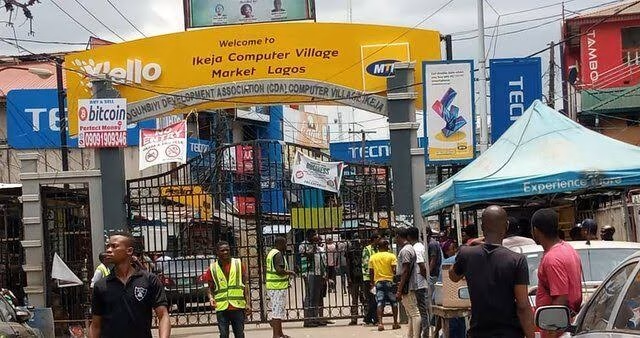
Lagos phone technicians demand better security after computer village explosion
The Association of Mobile Communication Device Technicians (AMCODET) is urging the Nigerian government to step up security in Computer Village, Ikeja, after a recent explosion left several people injured and raised fresh concerns about safety in the country’s largest electronics market. The incident occurred on Friday, April 11, 2025, at a CCTV dealer’s shop on Kodesho Street, near Computer Village. According to police reports, a parcel containing an explosive device detonated around 6:35 p.m., injuring five people who were inside and around the shop. The victims were quickly transported to the Lagos State University Teaching Hospital (LASUTH) for treatment. Security forces, including the Explosive Ordnance Disposal (EOD) Unit, Mobile Police Detachment, and Conventional Police Teams, responded immediately, cordoning off the area and launching a thorough investigation. The Lagos State Commissioner of Police, CP Olohundare Jimoh, assured the public that the situation was under control and urged residents to remain calm as detectives continue to probe the cause of the explosion. In the wake of the blast, AMCODET President Kehinde Apara expressed deep concern about the vulnerability of Computer Village to criminal activities, citing the lack of adequate security infrastructure as a major risk factor. “AMCODET has approached other stakeholders on the issue to improve security in the village and has proposed the installation of solar-powered CCTV cameras at the entrance of the village,” Apara said, emphasizing the need for surveillance to deter crime and prevent further incidents. Apara also called on the government to play a critical role in ensuring these security upgrades are implemented, warning that without intervention, the area could remain a target for future attacks. Beyond external security, AMCODET is introducing stricter protocols for technicians. The association plans to require customers to provide proof of ownership or a consent form before technicians unlock or service mobile devices. This measure aims to protect technicians from inadvertently working on stolen or questionable phones, a problem that has previously exposed members to legal and security risks. Apara further highlighted the need for ongoing training for phone technicians, particularly in recognizing security threats. He stressed the importance of collaboration between security agencies, technicians, and other stakeholders to develop effective safety strategies for Computer Village. The explosion has intensified call for stronger safety protocols and infrastructure in Computer Village. Many traders and residents are now looking to both the government and private sector for solutions that will restore confidence and ensure the market remains a safe place to do business. The Lagos State Police Command has reiterated its commitment to maintaining peace and security throughout the state, assuring the public that the area has been rendered safe and that normal activities can resume.

Nigeria’s digital economy set to contribute 21% to GDP, says minister Bosun Tijani
Nigeria’s digital economy is poised to make an even bigger impact on the nation’s Gross Domestic Product (GDP), rising from its current contribution of between 16% and 18% to 21%, according to Dr. Bosun Tijani, Minister of Communications, Innovation, and Digital Economy. Speaking during a visit to his alma mater, Anglican Grammar School in Onikolobo, Abeokuta, Tijani highlighted President Bola Tinubu’s administration’s commitment to transforming Nigeria’s economic landscape through technology. Central to this vision is a historic investment in 90,000 kilometers of fiber optic cables nationwide, which will deliver high-speed internet directly to schools and businesses, enhancing learning environments and boosting productivity across sectors. “This means more jobs and opportunities,” Tijani said. “For the first time in the history of this country, an administration is investing in infrastructure that will bring high-speed internet to schools through cables-not through jungles-enabling better learning environments.” The minister also encouraged students to dream big, reminding them that their backgrounds should not limit their ambitions. “You can become ministers, ambassadors, governors, or even the President. You can shake the world,” he told the students. To support education, Tijani announced a fellowship program for the top three students in Junior Secondary School (JSS) 1–3 and Senior Secondary School (SS) 1–2, offering each N100,000 annually, laptops, and school uniforms. About 70 students will benefit from this initiative each year. Plans are also underway to refurbish and digitally equip a school building and adopt the science laboratory to further enhance learning resources. Beyond education, Tijani emphasized the critical role of technology in agriculture during an Innovation and Startups Roundtable in Ogun. He urged Nigerian farmers to adopt digital tools such as mobile apps, sensors, and drones to monitor crops, control pests, and improve productivity, citing Ukraine’s sustained agricultural output amid conflict as an example of successful tech adoption. “Given our large population and reliance on traditional farming, we cannot meet local food demand without embracing digital tools,” he said, stressing that technology could reduce Nigeria’s dependence on food imports and preserve foreign exchange. The digital economy’s growth is expected to generate $18.3 billion by 2026, driven by thriving tech companies like Flutterwave, Jumia, Andela, and Interswitch, which demonstrate Nigeria’s rising digital potential. According to recent data, the Information and Communication Technology (ICT) sector contributed 17% to Nigeria’s real GDP in Q4 2024, reflecting steady growth despite some slowdown in nominal terms. The sector remains a vital engine of economic development, with mobile technology and digital services playing key roles in driving inclusion and productivity across industries. As Nigeria advances its digital infrastructure and policies, experts forecast the country to become the world’s fifth-largest economy by 2075, with the digital economy as a central pillar of this transformation.