Intel, one of the world’s leading chipmakers, is set to lay off more than 21,000 employees this week, over 20% of its global workforce, in a sweeping restructuring move under its new CEO, Lip-Bu Tan. This marks Intel’s second round of mass layoffs in less than a year. In August 2024, the company had already cut 15,000 jobs as part of cost-saving measures. The latest cuts will primarily affect non-engineering roles, including administrative, sales, marketing, and support staff. The company has struggled to keep pace with rivals like Nvidia in the booming AI chip market and has faced declining revenues and profits. Intel’s previous CEO, Pat Gelsinger, launched an ambitious turnaround plan, but progress was slow and financial results remained disappointing. New CEO Lip-Bu Tan, who took the helm last month, is moving quickly to reset Intel’s strategy. The company recently sold a majority stake in its programmable chip unit, Altera, and is now focusing on rebuilding engineering talent and revamping its manufacturing processes. “These decisions are not easy, but they are necessary to put Intel back on a path to growth and innovation,” Tan said in a statement. Intel’s layoffs are part of a broader trend of job cuts across the tech industry, as companies adjust to shifting market realities and economic pressures. Other major tech firms, including Google, Microsoft, and Unity, have also announced significant layoffs in recent months. Intel is expected to provide more details on its restructuring plans and future strategy during its upcoming first-quarter earnings call.

OPay launches ₦60 million scholarship scheme for UNILORIN students
Nigeria’s leading fintech company OPay has unveiled a ₦60 million scholarship programme set to run over the next decade, at the University of Ilorin (UNILORIN). Each year, 20 deserving UNILORIN students will receive ₦300,000 each to help cover their academic expenses. The scholarship, which will run for 10 years, is designed to ensure that more young Nigerians can focus on their studies and personal growth without being held back by financial barriers. OPay’s Corporate Social Responsibility Manager, Itoro Udo, emphasized that the programme is not just about financial aid but also about enhancing the employability and long-term success of beneficiaries. “We want to support hardworking youths who are striving to make their lives better through education,” Udo said during a visit to the university’s Registrar. UNILORIN’s Registrar, Mr. Mansur Alfanla, welcomed the initiative, describing it as a timely intervention that aligns with the university’s commitment to student-focused programmes. Vice Chancellor Professor Wahab Egbewole (SAN) also expressed gratitude, noting that OPay’s gesture supports the national agenda for educational advancement. The OPay scholarship is open to undergraduates from all departments, with recipients selected through a transparent, merit-based process managed by the university. The programme is part of OPay’s ongoing efforts to give back to the society, particularly to young people who form a significant part of its customer base. Launched in 2024, OPay’s nationwide scholarship scheme covers 20 universities across Nigeria, reaffirming the company’s role as not just a financial service provider but a partner in shaping the country’s future. Applications for the scholarship typically open in August each year, and interested students are encouraged to prepare their academic records and other required documents in advance.

Katsina State invests over N7 billion in solar power and electricity projects
Katsina State is making major strides in energy infrastructure, spending more than N7.6 billion on electricity projects, with a strong focus on solar power and renewable solutions under Governor Dikko Radda’s administration. Key Projects and Investments: Solar Mini-Grids: The government has allocated N3.8 billion for solar mini-grid installations at the General Hospital Katsina, Government House, and the State Secretariat Complex to ensure reliable power for critical services. Street Lighting: 74 kilometers of solar street lights have been installed across Katsina metropolis, with an additional 11 kilometers stretching from Al-Qalam University Roundabout to Darma Rice Mill, enhancing safety and visibility at night. Rural Electrification: New transformers, cable installations, and route changes have restored power to several communities, including a 17km supply route to Charanchi Local Government. Security Lighting: The state has used Japarana Concrete Technology to protect and beautify security lighting systems along major roads in Katsina. Deputy Governor Faruq Lawal-Jobe highlighted these achievements during a press briefing, emphasizing the administration’s commitment to sustainable, cost-effective, and environmentally friendly energy. The projects aim to improve living standards, boost economic activities, and attract investment to the state. Governor Radda’s administration has also signed significant energy deals, including a $500 million partnership with Genesis Energy to further expand clean energy infrastructure and support Katsina’s green economic ambitions.

Niger State bans nighttime tricycle, motorcycle operations in Minna over insecurity
The Niger State Government has banned commercial motorcycles and tricycles from operating between 6 p.m. and 6 a.m. in Minna, the state capital. The announcement was made on Wednesday, April 23, 2025, following a high-level security meeting led by Governor Umaru Bago. The government says the night ban is a direct response to a surge in criminal activities linked to motorcycle and tricycle operators after dark. “We cannot allow criminals to continue terrorizing our residents,” Governor Bago stated, emphasizing that protecting lives and property remains a top priority. Local leaders have been instructed to document all residents in their communities. The government warned that any house found sheltering criminals or used for drug-related activities will be demolished without hesitation. Security agencies have also been directed to intensify intelligence gathering and conduct coordinated raids on criminal hideouts. Parents and guardians are urged to monitor their children closely, with the governor warning that anyone caught engaging in violence or crime will face prosecution. Governor Bago called on traditional leaders, youth groups, and all residents to work together with security agencies to restore peace in Minna. “The fight against insecurity is a collective responsibility,” he said. The ban takes effect immediately, with authorities promising strict enforcement to ensure the safety of all citizens.
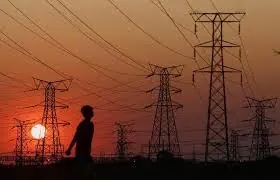
Nigerians decry “Band A” electricity scam as tariffs triple without reliable power
Nigerian electricity customers classified under the premium “Band A” category are raising alarms over what they describe as systemic fraud, alleging they pay triple tariffs for power supplies that fall far short of the promised 20-hour daily minimum. Energy analyst Ikechukwu Amaechi, who resides and operates a business in Lagos’s Band A zones, reported receiving less than 10 hours of electricity daily despite tariffs spiking from ₦62 to ₦206 per kWh. How the Banding System WorksNigeria’s Service-Based Tariff (SBT) divides consumers into five bands (A-E) based on daily power supply hours: Band A: 20+ hours (₦206–₦225/kWh) Band B: 16–20 hours (₦63/kWh) Band C: 12–16 hours (₦50/kWh) Band D: 8–12 hours (₦43/kWh) Band E: 4–8 hours (₦40/kWh) “This Band A system is a fraud,” Amaechi reiterated. “We’re paying more for darkness.” Customers can verify their band via DisCo portals like Ikeja Electric’s website by entering their meter number. However, many allege their assigned bands don’t match reality. Social media and consumer reports reveal widespread outages in Band A areas, with some customers experiencing under 10 hours daily, half the mandated minimum. A Band A resident in Abuja stated: “They said we’d be prioritized, but since the tariff hike, supply has worsened.” NERC’s enforcement mechanism requires DisCos to adjust tariffs downward if a feeder fails to meet its band’s hourly threshold for 60 days. However, customers claim this rarely occurs in practice. NERC fined Abuja DisCo (AEDC) ₦200 million in 2024 for overcharging downgraded Band A customers but has yet to address systemic classification inaccuracies. Analysts like Abubakar Umar warn the tariff hike could “create initial chaos” before pressuring DisCos to improve infrastructure. Consumer groups demand an independent audit of feeder classifications and stricter penalties for non-compliant DisCos. With Band A customers funding 40% of grid supply for just 15% of users, transparency in billing and service delivery remains critical to restoring public trust.

Meta launches Edits app globally, targeting TikTok and CapCut with watermark-free video creation
Meta, the parent company behind the new Edits app, has a significant history of privacy-related fines and regulatory scrutiny. Over the past five years, Meta’s major platforms, including Facebook, Instagram, and WhatsApp, have been fined a combined €2.6 billion for violations of the European Union’s General Data Protection Regulation (GDPR), with a notable portion of these fines related to mishandling children’s data and unclear privacy policies. In Nigeria, the Data Protection Commission (NDPC) is currently investigating Meta for possible data breaches, particularly regarding behavioral advertising without explicit user consent. This investigation involves around 40 million Facebook accounts and could result in Meta forfeiting 2% of its gross revenue if found guilty. While Edits offers advanced creative tools and watermark-free exports, Meta has not publicly detailed any unique privacy features or enhanced data protection mechanisms specific to the app as of its global launch. Given Meta’s broader ecosystem, it is likely that Edits will operate under the same privacy policies as other Meta apps, which have been criticized for issues such as unclear privacy terms and default public account settings. Meta’s history suggests users should be mindful of data collection and privacy settings when using Edits. Regulatory bodies in multiple countries are actively monitoring Meta’s data practices. No unique privacy protections for Edits have been announced beyond Meta’s standard policies. Users concerned about privacy should review Meta’s privacy policy for Edits and stay informed with Dailytech about ongoing regulatory developments.