
A Nigerian national, Charles Uchenna Nwadavid, has been indicted in the United States for his alleged involvement in a $2.5 million romance scam that targeted six victims across the country. The charges, which include mail fraud and money laundering, could result in a 20-year prison sentence if he is convicted. The U.S. Department of Justice revealed in a statement on Wednesday that Nwadavid, 34, was arrested on April 7, 2025, upon arriving at Dallas-Fort Worth International Airport from the United Kingdom. He is accused of orchestrating elaborate online scams between 2016 and 2019, using fake profiles on dating and social media platforms to lure victims into fraudulent relationships. According to court documents, perpetrators of romance scams typically create fictitious profiles to gain victims’ trust under the guise of a romantic relationship. Victims are then manipulated into transferring money or conducting financial transactions under false pretenses, such as claims of urgent medical needs or securing multimillion-dollar inheritances. Nwadavid allegedly used one victim from Massachusetts (referred to as Victim 1) as an intermediary to collect funds from five other victims across the U.S. He is accused of tricking Victim 1 into transferring her own money and funds from other victims through cryptocurrency transactions. The statement further alleges that he accessed accounts in Victim 1’s name remotely to move the stolen funds into cryptocurrency wallets he controlled via LocalBitcoins, an online trading platform. The charges against Nwadavid carry severe penalties. Mail fraud alone could lead to up to 20 years in prison, three years of supervised release, and fines of up to $250,000 or twice the financial loss caused to victims. Money laundering charges also carry a maximum sentence of 20 years in prison, three years of supervised release, and fines up to $500,000 or twice the value of laundered property. In addition to these penalties, Nwadavid may face deportation upon completing any sentence imposed by the court. Sentencing will be determined by a federal district court judge based on U.S. Sentencing Guidelines and relevant statutes. Nwadavid made his first court appearance on April 8, 2025, at a federal court in Fort Worth, Texas. He has been detained pending further legal proceedings. The U.S. Attorney’s Office emphasized that all charges are allegations at this stage and that Nwadavid is presumed innocent until proven guilty beyond a reasonable doubt.
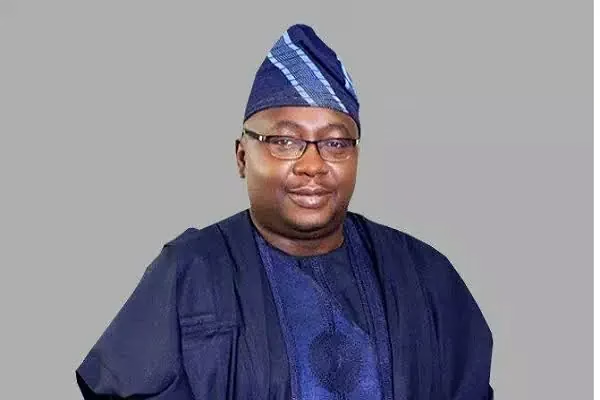
FG signs $328.8 million deal with Chinese firm to boost Nigeria’s power supply
The Federal Government on Wednesday signed a $328.8 million contract with China Machinery Engineering Corporation (CMEC). The agreement, under Phase 1 of the Presidential Power Initiative (PPI), aims to rehabilitate and expand the country’s electricity transmission network. The project will focus on the development of 330kV and 132kV transmission lines spanning 544 kilometers, with a load capacity of 7,140 megawatts. Speaking at the signing ceremony in Abuja, Minister of Power Adebayo Adelabu highlighted the importance of the initiative in improving grid reliability and reducing stranded generation capacity. “These critical infrastructure projects will act as main arteries for delivering increased power directly to homes, businesses, and industries,” he stated. The project will be managed by FGN Power Company, a special-purpose vehicle established to oversee PPI implementation. Kenny Anuwe, Managing Director of FGN Power Company, described the partnership with CMEC as strategic, complementing ongoing collaborations with Siemens Energy on generation and high-voltage transmission technologies. Vice President of SINOMACH, Li Xiaoyu, expressed gratitude for Nigeria’s trust in CMEC and emphasized the project’s role in enhancing electricity delivery nationwide. This initiative highlights President Bola Tinubu’s commitment to providing stable and reliable power for Nigerians.
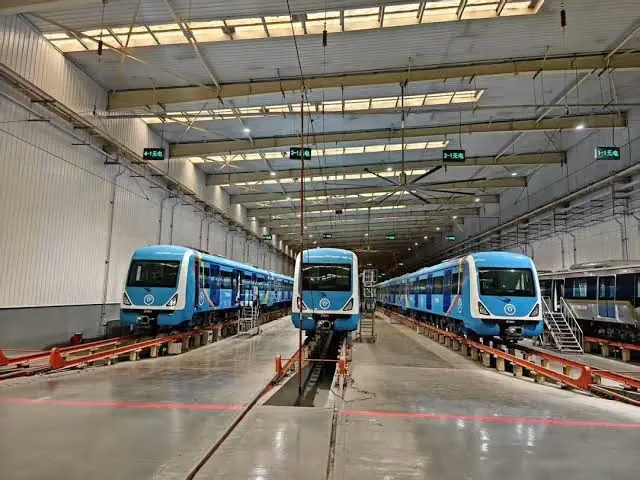
Lagos State to complete 68km Marina–Lekki green line rail before operations begin
The Lagos State Government has announced plans to fully construct the 68-kilometer Green Line rail project, connecting Marina to the Lekki Free Zone, before commencing operations. This marks a shift from the phased approach used for earlier rail projects like the Blue and Red Lines, where operations began after completing Phase 1 while subsequent phases were still under construction. The announcement was made by Dr. Oluyinka Olumide, Commissioner for Physical Planning and Urban Development, during a scoping workshop held on Wednesday. The workshop marked the start of the Environmental and Social Impact Assessment (ESIA) and Resettlement Policy Framework processes for the ambitious rail project. The Green Line rail is a critical component of the Lagos Strategic Transport Master Plan, which aims to ease traffic congestion across the state by developing six Light Rail Transit (LRT) lines. Upon completion, the Green Line is expected to serve over 500,000 passengers daily at launch, with capacity projected to exceed one million as demand increases over time. The route will connect major areas such as Victoria Island, Lekki, Ajah, and other surrounding communities. During the workshop, the Lagos Metropolitan Area Transport Authority (LAMATA) unveiled the 68-kilometer route alignment to stakeholders. While specific details of the alignment were not disclosed, LAMATA emphasized that building the line in its entirety would ensure seamless operations from day one. Community stakeholders, traditional leaders, government officials, and development partners attended the workshop to discuss the project’s implications. Representatives from affected communities, including Eti-Osa, Awoyaya, Alasia, and Iranla, expressed support for the initiative. Dr. Olumide urged property owners along the proposed corridor to regularize their building approval documents to avoid penalties. Engr. Olasunkanmi Okusaga, Technical Adviser for Rail Transport at LAMATA, highlighted that the Green Line would create jobs and significantly reduce traffic congestion in Lagos. He also assured that residents affected by construction would receive fair compensation. The ESIA process is being led by Sectec-Greenstad Consulting Limited under Dr. Mariame Mboup Fall’s leadership. China Harbour Engineering Company Limited (CHEC), which has partnered with Lagos State on the project’s design, financing, and operation, was also present at the session. The Green Line rail is backed by a Memorandum of Understanding (MoU) signed between Lagos State and the Federal Ministry of Finance Incorporated (MOFI). It is one of Lagos’ priority infrastructure projects under its N1.052 trillion development budget for 2025. A review of Nigeria’s federal budget proposal shows N146.14 billion allocated as counterpart funding for the project.

Burna boy exposes huge streaming revenue gap between Nigerian and international artists
Nigerian music superstar Burna Boy has shed light on the significant income gap between local and international music streams, revealing that Nigerian artists earn far less from local streams compared to their counterparts in the U.S., U.K., and Europe. The Grammy-winning artist disclosed that while 1 million streams in Nigeria generate just $300 to $400 for an artist, the same number of streams in the U.S. or U.K. can earn between $3,000 and $4,000. Burna Boy, known for global hits like Ye and Anybody, shared his thoughts on Instagram, calling attention to the financial challenges faced by Nigerian musicians who rely heavily on local streaming revenue. “Having the number one song on a Nigerian streaming platform doesn’t mean much financially,” he said, urging his peers to explore opportunities in international markets where payouts are significantly higher. The disparity stems from several factors, including subscription fees, ad revenue, and currency exchange rates. In Nigeria, streaming platforms like Spotify Premium charge as little as ₦1,300 (about $0.82) per month, far lower than the $10.99 monthly fee in the U.S. Similarly, YouTube Music Premium costs ₦1,300 ($0.82) in Nigeria compared to $11.99 in the U.S. Additionally, Nigeria’s smaller market size and weaker currency exacerbate the issue. For example, the Naira’s value has declined sharply over recent years, with exchange rates rising from ₦461.5/$1 at the start of 2023 to ₦1,535/$1 by the end of 2024. This economic reality limits ad revenue and paying subscribers in Nigeria, directly impacting how much artists earn per stream. According to Spotify’s 2024 Loud & Clear report, Nigerian artists earned over ₦58 billion (approximately $122 million) in royalties from the platform last year, more than double what they earned in 2023 and five times their 2022 earnings. This growth reflects the increasing global popularity of Afrobeats and other Nigerian genres. However, Burna Boy emphasized that while these numbers are promising, local earnings are still pale compared to those of international artists. He encouraged Nigerian musicians to expand their reach beyond local audiences to achieve better financial sustainability. Burna Boy’s comments highlight a broader issue within Africa’s creative industries, the need for improved revenue models that reflect the true value of local talent. While platforms like Spotify have amplified Nigerian music globally, there’s still a long way to go in ensuring fair compensation for African artists.
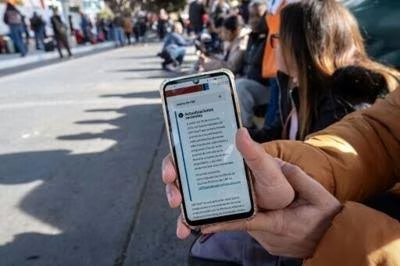
U.S. revokes parole status for migrants who entered via asylum app
The United States government has ordered migrants who entered the country using a special asylum scheduling app to leave immediately, following the revocation of their temporary parole status. This decision affects thousands of individuals who crossed the southern border and were granted permission to stay and work legally under a program introduced during the Biden administration.The CBP One app, launched to streamline asylum appointments, allowed migrants to schedule interviews and provided them with temporary legal status for up to two years, including work authorization. However, the Department of Homeland Security (DHS) has now canceled their parole status, rendering them unauthorized to remain in the U.S. Notices sent to affected migrants warn that failure to leave could lead to removal proceedings, fines, or even criminal prosecution. The CBP One app, launched to streamline asylum appointments, allowed migrants to schedule interviews and provided them with temporary legal status for up to two years, including work authorization. However, the Department of Homeland Security (DHS) has now canceled their parole status, rendering them unauthorized to remain in the U.S. Notices sent to affected migrants warn that failure to leave could lead to removal proceedings, fines, or even criminal prosecution. The revocation of parole status means these individuals lose access to work permits and other benefits tied to their temporary stay. Migrants have reported receiving emails instructing them to “leave the United States immediately” or face legal consequences. While the exact number of people impacted remains unclear, DHS has confirmed that notices have been sent out. Under the Trump administration, the CBP One app has been rebranded as CBP Home, shifting its focus from facilitating asylum appointments to encouraging voluntary self-deportation. The updated app now allows undocumented migrants to self-report their intent to leave the U.S., asking questions about their financial ability and passport validity for departure. This move is part of broader efforts by the U.S. government to address immigration challenges and secure its borders. DHS has emphasized that revoking paroles is a necessary step in managing the influx of migrants at the southern border. Additionally, plans for a national registry for undocumented migrants were announced earlier this year, requiring individuals aged 14 and older to submit personal information such as addresses and fingerprints. While these measures aim to strengthen border security, experts have raised concerns about enforcement difficulties and practical challenges in implementing these policies effectively. The situation highlights ongoing tensions in U.S. immigration policy as authorities balance border control with humanitarian considerations.
Mobile money transactions hit $1.68 trillion globally in 2024 – GSMA Report
The global mobile money industry processed a staggering $1.68 trillion in transactions in 2024, underscoring the growing importance of digital financial services in driving economic activity and financial inclusion worldwide. This was revealed in the State of the Industry Report on Mobile Money 2025 released by the Global System for Mobile Communications Association (GSMA) on Tuesday. According to the report, mobile money services recorded approximately 108 billion transactions last year, marking a 20% increase in transaction volume compared to 2023. This sustained double-digit growth highlights the expanding role of mobile money in everyday financial activities. Peer-to-peer (P2P) transfers emerged as the leading contributor to this surge, accounting for nearly half of the total increase in transaction volume. Additionally, interoperable transactions, those that allow transfers between different mobile money platforms or providers, contributed 23% of the growth. The report also noted a 15% rise in transaction values, which reached $227 billion in 2024. However, for the third consecutive year, transaction volumes grew faster than transaction values, resulting in a slight 4% decline in the average value per transaction. Despite this dip, user engagement with mobile money platforms deepened significantly. The average active account (measured over a 30-day period) saw a 4% increase in total amounts transacted and an 8% rise in transaction frequency compared to the previous year. This suggests that users are increasingly relying on mobile money for smaller, more frequent transactions. The GSMA emphasized the transformative impact of mobile money on financial inclusion, particularly in emerging markets where traditional banking infrastructure remains limited. By December 2024, 21 out of every 100 adults in countries with mobile money services had used an account within the preceding three months. “Mobile money continues to drive financial inclusion and economic growth,” said Vivek Badrinath, Director General of GSMA. “At the end of 2023, the GDP of countries with mobile money services was $720 billion higher than it would have been without these services.” Sub-Saharan Africa maintained its position as the most active region for mobile money globally. However, East Asia-Pacific also showed promising growth, reflecting an expanding adoption of digital finance across diverse markets. With sustained growth and innovation, mobile money is poised to remain a cornerstone of global financial inclusion efforts for years to come.