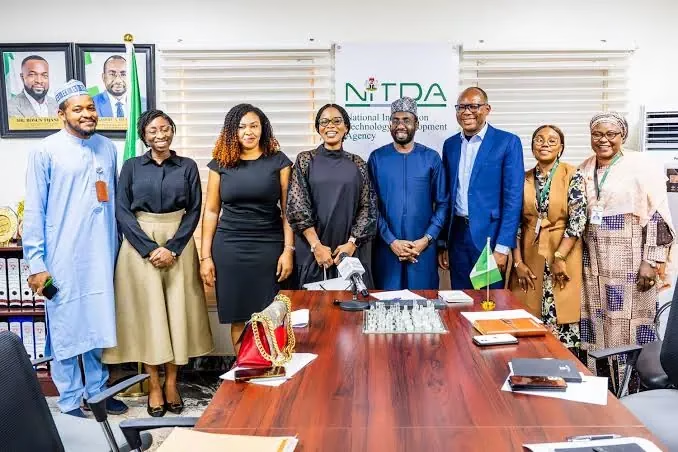
Nigeria’s National Information Technology Development Agency (NITDA) has forged a strategic alliance with Doballi, a Dubai-based AI recruitment platform, to bridge the gap between skilled Nigerian tech professionals and international job markets. The collaboration, announced on Monday, seeks to tackle underemployment in Nigeria’s booming tech sector while positioning the country as a hub for global digital talent. Despite Nigeria’s rapidly expanding digital ecosystem, many locally trained tech professionals struggle to secure roles in the global marketplace. This partnership aims to reverse the trend by leveraging Doballi’s AI-driven platform to match Nigerian talent with remote opportunities at multinational firms. Under the agreement, NITDA will curate a pipeline of job-ready professionals, while Doballi will waive its $150 onboarding assessment fee for Nigerian applicants, a move expected to democratize access for early-career developers and engineers. “This isn’t just about job placements, it’s about sustainably integrating Nigeria into the global digital economy,” said NITDA Director-General Kashifu Inuwa Abdullahi. “The data we gather from this initiative will directly inform policies to strengthen our tech ecosystem’s competitiveness.” The Memorandum of Understanding outlines a four-pronged approach: Talent Development: NITDA will vet candidates through its existing programs like the 3 Million Technical Talent (3MTT) initiative, which aims to upskill three million Nigerians by 2027. Global Networking: Doballi will connect pre-screened professionals with enterprises in Europe, North America, and Asia seeking African tech talent. Cultural Readiness: The platform will provide cross-cultural training modules to help Nigerians navigate international workplaces. Real-Time Tracking: A customized dashboard will allow NITDA to monitor placements, employer feedback, and foreign currency inflows—a critical feature given Nigeria’s push to stabilize its economy through diaspora remittances. Doballi’s Country Director for Nigeria, Mrs. Nneoma Ijei, emphasized the strategic timing: “With global tech talent shortages projected to reach 85 million workers by 2030, Nigeria’s youth demographic positions us to fill this gap while driving domestic economic growth.” This partnership aligns with multiple federal initiatives to cement Nigeria’s tech leadership: Curriculum Overhaul: NITDA’s collaboration with the National Universities Commission to integrate AI, blockchain, and cybersecurity into degree programs. Startup Support: Programs like iHATCH incubator and the National Skills Framework, which align education with industry needs. Financial Backing: Enhanced funding access through agencies like the Industrial Training Fund (ITF) and National Social Investment Program (NSIP). Industry analysts note the Doballi deal could amplify Nigeria’s $6.4 billion tech startup ecosystem, Africa’s largest, by creating pathways for developers to gain international experience before launching homegrown ventures. While the initiative has been widely praised, experts caution that infrastructure gaps, including unstable electricity and internet connectivity, could hinder remote workers. However, NITDA’s recent push for localized data hosting and improved cybersecurity protocols suggests these issues are being prioritized.

Natasha Akpoti defies curfew, lands in Kogi by helicopter, accuses leaders of intimidation
Suspended Senator Natasha Akpoti-Uduaghan made a bold return to her constituency in Kogi Central on Tuesday, defying a curfew and restrictions imposed by the state government. Arriving by helicopter in Okehi Local Government Area, she was greeted by a massive crowd of supporters who had gathered despite the ban on public gatherings. The curfew, declared earlier by Okehi LGA Chairman Amoka Eneji, aimed to prevent potential security breaches during the senator’s planned Sallah homecoming. Authorities had warned against political rallies and gatherings, citing concerns over peace and order. However, Akpoti-Uduaghan dismissed these directives, insisting that her visit was a celebration with her community and not a political rally. Speaking to her supporters, she reaffirmed her connection to her roots, stating, “Nobody and nothing can stop me from coming home. I’m an Ebira person; this is my land.” She also accused key political figures, including Governor Usman Ododo and Senate President Godswill Akpabio, of intimidation tactics. Akpoti-Uduaghan’s return comes amid her six-month suspension from the Senate for alleged rule violations and ongoing tensions with the ruling All Progressives Congress (APC).

Nigeria enacts 10-year jail terms for ponzi scheme promoters
The recently signed Investment and Securities Act (ISA 2025) by President Bola Ahmed Tinubu marks a significant step in Nigeria’s fight against Ponzi schemes. Under the new law, promoters of these fraudulent schemes face a minimum of 10 years imprisonment and a fine of at least N40 million. Dr. Emomotimi Agama, Director-General of the Securities and Exchange Commission (SEC), emphasized during an interview that the Act provides the Commission with enhanced powers to prosecute offenders and recover profits gained through fraudulent activities. Beyond financial penalties, the law ensures disgorgement of ill-gotten gains, aiming to restitute victims and deter future crimes. The ISA 2025 also empowers SEC to access communication records for investigations, strengthening its ability to tackle illegal fund managers.

Iyabo Ojo’s ‘Labake Olododo’ shines with N50.4 million opening weekend
Nollywood’s latest blockbuster, Labake Olododo: The Warrior Lord, has made a remarkable debut, earning N50.4 million at the Nigerian box office during its opening weekend from March 28-30, 2025. Produced by veteran actress and filmmaker Iyabo Ojo and directed by Biodun Stephen, Labake Olododo is a gripping tale of power, loyalty, and leadership rooted in Yoruba culture. The film features an ensemble cast including Tayo Faniran, Muyiwa Ademola, Ibrahim Chatta, Bimbo Akintola, and Fathia Balogun, alongside rising stars like Lololade Okunsanya and Nkechi Blessing. Ojo joins other trailblazing women like Wumi Toriola, whose Queen Lateefah grossed N350 million last year, and Eniola Ajao’s Ajakaju: Beasts of Two Worlds, which earned over N200 million. Iyabo Ojo’s career spans over two decades with more than 150 acting credits and 14 productions to her name. Her latest venture continues her tradition of blending cultural depth with mainstream appeal. As Nollywood evolves, women filmmakers are proving instrumental in shaping its future, delivering compelling stories that captivate both local and international audiences. Labake Olododo is yet another milestone in this exciting transformation.

Enugu introduces smart farm estates across 17 LGAs
The Enugu State Government is set to launch an ambitious initiative aimed at transforming agriculture in the region by establishing 260 Smart Farm Estates. This project, known as “One Ward, One Smart Farm Estate,” was announced by the state’s Commissioner for Agriculture and Agro-Industrialization, Mr. Patrick Ubru, during a recent inspection of a pilot site in Akpawfu, Nkanu East Local Government Area. With a budget allocation of N2 billion for 2025, the initiative is designed to cover all 260 political wards across Enugu’s 17 local government areas. It aims to engage residents in farming and promote agricultural development as a means to diversify the state’s economy and boost Internally Generated Revenue (IGR). Ubru emphasized the importance of community involvement, urging individuals, cooperative societies, and agricultural agencies to collaborate on the project. He highlighted that the initiative will not only provide opportunities for local farmers but also address pressing issues such as youth unemployment and food insecurity. The pilot Smart Farm Estate will span 200 hectares and be allocated to 200 local farmers, each responsible for cultivating specific crops. Plans include essential infrastructure such as uninterrupted electricity, water supply, and irrigation systems to support farming activities. Additionally, a central warehouse is under construction to assist farmers in managing their produce effectively. Workshops will be organized to equip farmers with modern agricultural practices and skills. Ubru expressed confidence in the project’s potential to create a positive impact on the community and align with Governor Peter Mbah’s vision for agricultural advancement in Enugu State.

AMCODET urge NCC to mandate phone registration to combat theft in Nigeria
Mobile phone technicians in Nigeria are calling on the Nigeria Communications Commission (NCC) to implement a mandatory registration process for mobile phones at the point of purchase. This initiative, proposed by the Association of Mobile Communication Device Technicians of Nigeria (AMCODET), aims to tackle the growing issue of phone theft and enhance security within the mobile device industry. During an interview with the News Agency of Nigeria (NAN) in Lagos, Mr. Kehinde Apara, President of AMCODET, emphasized that registering phones at the time of sale would significantly deter theft. He explained that if phones are registered, it becomes much more challenging for criminals to sell stolen devices. “Registration of mobile phones will reduce theft to the barest minimum, as it will be difficult for thieves to sell registered stolen phones” – Apara In addition to addressing theft, Apara noted that mandatory registration could also alleviate the harassment faced by technicians. Many members of AMCODET have been wrongfully accused by security agencies of being involved in phone theft simply because customers often bring in stolen devices for repair. “We believe this is unfair to such innocent people,” he added. Apara also reflected on previous efforts to improve phone security, particularly the NIN-SIM linkage initiative designed to combat insecurity and mobile theft. While he acknowledged its positive impact, he insisted that it is not enough on its own to solve these issues. To further bolster Nigeria’s mobile phone industry, Apara called for increased support from individuals and private organizations. He believes that with the right backing, Nigeria can develop its own technology and reduce reliance on imported devices. “We need individuals’ support to develop our industry, rather than relying on the government for everything,” he added. Despite the challenges ahead, Apara remains optimistic about the future of Nigeria’s mobile phone sector. He envisions a time when the country can produce its own devices and technology with adequate support from both individuals and organizations.