
The Lagos State Government is taking bold steps to transform waste management in Nigeria’s commercial hub by introducing waste-to-energy plants and shutting down major dumpsites. These initiatives aim to tackle environmental challenges while generating sustainable energy for the state. Key Developments: Closure of Dumpsites: The Lagos Waste Management Authority (LAWMA) plans to close the Olusosun dumpsite in Ojota and other landfill sites, redirecting waste to materials recovery facilities in Ikorodu and Badagry. These facilities will extract biogas for electricity generation. Waste-to-Energy Plants: A new plant in Epe, developed in partnership with Dutch company Harvest Waste, will process 2,500 tonnes of waste daily and produce 60–80 megawatts of electricity. The project has secured €100 million in funding. Biogas Facility: LAWMA is also establishing a biogas facility, leveraging a feasibility study conducted with the Swedish Government. This plant will repurpose organic waste into biomethane for compressed natural gas-powered buses. With Lagos generating 13,000 tonnes of waste daily, the government aims to divert organic waste from landfills to produce compost and biomethane. These efforts align with global practices like Sweden’s zero-waste model and could generate $2.5 billion annually while reducing CO2 emissions. Governor Babajide Sanwo-Olu’s administration remains committed to building a cleaner, more sustainable city through strategic partnerships and innovative solutions. These projects promise not only environmental benefits but also economic growth and improved living standards for Lagosians.

TikTok removes 2.4 million Nigerian videos in Q4 2024 for policy violations
TikTok has revealed that it removed 2.4 million videos uploaded by Nigerian users in the fourth quarter of 2024 due to violations of its community guidelines. Globally, TikTok took down a total of 153 million videos, with 90% of these stemming from the top 50 markets. The removed content violated TikTok’s policies on privacy, security, mental health, safety, and civility. In addition to video removals, TikTok deleted 211.5 million accounts globally. Of these, 185.3 million were fake accounts, while 20.5 million were suspected to belong to users under the age of 13. TikTok emphasized its commitment to safeguarding users by leveraging advanced technology and human oversight to detect and remove harmful content proactively. Despite these efforts, the platform faces legal challenges in the U.S., where lawsuits allege that TikTok exploits young users’ vulnerabilities for profit through addictive designs
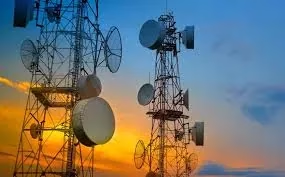
Nigerian telecom operators unite to protect infrastructure amid rising vandalism
Telecom operators in Nigeria have launched an Industry Working Group to safeguard critical telecommunications infrastructure across the country. This move comes in response to escalating cases of fiber cuts, equipment theft, and vandalism, which have significantly disrupted services and increased operational costs. The Working Group was established during a high-level meeting hosted by IHS Nigeria in Lagos, bringing together industry leaders, regulators, and law enforcement agencies under the Association of Licensed Telecom Operators of Nigeria (ALTON). Recognizing telecom infrastructure as vital for national security, economic growth, and social cohesion, stakeholders emphasized the urgency of collaborative solutions to address these challenges. Key Objectives of the Working Group:Real-time Monitoring: Leveraging advanced technology to monitor and protect telecom sites. Enhanced Security: Strengthening physical security measures around installations. Collaboration: Partnering with regulatory and security agencies to tackle vandalism and theft. Public Awareness Campaigns: Educating communities on the importance of safeguarding telecom assets. Dapo Otunla, Senior Vice President at IHS Nigeria, highlighted the daily losses faced by operators due to vandalism, stressing that protecting Critical National Information Infrastructure (CNII) is essential for sustaining Nigeria’s digital ecosystem. This initiative aligns with the government’s CNII policy. In August 2024, President Bola Tinubu signed an order designating telecom infrastructure as critical national assets and criminalizing their destruction. However, previous efforts to enforce similar protections have struggled to curb widespread vandalism.
Amazon photos app now lets you shop directly from your images
Amazon has launched a feature in its Photos app that allows users to shop directly from their stored images. The new tool, powered by artificial intelligence, enables customers to identify products captured in their photos and find similar items available for purchase on Amazon’s platform. Announcing the update on social media, Panos Panay, Senior Vice President of Amazon’s Devices and Services division, emphasized the convenience of the feature. “Awesome update to Amazon Photos – you can now search your photo library to find similar products on Amazon. Spot something you loved at a friend’s house or a toy your kid was obsessed with? Just search your photos and we’ll surface relevant items for you” – Panay The feature uses advanced AI technology to analyze images stored in the Amazon Photos app. Users simply select a photo containing a product they are interested in and tap the Lens icon within the app interface. The system scans the image, identifies recognizable items, and generates a list of visually similar products available on Amazon. Once the scan is complete, users are presented with direct shopping links that lead to Amazon’s retail app or website. From there, they can browse options, compare prices, and make purchases, all with just a few taps. Whether it’s stylish home decor, trendy outfits, or unique gadgets spotted in their photo collection, this tool streamlines the shopping experience by eliminating the need for manual searches. This latest addition is part of Amazon’s broader strategy to enhance customer engagement and boost sales through innovative features. Last month, the company began testing Native Commerce Advertising (NCA), an initiative designed to compensate media companies for directing traffic to its platform through product recommendations. Unlike traditional affiliate programs that pay commissions based on sales, NCA rewards publishers based on traffic volume alone. Major media companies like CNN and Vox Media have already begun testing NCA. While it offers new revenue streams for publishers amid declining advertising revenues, some have noted challenges such as fluctuating cost-per-click rates and potential impacts on editorial content. By integrating AI-powered tools like the Photos shopping feature and expanding advertising partnerships through programs like NCA, Amazon continues to solidify its position as a leader in e-commerce innovation.

Tinubu explains decision to appoint Bosun Tijani as minister despite past criticism
President Bola Tinubu has shed light on his decision to appoint Dr. Bosun Tijani as Nigeria’s Minister of Communications, Innovation, and Digital Economy, despite the tech entrepreneur’s history of public criticism against him and the National Assembly. Tinubu revealed that the move was driven by his belief in recognizing talent and prioritizing contributions to national development over past disagreements. Speaking during a special Iftar held at the Presidential Villa to celebrate his 73rd birthday, Tinubu acknowledged that nominating Tijani was a tough decision, especially amid pushback from close associates and members of his political party. “When I picked him, it was tough. My very close confidante, who had read his comments on social media, came to me and said, ‘No, never.’ But I said, ‘Yes, he is talented. Just because he criticizes me and the parliament doesn’t mean he has nothing to offer,’” Tinubu explained. The President added that he saw potential in Tijani’s record as an activist and believed that his past frustrations could drive him to make meaningful contributions to governance. “Today, he is doing that, and I am very proud of him,” Tinubu stated. Dr. Bosun Tijani’s nomination in 2023 stirred controversy due to his outspoken criticism of the All Progressives Congress (APC) government on social media. During his Senate screening, lawmakers raised concerns about his past remarks, including tweets where he referred to Nigerian senators as “morons.” Senate President Godswill Akpabio recounted the heated debate during the screening process, noting that senators initially opposed confirming Tijani. “When he came for screening, senators said, ‘No, we can’t have him.’ One senator quoted from the internet where he described all Nigerian senators as ‘morons.’ I had to stop proceedings and ask, ‘Did you write this?’ He admitted, ‘Yes, because that was how I felt then,’” Akpabio shared. Despite the backlash, the Senate ultimately confirmed Tijani based on trust in Tinubu’s judgment. Reflecting on his appointment, Tijani expressed surprise at Tinubu’s magnanimity. “Before my appointment, I had never met Mr. President,” he revealed. “But after my confirmation, he told me, ‘I have looked at your records and activism, and I have seen there is something in you. I am giving you the opportunity to represent your country and contribute to making it a better place.’” Since assuming office, Tijani has focused on advancing Nigeria’s digital economy by leveraging his extensive experience in technology and innovation. His plans include training over one million Nigerians in digital skills by 2027 and fostering collaboration between the government and tech innovators to position Nigeria as a global leader in technology. Tijani’s appointment highlights Tinubu’s willingness to prioritize merit over political loyalty, a decision that has already begun yielding results. As Senate President Akpabio remarked during the Iftar event: “Today, I’m happy to say he is one of the best-performing ministers in the cabinet.” Despite initial resistance from party loyalists and lawmakers, Tijani’s performance has earned praise across political divides.
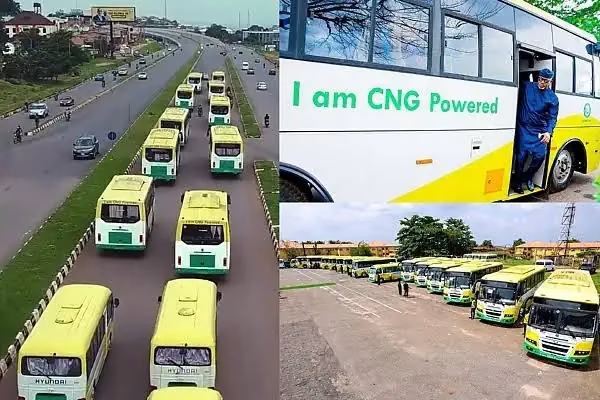
Nigerian government launches N2.5 billion credit scheme to boost CNG adoption
The Federal Government of Nigeria has introduced a N2.5 billion credit initiative aimed at promoting the use of Compressed Natural Gas (CNG) as an alternative fuel. The program, known as the Credit Access for Light and Mobility (CALM) scheme, was unveiled by the Presidential Compressed Natural Gas Initiative (PCNGi). The CALM initiative is designed to provide affordable financing options for Nigerians to convert their vehicles to run on CNG and support the local manufacturing of conversion kits. Speaking at the launch, Michael Oluwagbemi, CEO of PCNGi, emphasized that the program has the potential to drive domestic investment in the CNG sector while reducing energy costs for citizens. “This initiative will not only make it easier for Nigerians to access credit for CNG conversion but also encourage local production of these kits. By fostering domestic manufacturing capacity, we are creating jobs, promoting self-reliance, and supporting economic growth” – Oluwagbemi The scheme is being implemented through a partnership between the Ministry of Finance Incorporated (MoFI), Credicorp, and PCNGi. It is part of a broader government effort to transition Nigeria toward cleaner energy solutions and reduce dependency on traditional fuels. The CALM initiative builds on other government programs aimed at promoting CNG adoption. For instance, the “Transport Fare Drop Programme,” launched in collaboration with the National Union of Transport Workers (NURTW), offers free CNG conversions for public vehicles to lower transportation costs by up to 40%. Additionally, plans are underway to establish a CNG manufacturing park in Kogi State to support local production. Last year, Credicorp opened applications for the CALM Fund, enabling Nigerians to access financing for both CNG conversions and solar home systems through partner financial institutions. These efforts reflect the government’s commitment to easing financial pressures on citizens while advancing sustainable energy solutions. Oluwagbemi highlighted that initiatives like CALM are critical for attracting investments into Nigeria’s energy sector. “This program is not just about providing consumer credit; it’s about building a sustainable ecosystem that benefits everyone, from manufacturers to end-users,” he said. With these measures in place, the government hopes to accelerate the adoption of CNG as a cost-effective and environmentally friendly fuel alternative while boosting local industries and creating jobs.