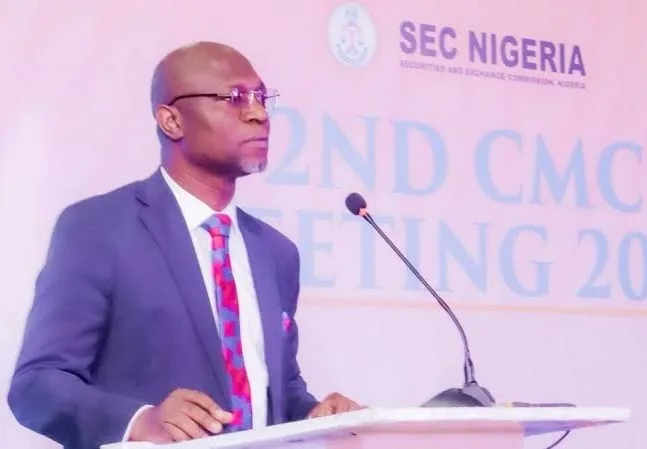
The Securities and Exchange Commission (SEC) has called for the use of Artificial Intelligence (AI) to improve how Nigeria’s capital market is monitored and regulated. At a recent lecture by the Capital Market Academics of Nigeria, SEC Director-General Dr. Emomotimi Agama explained that AI-driven systems would help regulators watch market activities in real time. This means quicker detection of fraud and better management of risks, moving away from the old reactive approach to a more predictive and tech-savvy way of overseeing the market. Dr. Agama pointed out that despite recent reforms, Nigeria’s capital market still struggles with issues like poor coordination between the SEC and the Central Bank of Nigeria, and challenges in raising capital fairly. He suggested Nigeria learn from the UK’s fintech model, which uses phased licensing and regulatory sandboxes to safely test new financial technologies. The SEC also projects Nigeria’s cryptocurrency market to grow to $52.5 million by 2028, showing the rising interest in digital assets. However, Dr. Agama stressed the need for clear regulations and stronger security to protect investors. He urged regulators, policymakers, and the private sector to work together to build a capital market that embraces innovation and gains investor trust.

Owolabi Salis makes history as first Nigerian to travel to space
Owolabi Salis, a Nigerian-born lawyer and politician based in the US, has become the first Nigerian to travel to space. On June 29, 2025, Salis joined five other private astronauts aboard Blue Origin’s NS-33 suborbital flight from West Texas. The 10-minute journey crossed the Kármán line, the internationally recognized edge of space, reaching an altitude of 105.2 kilometres. Salis described the mission as more than just a scientific trip. He called it a “spiritual journey” meant to inspire future generations, especially young Africans, to pursue science, technology, and space exploration. Born in Ikorodu, Lagos, Salis is also a chartered accountant and attorney licensed to practice in Nigeria and the US. He authored Equitocracy, a book advocating fairness and equity in democracy. Before this, Salis made history as the first Black African to visit both the Arctic and Antarctic in the same season. He has also been active in Lagos politics, running for governor under different parties over the years. Blue Origin’s New Shepard programme, led by Jeff Bezos, aims to make space travel accessible to civilians without the need for traditional astronaut training. Salis’s flight marks a proud moment for Nigeria, opening doors for more Africans to dream beyond Earth. Salis hopes his journey will spark curiosity and ambition among African youths, encouraging them to explore the vast possibilities in science and space technology.
Court denies bail to CBEX promoters in $1 billion crypto scam case
The Federal High Court in Abuja has refused bail to three promoters of the collapsed cryptocurrency platform CBEX, accused of defrauding Nigerians of over $1 billion. Justice Emeka Nwite made the ruling on June 30, 2025, after hearing bail applications from the suspects’ lawyers. The Economic and Financial Crimes Commission (EFCC) had arrested the promoters following allegations that they used CBEX and a company called ST Technologies to lure investors. After collecting huge sums, the platform suddenly became unreachable, locking out users from their funds. The judge said the evidence against the accused is strong and noted that the EFCC had already obtained a court order to detain them. Although no formal charges were filed when bail was requested, charges have since been filed and will be heard alongside any future bail applications. Justice Nwite also dismissed claims that one defendant needed urgent medical attention, saying the EFCC could provide hospital care if necessary. Recall that on April 21st, 2025, Daily Tech Nigeria reported that Dr. Emomotimi Agama, Director General of the Securities and Exchange Commission (SEC), warned that “becoming influencers or introducing meme coins that do not benefit the Nigerian public will not be tolerated.” He also stated that promoting unregistered or fraudulent investment schemes now carries severe legal consequences, including up to 10 years in prison and fines of at least ₦20 million under the new Investments and Securities Act (ISA) 2025. This decision is a key step in the ongoing investigation into one of Nigeria’s largest crypto scams. The EFCC continues to pursue the case as authorities seek justice for the many victims.
NCAA grounds Rano Air plane after mid-air engine failure and smoke incident
The Nigeria Civil Aviation Authority (NCAA) has grounded a Rano Air aircraft following an engine failure that caused smoke in the cabin and cockpit during a recent flight. The incident involved Rano Air’s plane with registration 5N-BZY, which experienced a malfunction on its number 1 engine. Smoke was detected in both the cabin and flight deck, prompting the crew to activate emergency protocols and don oxygen masks. The pilot managed to land the plane safely with no injuries reported. Recall in January 2025, a similar incident occurred at the Mallam Aminu Kano International Airport, where a Boeing 737 (5N-MBD) experienced a nose wheel collapse and rear tire burst during landing, where all 53 passengers and six crew members onboard were unharmed, cited by Daily Tech Nigeria on the 18th of March in a report. Following the safe landing, the NCAA’s Directorate of Airworthiness ordered the aircraft to remain grounded pending a full investigation. Engineers are currently inspecting the plane to determine the cause of the engine failure and smoke. The incident disrupted Rano Air’s operations, particularly affecting passengers scheduled to fly from Sokoto. A rescue plane intended to airlift stranded passengers was already committed to another route, leading to the cancellation of the Sokoto flight to avoid further delays and passenger inconvenience. NCAA emphasized that safety is its top priority and that Nigerian aviation standards often exceed global benchmarks. The agency reassured the public that flights are cancelled at the slightest safety concern to protect passengers. Passengers affected by cancellations are expected to receive support in line with consumer protection laws. NCAA will provide updates as investigations progress.
Nigeria ranks third in Africa for ransomware attacks in 2024, INTERPOL report shows
Nigeria has become one of the top targets for ransomware attacks in Africa, ranking third with 3,459 threat detections in 2024, according to the latest report by INTERPOL. The 2025 Africa Cyberthreat Assessment Report reveals that cybercriminals are increasingly focusing on African countries as the continent’s digital economy grows. Egypt and South Africa lead the list with 17,849 and 12,281 ransomware detections respectively, showing that countries with more digital infrastructure face higher risks. Ransomware attacks have hit important sectors like finance, government, telecommunications, and energy. One major case involved Nigerian fintech company Flutterwave, where hackers stole about $7 million in April 2024. Other attacks disrupted government agencies and utility services in Kenya, Cameroon, and South Africa. The report shows dangerous ransomware groups active in Africa, including LockBit, Hunters International, and BlackSuit. These groups use tactics like stealing data and threatening to leak it publicly if ransom demands are not met. Most ransoms are demanded in cryptocurrency, making it harder to track the criminals. Cybercrime now makes up more than 30% of reported crimes in West and East Africa, showing how urgent it is for governments and businesses to improve their cybersecurity defenses. Experts say the rise in ransomware attacks is a warning that digital safety must be a top priority as Africa’s online economy expands. Without stronger protections, more companies and public services risk costly disruptions and data breaches. The INTERPOL report calls for increased cooperation between countries and better security measures to fight these growing cyber threats. This trend affects everyone, from young professionals to students, because it threatens the stability of digital services we all rely on. Staying informed and cautious online is more important than ever.

Nigerian ‘businessman’ to be sentenced in US for $2.5 million romance scam
Charles Uchenna Nwadavid, a 35-year-old businessman from Abuja, will be sentenced in a US federal court on September 23, 2025, after pleading guilty to charges related to a $2.5 million romance scam. Nwadavid admitted to mail fraud and money laundering offences involving victims across the US between 2016 and 2019. He used cryptocurrency platforms like LocalBitcoins to move stolen funds, hiding their final destination. One victim from Massachusetts was tricked into receiving money from five others, which Nwadavid then transferred to his own accounts. He was indicted in Boston in 2024 and arrested in April 2025 after arriving at Dallas-Fort Worth Airport from the UK. If sentenced, Nwadavid could face up to 40 years in prison, fines of up to $750,000, and possible deportation after serving his term. The sentencing will be overseen by U.S. District Court Judge Leo T. Sorokin. This potential sentence follows a strict ruling handed down on June 18th, exactly 12 days ago, when Daily Tech Nigeria reported that five Nigerians were sentenced to a total of 159 years in prison for a $17 million fraud involving romance scams and other cybercrimes. This serves as a warning against online scams and the misuse of digital currencies in illegal activities.