
The Nigerian Communications Commission (NCC) is set to unveil a comprehensive cybersecurity framework next year designed to protect the nation’s telecom networks and strengthen digital safety for consumers. The plan, backed by the World Bank, aims to fortify Nigeria’s digital economy against rising cyber threats. Amid growing concerns over sophisticated cyberattacks targeting critical infrastructures, the NCC has intensified efforts to develop a detailed security blueprint for the telecom industry. This project emerged from collaborative discussions with industry leaders at a recent stakeholder workshop in Abuja, marking the second of such engagements in 2025. NCC’s Executive Commissioner for Technical Services, Abraham Oshadami, stressed the urgency of this endeavor, noting the evolving landscape of cyber risks that now extend far beyond data breaches to threaten human safety. He emphasized the critical role the telecom sector plays as the backbone of Nigeria’s digital economy, which makes it a strategic asset and a lucrative target for malicious actors. In his address, Oshadami explained that both governmental and non-governmental entities are increasingly coordinating attacks on essential systems, which places operational technologies at serious risk. The framework therefore aims to bolster the resilience of digital infrastructure through adaptive, inclusive safeguards that reflect the latest technological advancements. The NCC emphasized that the development of the cybersecurity plan has been highly consultative, incorporating feedback from telecom operators, government agencies, and cybersecurity experts. Dr. Kazeem Durodoye, CEO of CyberNover, the consultancy assisting the NCC, presented the refined draft, showcasing a multifaceted strategy that includes risk management, incident reporting, and cooperation with regulatory bodies. Babagana Digima, Head of Cybersecurity and Internet Governance at NCC, acknowledged the World Bank’s support and encouraged ongoing collaboration to ensure the final blueprint meets the needs of all stakeholders. According to Digima, formal adoption of the plan is anticipated in the third quarter of 2025, with rollout starting early next year. This comprehensive approach seeks to unify the industry under a national standard, requiring consistent audits, data protection protocols, and incident response mechanisms. It aligns with existing legislation such as the Cybercrime Prevention Act of 2015 and the Nigerian Data Protection Act of 2023, reinforcing Nigeria’s commitment to securing its digital future. This cooperative effort between regulators, industry players, and international partners shows a proactive commitment to protecting the country’s digital backbone while fostering trust and innovation within the sector, as cyber threats become increasingly complex.
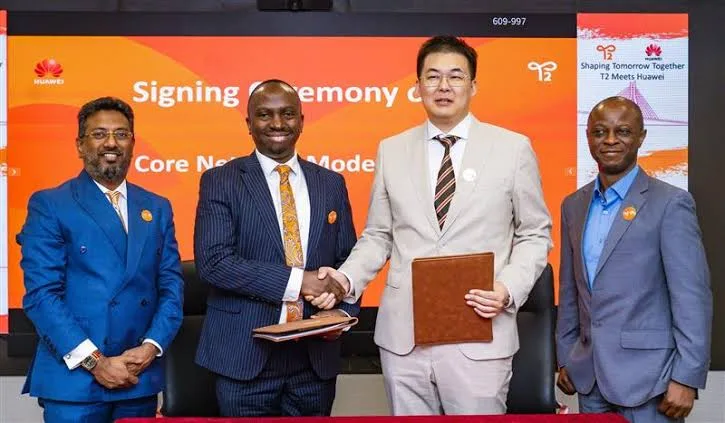
T2mobile partners with Huawei in multi-million dollar deal to revamp network infrastructure
Telecommunications provider T2mobile, formerly known as 9Mobile, has entered an agreement worth several million dollars with Huawei to enhance its network capabilities. At a formal event held in Lagos, Obafemi Banigbe, Chief Executive Officer of T2mobile, described the pact with Huawei as a vital stride towards sustained growth and innovation. He emphasized that leveraging the advanced technology from Huawei positions the operator to deliver more dependable services both now and in the future. This partnership transcends a conventional contract; it acts as a springboard for progress. Huawei has proven to be a steadfast collaborator throughout our journey, and this new phase cements our mutual dedication to creativity, dependability, and top-tier performance. With Huawei’s expertise, we’re not only enhancing our existing network, but also preparing it for the challenges ahead The overhaul of the core network infrastructure is slated for completion within the upcoming months, which shows T2mobile’s pledge to resilience and quality service for Nigerian users. The alliance will also enable T2mobile to tap into Huawei’s innovations for both network enhancement and improved cybersecurity, bolstering its competitive edge against industry giants like MTN, Airtel, and Globacom. Since transitioning from 9Mobile, the telecom operator has embarked on several critical ventures designed to transform its market position. This newly signed commitment with Huawei complements its recent cooperative agreement with MTN Nigeria, allowing for national roaming. That earlier collaboration permits T2mobile customers to utilize MTN’s expansive network in regions where its own footprint is limited, greatly enhancing coverage while optimizing operational costs. Such collaborative frameworks are intended to deliver a seamless digital experience to Nigerian subscribers and attract investor confidence through cost-effective network expansion. Data from the Nigeria Communications Commission (NCC) showed a subscriber increase of over 290,000 in July 2025, a rare positive shift compared to declines seen among other major providers during the same period. While challenges such as infrastructure vandalism and network interruptions remain prevalent in the Nigerian telecom landscape which to some extent are seen as roadblock, the company’s proactive strategies and strategic partnerships shows a promising road ahead.

9mobile achieves first subscriber growth of 2025 following strategic MTN infrastructure sharing deal
Telecom operator 9mobile, rebranded recently as T2, recorded a notable uptick in new subscribers in July 2025, marking its first growth spurt this year. This positive turnaround follows the implementation of an infrastructure sharing agreement with MTN Nigeria. After months of subscriber losses, 9mobile experienced a fresh increase, adding 290,601 new customers in July alone. This boost was driven largely by the collaboration with MTN, Nigeria’s largest mobile network operator, allowing 9mobile users to access MTN’s expansive network where 9mobile’s service was previously weak or unavailable. The national roaming pact, approved earlier in July by the Nigerian Communications Commission (NCC), enables subscribers of 9mobile to make calls, send texts, and enjoy data connectivity seamlessly across MTN’s infrastructure nationwide. By leveraging MTN’s well-established network, 9mobile avoided the high capital costs of expanding its own towers and infrastructure, turning this collaboration into a major boon for its operational viability. While 9mobile gained subscribers, overall active mobile subscriptions in Nigeria fell slightly, dropping from 171.5 million in June to 169.1 million in July 2025. The losses came primarily from competitors Airtel, MTN, and Globacom. Airtel, in particular, saw a steep decline of 2.4 million subscribers in the same period. Despite this, MTN maintained dominance with over half the market share, closely followed by Airtel, while 9mobile held a smaller, but now improving, position. Obafemi Banigbe applauded the leadership of the NCC and Minister Dr. Bosun Tijani for supporting a consumer-focused and resource-efficient telecom ecosystem. The infrastructure sharing agreement marks a step toward wider network inclusion and improved service quality in Nigeria’s telecommunications market.
NITDA issues urgent warning on critical eSIM security flaw affecting over 2 billion devices globally
The National Information Technology Development Agency (NITDA) has alerted Nigerians and the global tech community about a critical security vulnerability in embedded SIM (eSIM) technology that threatens over two billion devices, including smartphones, tablets, wearables, and Internet of Things (IoT) gadgets. The warning was issued on August 23, 2025, emphasizing the urgent need for device makers and service providers to take immediate action. The flaw, traced to the GSMA TS 48 Generic Test Profile (version 6.0 and earlier), exposes eUICC (Embedded Universal Integrated Circuit Card) chips to cyberattacks by allowing malicious actors to gain either physical or remote access to devices. If exploited, attackers could install harmful applets, extract sensitive cryptographic keys, or even clone eSIM profiles, leading to widespread communication interceptions and unauthorized device control. NITDA stressed that the vulnerability affects billions of devices globally, making it one of the most severe cybersecurity threats in recent times. This is a wake-up call for all stakeholders to act swiftly. Leaving this vulnerability unchecked could compromise national communication infrastructures and personal data privacy – said Dr. Amina Bello, NITDA’s Director of Cybersecurity A Lagos-based mobile user, Chinedu Okoro, shared his concerns I’ve been using an eSIM for over two years now. Knowing there’s such a vulnerability is unsettling, but I trust that updates will keep us safe. It’s vital for operators to communicate clearly with users like me Cybersecurity experts explained that as eSIM technology expands, so too must the rigor of security measures. eSIMs represent the future of connectivity, but their embedded nature means vulnerabilities at the chip level can have far-reaching consequences. Immediate remediation and ongoing vigilance are non-negotiable – Professor Ifeanyi Umeh, a leading cybersecurity analyst at the University of Lagos. NITDA plans to intensify collaboration with local telecom operators and international bodies to monitor developments and support implementation of necessary security patches. The agency also urges consumers to stay alert for official updates and to apply device updates promptly. Dr. Bello called on all Nigerians and global partners to prioritize these updates and work together to safeguard Nigeria’s communication networks.
MTN Nigeria to interrupt services in parts of Adamawa, Borno, and Kano for fiber network upgrade on August 24
Subscribers of MTN Nigeria in select areas of Adamawa, Borno, and Kano states will face short-term connectivity interruptions on Saturday, August 24, as the telecom company carries out essential maintenance on a key fiber optic route to enhance network performance. The telecom giant issued a statement on Friday revealing that the operation will impact 101 network sites spread across 15 Local Government Areas (LGAs). Scheduled to occur from 6:00 AM to 8:00 AM, the maintenance work involves transferring traffic to newly installed fiber optic infrastructure along the AFCOT–Bawo Village pathway in Adamawa State. This replacement is intended to permanently fix damaged fiber spans and bolster overall network stability. During the two-hour window, customers using 2G, 3G, and 4G services, as well as a number of corporate clients, may experience temporary disruptions. MTN explained that because the route is linear and unprotected, connectivity interruptions are unavoidable while upgrades are conducted in daylight hours due to security protocols. The affected regions include LGAs such as Girei, Song, Mubi North, Hong, Gombi, Fufore, Mubi South, Madagali, Michika, Maiha, Chibok, and Yola North in Adamawa; Askira/Uba and Shani in Borno; and Nasarawa in Kano State. While apologizing for any inconvenience caused, MTN emphasized that the enhancement aims to improve service reliability and quality for users within these communities. This scheduled outage also draws attention to the persistent challenge of fiber cuts nationwide. Telecom operators regularly grapple with damages caused by construction activities, vandalism, and fragmented coordination among stakeholders, posing operational and financial strains. Airtel Nigeria’s Director of Corporate Communications and CSR, Femi Adeniran, recently shared that his network experiences around 43 fiber cuts daily on average. Such damage disrupts customer experience, hampers businesses, delays government operations, and jeopardizes public safety, particularly during emergencies…We urge urgent, coordinated actions to protect this vital infrastructure for the benefit of all Nigerians Over the past six months alone, Airtel has recorded more than 7,700 incidents. Simultaneous fiber disruptions in May affected MTN and 9mobile users in Kebbi, Sokoto, and Zamfara states, demonstrating the widespread nature of the problem. In response, the Nigerian Communications Commission (NCC) announced a comprehensive approach combining regulatory enforcement, public awareness campaigns, and partnerships with security agencies to tackle the crisis. Recognizing telecommunications as Critical National Information Infrastructure (CNII) under the Cybersecurity Act, the government has emphasized the collective responsibility of operators, regulators, security bodies, and citizens to safeguard essential network assets. Since the route is linear and unprotected, service interruptions are necessary during the transition to new fiber infrastructure…all work will be done during daylight hours to ensure safety – MTN Telecom operators confront approximately 1,100 fiber cuts every week. Our multi-faceted strategy encompasses technical enforcement and collaborative efforts to secure the networks – Dr. Aminu Maida, Executive Vice Chairman of NCC, shared The critical network upgrade is underway, even as telecom providers and regulators tackle the ongoing challenge of fiber cable damage. With sustained efforts to safeguard infrastructure and strengthen collaboration, millions of Nigerians can look forward to more reliable and uninterrupted service in the near future.

Abu Dhabi’s Space42 sets sights on African expansion to rival Elon Musk’s Starlink in Nigeria and beyond
Abu Dhabi-based Space42 is making moves to broaden its presence across Africa, aiming to compete with Elon Musk’s Starlink service, which currently holds a strong foothold in Nigeria and 17 other countries. The company is engaging with key partners and preparing to deploy more satellites to boost internet connectivity on the continent. Space42, supported by Mubadala, Abu Dhabi’s sovereign wealth fund, is in preliminary negotiations with several influential organizations including the African Union Development Agency, Microsoft, Esri, and several financial backers. These talks seek to enhance Space42’s footprint throughout Africa’s diverse markets, according to CEO Hasan Al Hosani. Without setting a definitive fundraising goal, Space42 has already established a physical presence in select countries such as South Africa and Zimbabwe. Their early efforts involve linking schools and health clinics to the internet, bridging the digital divide in underserved areas. While Starlink dominates the African satellite internet landscape with over 8,000 low-earth orbit satellites worldwide, Space42 is rapidly closing the gap. The Emirati firm currently operates eight satellites but plans to launch three additional ones later this year. Collaborations with tech giants Microsoft and Esri focus on developing advanced mapping tools aimed at enhancing digital infrastructure across the region. There’s extensive groundwork that must take place locally in each country. Identifying partners, both governmental and private, is a key part of our approach to ensure our services integrate well with local needs. Africa’s young and rapidly expanding population creates a unique opportunity for satellite connectivity providers. Still, regulatory diversity requires tailored strategies for each nation – Hasan Al Hosani, CEO Africa’s strong demographic growth and the rising demand for internet access make the continent highly appealing to satellite internet providers. However, navigating the complex and varying regulatory landscapes across Africa’s 54 nations remains a challenge. Nigeria, where Starlink secured regulatory approval in 2022, is shaping up to be a critical market for Space42’s expansion. Millions of people living in remote and rural regions are eagerly waiting for reliable connectivity options, placing satellite services as a preferable alternative to traditional internet providers that struggle with last-mile delivery. As of the first quarter of 2025, Starlink had grown to become Nigeria’s second-largest internet service provider by subscriber numbers. Data from the Nigerian Communications Commission indicates that Starlink had 59,509 users in Q1 2025, down slightly from its peak of 65,564 in Q3 2024, but still ahead of most competitors. Despite its premium pricing, Starlink maintains popularity thanks to its quality and extensive coverage, outpacing over 200 other ISPs including Spectranet, the country’s pioneer 4G provider. Space42’s planned ventures into Africa is a bold attempt to disrupt the satellite internet market and extend digital access to regions where terrestrial networks remain scarce.