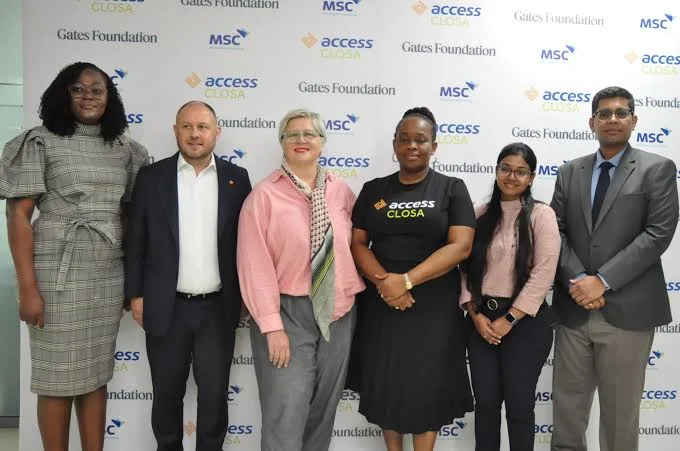
Access Bank Plc, in partnership with the Gates Foundation and MicroSave Consulting (MSC), has announced a new initiative aimed at empowering 50,000 female Cash In and Cash Out (CICO) agents across Nigeria. The program, known as Scaling Female Agent Networks in Nigeria (SFAN), seeks to boost women’s participation in agency banking by providing training, financial support, and digital tools. The three-year project will focus on rural and underserved areas, particularly in Northern and Central Nigeria, where access to financial services remains limited. By empowering women as agents, the initiative aims to deepen financial inclusion and enable more Nigerians to access banking services conveniently. “Agent networks are critical to improving financial inclusion in any country,” said Akshat Pathak, Associate Partner at MSC. “Female agents, in particular, play a vital role in empowering female consumers, who often feel more confident interacting with women for both transactions and financial advice.” Access Bank’s Senior Retail Advisor, Robert Giles, emphasized the bank’s commitment to sustainable banking and long-term impact. “Our projects are designed for the long term. We want to deliver better outcomes for our agents, who are also our customers,” Giles said. Chizoba Iheme, Group Head of Agency Banking and Financial Inclusion at Access Bank, highlighted that the bank will support agents with loans and training. “We aim to impact 50,000 female CICO agents by empowering them to perform more transactions and by gathering gender-disaggregated data to better understand their behavior,” she explained. The program also addresses challenges such as energy constraints in rural areas by partnering with a solar company to support agents in off-grid communities. Funded by the Gates Foundation, the initiative will include advisory and monitoring roles to ensure its success and sustainability. This partnership builds on Access Bank’s long-standing efforts to support women, dating back to 2013 with its Beta Proposition program, which currently maintains over 70% female participation in its Beta Friends workforce. The Scaling Female Agent Networks in Nigeria initiative represents a significant step toward financial inclusion, empowering women to become key players in Nigeria’s growing agency banking sector.

Telecom mast collapses on Ogun home during storm, landlord survives
A landlord in Unity Estate, Alagbole-Akute, Ogun State, narrowly escaped serious injury on Tuesday after a telecommunication mast crashed onto his building during a heavy rainstorm. The incident occurred around 2:39 p.m., when severe weather caused a mast belonging to IHS Company, located in Ajuwon, Akute, to collapse. The structure fell directly onto the residential property, damaging several sections of the house. Despite being inside at the time, the landlord suffered only minor injuries and is now in stable condition after receiving prompt medical attention. Ogun State Police Command spokesperson, CSP Omolola Odutola, confirmed the incident in a statement released Wednesday. “According to an eyewitness account, a communication mast belonging to IHS Company collapsed due to the severe weather conditions. The mast fell on a residential building in Unity Estate, Alagbole. Fortunately, the landlord, who was inside the house at the time of the incident, survived with minor bruises. He was promptly attended to by medical personnel and is confirmed to be in stable condition,” Odutola stated. Following the event, the state’s Commissioner of Police, Lanre Ogunlowo, directed area commanders to engage with companies owning masts near residential areas. The goal is to assess the structural integrity of these installations and ensure the safety of residents. The police have also launched a preliminary investigation and promised to keep the public informed of any developments. Residents are urged to remain vigilant, especially during adverse weather, and to report any structures that appear unstable. The police command emphasized its commitment to public safety and called for cooperation from both telecom companies and the community. No fatalities were reported, but the incident has raised concerns about the safety of masts located close to homes, particularly during Nigeria’s rainy season.

FG partners with Gates Foundation to launch $7.5 million Nigerian AI Scaling Hub
The Federal Government of Nigeria has signed a $7.5 million agreement with the Bill & Melinda Gates Foundation to establish the Nigerian AI Scaling Hub, a new initiative aimed at accelerating the use of artificial intelligence in key sectors like healthcare, agriculture, and education. The announcement was made by Dr. Bosun Tijani, Minister of Communications, Innovation, and Digital Economy, following a meeting with Bill Gates and the Gates Foundation team in Abuja on June 3, 2025. The minister emphasized that the hub will focus on practical AI applications that address everyday challenges faced by Nigerians. “This partnership reflects a shared belief that Nigeria can not only adopt technology but also shape it to solve real problems,” Tijani said. Bill Gates is currently on a visit to Africa, meeting with leaders and attending events such as the Goalkeepers Nigeria event, which highlights local AI innovations and efforts to strengthen primary healthcare. The Gates Foundation plans to invest the majority of its $200 billion funding over the next 20 years in Africa, focusing on health and development priorities.
Moniepoint secures regulatory approval to acquire 78% stake in Kenya’s Sumac Microfinance Bank
Nigerian fintech giant Moniepoint Inc. has received the green light from the Competition Authority of Kenya (CAK) to acquire a 78% stake in Sumac Microfinance Bank Limited, marking the company’s first major entry into Kenya’s financial services sector. The CAK’s unconditional approval follows a thorough review, which found that the acquisition would not harm competition or public interest in Kenya’s microfinance industry. Moniepoint, a U.S.-registered fintech operating primarily through its Nigerian subsidiary, will gain immediate access to Sumac, a licensed deposit-taking microfinance bank founded in 2002. Sumac offers services including lending, deposit-taking, leasing, insurance agency, money transfers, and forex trading. Sumac is classified as a medium-sized microfinance bank with a 4.3% market share, below the 5% threshold for large players in Kenya’s microfinance banking market, which is dominated by five large institutions holding nearly 84% of the market. The CAK noted that Moniepoint currently has no operations in Kenya, so the acquisition will not lead to market dominance or reduce competition. Importantly, the CAK confirmed that the transaction will not result in any job losses, with all existing Sumac employees retained under current terms. The deal is also expected to have no negative impact on small and medium enterprises (SMEs) or the broader financial ecosystem. Moniepoint’s acquisition of Sumac follows a previous unsuccessful bid to acquire Kenyan payments firm KopoKopo. This new deal offers Moniepoint a strategic foothold in one of East Africa’s most dynamic financial markets, enabling it to scale its digital payment and banking services to Kenya’s large mobile-first consumer base. The transaction is pending final approval from the Central Bank of Kenya, which oversees licensed financial institutions. Sumac currently manages over 43,000 active loan accounts and holds assets valued at approximately $23 million (KES 3 billion). The acquisition is expected to bring increased capital, innovation, and technology infrastructure to Sumac, enhancing its capacity to serve Kenyan consumers and SMEs. Moniepoint, founded in 2015 and valued at over $1 billion following recent funding rounds, aims to leverage this acquisition to deepen its presence in East Africa and accelerate financial inclusion through digital solutions.

EU to invest €10.4 million to power Nigerian primary healthcare centres with solar energy
The European Union (EU) has committed €10.4 million to the Nigeria Solar for Health Project (NISHP), aiming to provide reliable solar power to primary healthcare centres across Nigeria. The initiative seeks to improve healthcare delivery by ensuring 24-hour access to clean and sustainable energy in 45 public health facilities in states including Abia, Akwa-Ibom, Ogun, Plateau, and Enugu. Inga Stephanowicz, Head of Section, Green & Digital Economy at the EU, said the project will enhance Nigeria’s healthcare sector by powering essential services such as vaccine storage and emergency care. “This initiative marks a milestone in supporting Nigeria’s development goals by providing efficient solar energy to health centres,” she said during the NISHP workshop in Abuja. The project, running from 2024 to 2027, involves collaboration between the EU, Nigerian government, private sector, and local communities. It also plans to electrify small and medium-sized enterprises and telecom towers near healthcare facilities, boosting economic growth and community development. Nasiru Bello, Team Lead for NISHP, emphasized the project’s potential to transform healthcare outcomes and promote sustainable development. “With continued support and effective implementation, this initiative can make a lasting difference in the lives of millions of Nigerians,” Bello said. The NISHP also targets rural areas with limited electricity access, helping reduce reliance on fossil fuels and contributing to climate change mitigation. Stakeholder Engagement Expert Tinyan Ogiehor highlighted the broader environmental benefits, noting that solar power can promote sustainable energy solutions while improving medical care. This EU-funded project demonstrates a strong commitment to renewable energy and health infrastructure development in Nigeria, setting a model for similar initiatives across Africa.
NCC implements new USSD billing model – charges shift from bank accounts to mobile airtime starting June 3, 2025
Effective June 3, 2025, the Nigerian Communications Commission (NCC) has mandated an important change in the billing process for USSD banking transactions across Nigeria. Charges for USSD services will no longer be deducted directly from customers’ bank accounts again but will instead be debited from their mobile airtime balances, marking the official start of the End-User Billing (EUB) model with the aim of resolving a long-standing dispute between banks and telecom operators. The directive follows years of unresolved disagreements between Deposit Money Banks (DMBs) and Mobile Network Operators (MNOs) over the payment for USSD services used in banking transactions. Telecom companies had accused banks of deducting USSD fees from customers but failing to remit payments, leading to a debt estimated at over N250 billion. The Central Bank of Nigeria (CBN) and NCC jointly intervened, issuing directives to settle outstanding debts and streamline billing processes. Under the new EUB framework, customers will be charged ₦6.98 for every 120 seconds of USSD session time, with airtime deductions made only after user consent is obtained at the start of each session. This change ensures transparency and gives users control over their USSD transactions. Banks like United Bank for Africa (UBA) have already informed customers about the transition and reassured them of the availability of alternative digital banking channels such as mobile apps and internet banking. The NCC and CBN’s joint circular also introduced the “10-second rule,” stipulating that USSD sessions lasting less than ten seconds will not be billable, a measure designed to prevent unfair charges and enhance consumer trust. Furthermore, banks and telecom operators have been instructed to discontinue all ongoing litigation related to the USSD debt dispute and to comply fully with payment schedules set by regulators, with sanctions threatened for non-compliance. Gbenga Adebayo, Chairman of the Association of Licensed Telecommunications Operators of Nigeria (ALTON), outlined the significance of this move, noting that the dispute has persisted since 2019 and that the adoption of the EUB model represents a critical step toward resolving billing conflicts and ensuring sector stability. The USSD billing conflict has affected millions of Nigerians relying on mobile banking, with telecom operators threatening to disconnect banks from USSD services due to unpaid fees. The NCC and CBN’s coordinated approach seeks to balance the interests of telecom operators, banks, and consumers while safeguarding uninterrupted access to essential financial services. The transition to EUB is contingent on banks settling a significant portion of outstanding debts by set deadlines, with 85% of post-API invoices due by the end of 2024 and 60% of pre-API invoices required as full settlement. As the new USSD billing process takes effect, consumers are advised to monitor their airtime balances and consent to charges consciously. The NCC and CBN have pledged ongoing public enlightenment efforts to support a smooth transition. Meanwhile, Daily Tech Nigeria recently reported that NCC orders telecom operators to notify consumers ahead of service disruptions.