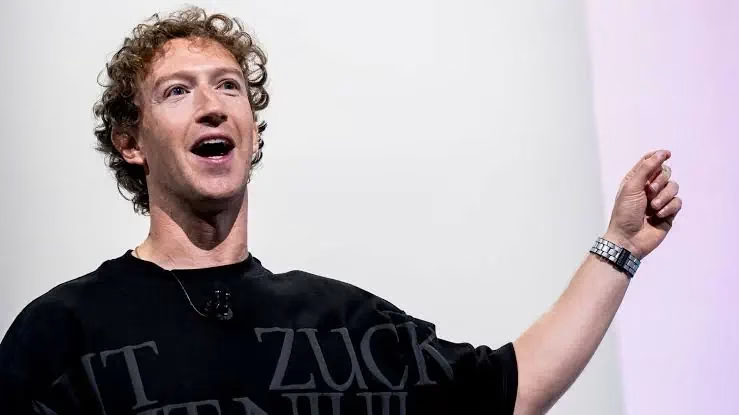
Millions of Nigerians could soon lose access to Facebook and Instagram as Meta, the parent company of both platforms, has threatened to suspend its services in the country following a series of hefty fines and what it calls “unrealistic” regulatory demands from Nigerian authorities. Last year, three Nigerian regulatory agencies-the Federal Competition and Consumer Protection Commission (FCCPC), the Advertising Regulatory Council of Nigeria (ARCON), and the Nigerian Data Protection Commission (NDPC)-slapped Meta with fines totaling more than $290 million. The penalties stem from alleged violations of competition, advertising, and data protection laws, including claims of anti-competitive practices, unauthorized advertising, and breaches of user privacy through the transfer of data abroad without proper consent. Meta challenged the fines in Nigeria’s Federal High Court in Abuja but lost. The court has now ordered the tech giant to pay the full amount by the end of June 2025. In court documents, Meta warned that it may be forced to “effectively shut down the Facebook and Instagram services in Nigeria in order to mitigate the risk of enforcement measures” if the situation is not resolved. While Meta also owns WhatsApp, the company did not mention the messaging app in its shutdown threat, suggesting that WhatsApp may remain available in Nigeria for now. Facebook remains the most widely used social media platform in Nigeria, serving tens of millions of users daily for communication, news, and business. The platform is especially vital for small online entrepreneurs and content creators who rely on it for their livelihoods. If Meta follows through with its threat, the shutdown could disrupt communication, online business, and access to information for millions across the country. At the heart of the dispute are Nigeria’s strict data protection requirements. Authorities have demanded that Meta obtain explicit approval before transferring any user data out of the country and add visible links on its platforms leading to educational content about the risks of manipulative and unfair data practices. Meta has described these demands as excessive and impractical, arguing that they place an unreasonable burden on its operations in Nigeria. The FCCPC’s chief executive, Adamu Abdullahi, said investigations conducted with the NDPC uncovered “invasive practices against data subjects/consumers in Nigeria,” though specific details were not disclosed. Meta has until the end of June to comply with the court’s order and pay the fines. The company has not yet announced its final decision, but the possibility of losing access to Facebook and Instagram has sparked concern among Nigerian users and businesses who depend on these platforms for daily activities. The BBC and other outlets have reached out to Meta for further comment, but the company has not responded as of press time.
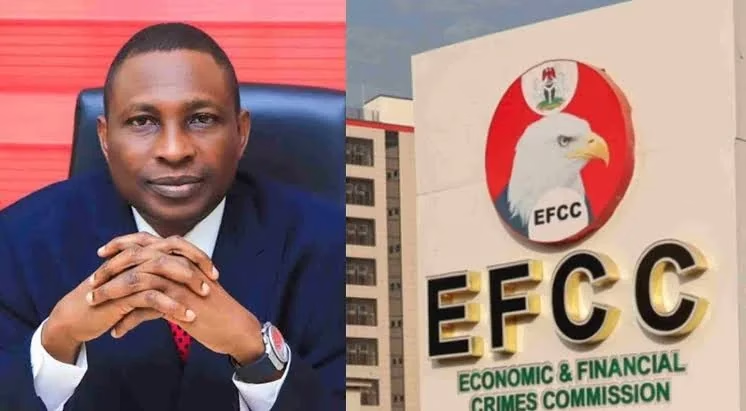
EFCC traces CBEX crypto funds to four countries, says full recovery unlikely
The Economic and Financial Crimes Commission (EFCC) has tracked funds from the failed CBEX crypto bridge exchange scheme to at least four countries, but warns that full recovery for victims may not be possible. EFCC Chairman Ola Olukoyede revealed this development during an interview on Channels Television. He explained that while the agency has managed to freeze several accounts and block some funds, the majority of the transactions were carried out in cryptocurrency and routed through wallets outside Nigeria’s jurisdiction. “We have been able to block some accounts. We have been able to freeze some funds, which I will not be able to give you a figure, but some reasonable amount of funds, we have been able to freeze,” Olukoyede said. “I will not sit down and tell you that we are going to restitute every victim. It will become practically impossible because quite a certain number of money has been dissipated and not within our system.” Olukoyede also stated that the main suspects behind the scheme are foreigners, complicating recovery efforts. The EFCC has arrested three individuals who are currently in custody and have provided useful information to investigators. The CBEX platform collapsed in April, leaving many Nigerians unable to access their investments. The Securities and Exchange Commission later confirmed that CBEX was not registered in Nigeria. A federal high court has since authorized the EFCC to detain six CBEX promoters over a $1 billion fraud allegation. Despite ongoing efforts and collaboration with international partners, the EFCC cautions that some victims may never recover their lost funds due to the cross-border nature of the crime and the use of digital currencies.

Social media activist VeryDarkMan arrested at GTBank, lawyer alleges inhumane treatment
Nigerian social media activist Martins Vincent Otse, widely known as VeryDarkMan (VDM), was arrested on Friday, May 2, 2025, at a branch of Guaranty Trust Bank (GTBank) in Abuja. The incident has sparked widespread concern online, with critics questioning the role of both the bank and the authorities in what some describe as a targeted crackdown on dissenting voices. According to VDM’s legal representative, human rights lawyer Deji Adeyanju, the activist was ambushed by operatives of the Economic and Financial Crimes Commission (EFCC) and the Nigeria Police Force shortly after visiting the bank with his mother. VDM had gone to the bank to address alleged unauthorized deductions from his mother’s account and to request a copy of her bank statement. Adeyanju claimed that VDM was deliberately trapped inside the bank’s exit door for over five minutes, a move he believes was orchestrated to allow EFCC officers to carry out the arrest. “VDM was locked inside the GTB exit door for over 5 mins to enable EFCC arrest him and his friend,” Adeyanju stated. He further described the treatment as inhumane and announced plans to take legal action against GTBank. VDM’s friend, identified as C Park, was also detained during the operation, but his mother was not arrested. Adeyanju confirmed that his legal team, led by Marvin Omorogbe, had located both men at the EFCC office and were working to secure their release. He added that VDM, who has been outspoken in his criticism of the Nigerian elite and government institutions, refused to see anyone while in custody. The exact reasons for VDM’s arrest remain unclear, as neither the EFCC nor the police have released an official statement detailing the allegations. The incident has fueled concerns about the use of state agencies to silence activists and critics, a trend observers say has become increasingly common in recent years. VDM’s arrest has drawn swift reactions on social media, with many Nigerians calling for his immediate release and demanding accountability from both GTBank and the authorities involved.
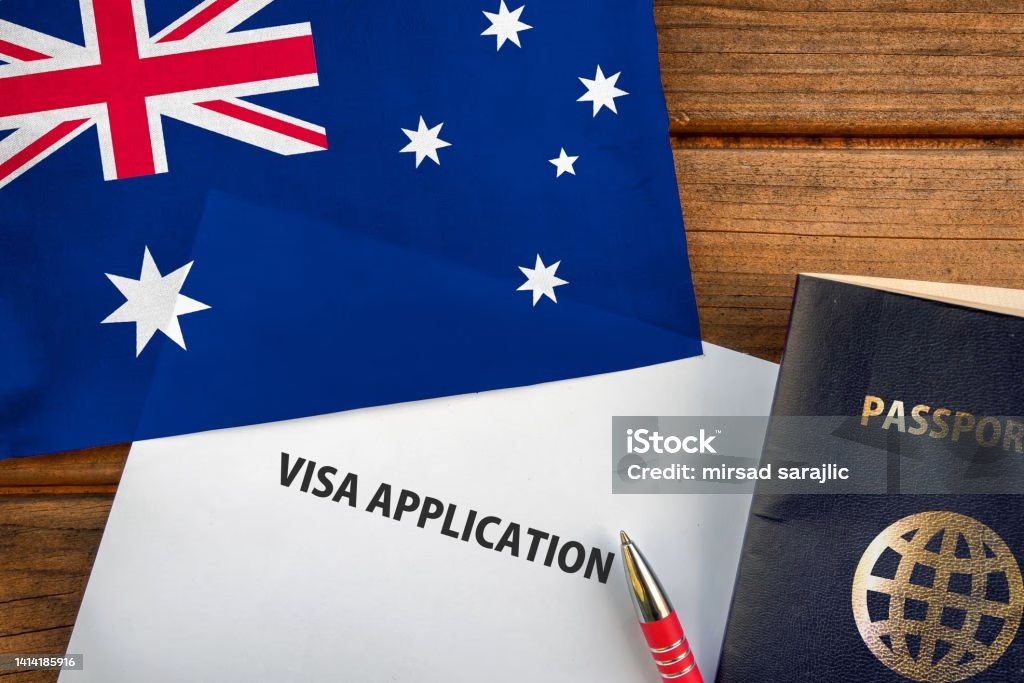
Australia unveils digital tools to speed up 2025 student Visa applications
Australia has launched two new digital tools aimed at making student visa applications faster and easier for international students starting in 2025. The Department of Home Affairs announced the rollout of the Visa Finder and Document Checklist Tool, part of a broader digital upgrade designed to reduce errors, improve document accuracy, and cut approval times for student visas. The Visa Finder helps applicants quickly identify the right visa for their needs by asking questions about their travel purpose, nationality, and length of stay. This feature is especially helpful for students deciding between the Student visa (subclass 500) and other options, such as Training or Graduate visas. Meanwhile, the Document Checklist Tool generates a personalized list of required documents based on the applicant’s country of passport and chosen education provider. This tool supports special categories, including government-sponsored students and those extending visas for PhD thesis marking, and is integrated with the ImmiAccount application system. Officials say these innovations will streamline the application process, reduce delays caused by missing paperwork, and improve approval chances for students. “By leveraging these digital tools, Australia aims to provide a smoother and more user-friendly experience for individuals seeking to study, work, or travel to the country,” the Department stated. Applicants are advised to use the tools via the Home Affairs website, ensuring all required documents are attached to avoid processing delays or refusals. For those whose education provider is not yet listed in the system, a placeholder option is available until records are updated. The launch comes as Australia continues to reform its migration system, with changes including higher student visa fees set for 2025.
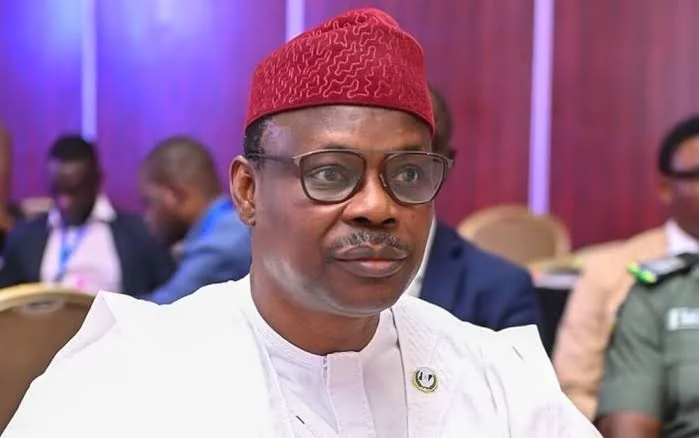
FG to launch electronic portal to fast-track health research in Nigeria by Q3 2025
The Federal Government has announced plans to roll out a groundbreaking electronic portal for health research proposal submission and approval before the end of 2025-a move set to transform Nigeria’s research landscape and align the country with international best practices. Speaking at a two-day workshop in Abuja, Minister of State for Health and Social Welfare, Dr. Iziaq Salako (represented by Dr. Kamil Shotirere), explained that the new e-portal will streamline the process for submitting, reviewing, and approving health research proposals. The system aims to eliminate bureaucratic delays, enhance transparency, and allow researchers to track their applications in real time, significantly improving efficiency and accountability. Members of the National Health Research Ethics Committee (NHREC) are being trained to use the platform, which will ensure that all research involving human participants adheres to strict ethical guidelines. Funded in part by the Gates Foundation and developed with technical support from the U.S. Centers for Disease Control and Prevention, the e-portal is expected to help Nigeria attract more international research collaborations and accelerate studies on national health priorities such as infectious diseases, maternal health, and non-communicable diseases. The government has set a target for the portal to be fully operational before the end of the third quarter of 2025, with pilot submissions starting earlier. Stakeholders believe this digital leap will not only boost Nigeria’s competitiveness in global health research but also ensure that ethical principles remain central to scientific innovation in the country.
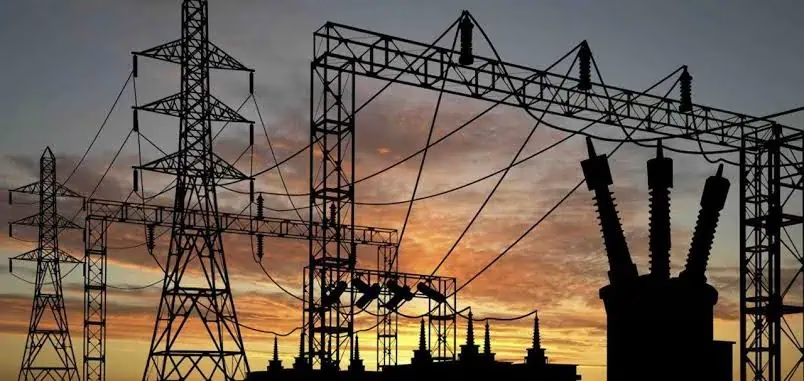
Wuse 2 businesses buckle under prolonged Abuja power crisis
Once the beating heart of Abuja’s commercial activity, Wuse 2 is now facing a dramatic downturn as an unrelenting power crisis pushes local businesses to the brink. For the past month, salons, boutique hotels, tech startups, cafés, restaurants, and corporate offices in the district have struggled through near-total darkness, forcing owners to scale back, relocate, or shut down entirely as they grapple with skyrocketing generator costs and erratic electricity supply. The blackout has upended daily life for business owners and workers alike. Seyi, who manages a beauty spa near Aminu Kano Crescent, described the dire situation: “We can’t afford diesel daily anymore. For every day the lights stay off, we lose customers and money. This is not sustainable”. Juliet, who left her 9-to-5 job to start a women’s clothing boutique in Wuse 2, is already considering closing shop. “I spend about N100,000 weekly on electricity. We hardly get five hours of light a day, even at the best of times, and we’re on Band A. Sometimes, for more than two straight days, we go without light. How much am I even making?” she lamented. For many, the cost of running generators has become unmanageable, and perishable goods are spoiling as operations grind to a halt. “Businesses in Wuse 2 are dying like flies… There’s little to no electricity provision in Abuja’s commercial hub for at least a month. They can’t run fully on generators. The cost of electricity is too high for even Aso Villa, let alone small businesses,” wrote resident Fakhuus Hashim on X (formerly Twitter), echoing the frustration and despair felt across the district. The crisis in Wuse 2 mirrors a broader national challenge. According to the Manufacturers Association of Nigeria, manufacturers spent a staggering N1.11 trillion on alternative energy in 2024-a 42.3% increase from the previous year. Energy spending jumped from N404.80 billion in the first half of 2024 to N708.07 billion in the second half, a 75% surge in just six months. These rising costs have trickled down to small and medium enterprises (SMEs), many of which now face insolvency. The Abuja Electricity Distribution Company (AEDC) has attributed some outages to technical faults and ongoing maintenance, but for Wuse 2, the crisis has dragged on far longer than typical disruptions. Residents and business owners say they feel abandoned, with no clear plan from authorities to restore reliable power. Industry insiders point to persistent infrastructure decay, the inability of distribution companies to meet commercial demand, and the rising price of gas and diesel as root causes of the crisis. “We were promised that metering and reforms would reduce inefficiencies. But what we have now is a system that fails at the very basic-keeping the lights on,” said Sule Muktar, a policy analyst at a local energy consultancy. Dr. Bulus Anag of Nasarawa State University warned that neglecting energy security could derail Nigeria’s ambitions of becoming a trillion-dollar economy. “When even Abuja’s most prestigious commercial zones can’t guarantee power, what message are we sending to foreign investors, startup founders, or global tech companies eyeing Nigeria?” he asked. For Wuse 2, the stakes are clear, without swift intervention, the district risks losing its status as a commercial powerhouse. The ongoing blackout is not just a local emergency but a stark reminder of the urgent need for sustainable energy solutions across Nigeria.