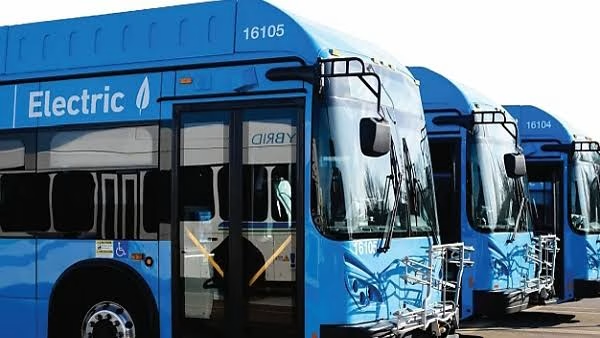
The Lagos Metropolitan Area Transport Authority (LAMATA) has announced plans to introduce articulated buses along the city’s Bus Rapid Transit (BRT) corridors, which represents a significant step toward expanding passenger capacity and modernizing Lagos’ public transport network. LAMATA Managing Director, Abimbola Akinajo, revealed the initiative during a recent episode of the “Mobility Redefined” podcast, hosted by transport technology firm Modaxo. While no specific rollout date was provided, Akinajo emphasized that deploying articulated buses-longer vehicles with a flexible midsection-will allow the BRT system to carry more passengers and operate more efficiently on dedicated lanes. “When we’re looking at BRT routes, obviously it’s about increasing the number of rolling stock we have, and beginning to look at the possibility of articulated rolling stock for the BRT routes because if they’re dedicated, then yes, we can utilize that,” Akinajo said. This is a strategy to reduce Lagos’ heavy reliance on informal minibus operators, known locally as danfos. Currently, danfos account for about 75% of daily passenger movement in Lagos, with over 75,000 minibuses operating across the city’s roads. The Lagos State Government’s long-term plan, outlined in the Strategic Transport Master Plan (STMP), aims to replace these with a fleet of 15,000 high-capacity buses. The STMP also includes the development of six rail lines, 14 BRT corridors, and more than 20 water transport routes. The first phases of the Blue and Red rail lines are already operational, with further extensions underway. Akinajo highlighted that integrating informal operators into the regulated system will be crucial. Some danfo drivers may be retrained or absorbed into new first-and-last-mile services, which will be subject to stricter standards such as digital ticketing and GPS tracking. LAMATA is also working to make Lagos’ public transport more sustainable. The agency is adopting cleaner fuel technologies, including compressed natural gas (CNG) and waste-to-energy solutions, and has started implementing an Intelligent Transport System (ITS) to improve bus scheduling, monitoring, and service delivery. To support seamless travel across different modes of transport, new interchanges are being constructed to connect buses, ferries, and trains. Akinajo also confirmed that service on the Lagos Blue Line will soon improve, with trains expected to run every 10 minutes during peak hours. Lagos state with this initiative, is taking bold steps to transform its public transport landscape, aiming for a safer, more efficient, and environmentally friendly system that meets the needs of its rapidly growing population.
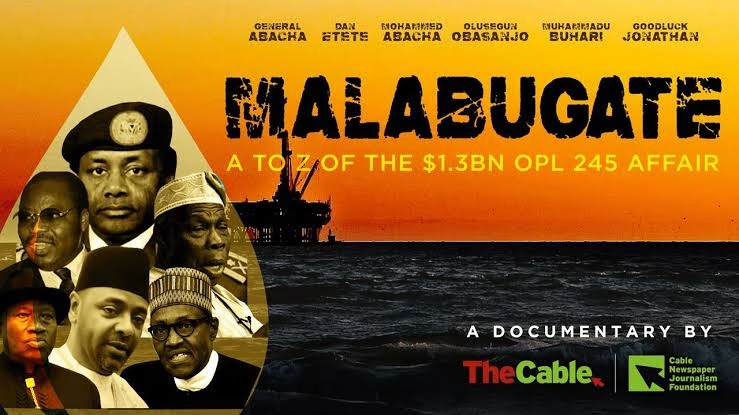
TVC news to air TheCable’s documentary on $1.3 billion Malabu oil scandal
TVC News will tonight broadcast the highly anticipated premiere of “Malabugate,” an investigative documentary that dives deep into the $1.3 billion OPL 245 oil saga-widely regarded as one of Nigeria’s most consequential and complex scandals. The documentary, produced by TheCable newspaper and the Cable Foundation, airs at 9pm and promises to shed new light on a controversy that has spanned decades, crossed borders, and dominated courtrooms around the world. The OPL 245 saga, also known as the Malabu scandal, traces its roots back to 1998, when the Nigerian military government awarded the lucrative oil block to Malabu Oil & Gas Ltd, a little-known company at the time. The situation took a dramatic turn in 2001 when President Olusegun Obasanjo revoked the licence, setting off a chain of legal battles, settlements, and international intrigue that continues to reverberate through Nigeria’s political and energy sectors. According to TheCable, “Malabugate” reconstructs the scandal from the ground up, offering viewers “an unprecedented narrative into the billion-dollar oil deal that has spanned administrations, borders, and courtrooms.” The documentary uses compelling storytelling and original investigative reporting to address questions that have lingered for years: Why did President Obasanjo revoke OPL 245 in 2001, only to settle out of court with Malabu in 2006? What led President Goodluck Jonathan to return the oil block to Malabu in 2010? Why did oil giants Shell and Eni pay $1.1 billion to acquire Malabu’s interest in 2011? What role did the Abacha family and former petroleum minister Dan Etete play in the saga? Why did President Muhammadu Buhari pursue criminal charges against key figures, and how did former Attorney-General Mohammed Bello Adoke become central to the court cases? Why did Nigeria lose all related court cases in Italy, the UK, and Nigeria? The documentary goes beyond the headlines, tracking the origin and allocation of OPL 245, following the global money trail, dissecting legal documents, and breaking down how some of the world’s biggest oil companies became entangled in the scandal. It also examines the impact of the controversy on Nigeria’s justice and energy sectors, offering viewers a comprehensive understanding of why the OPL 245 affair remains a defining chapter in the nation’s history.
Nigerian government stands firm as Meta threatens to pull Facebook, Instagram over $290 million fines
The Nigerian government has rejected Meta’s warning that it may shut down Facebook and Instagram in the country, insisting the tech giant must pay more than $290 million in fines for alleged violations of local data protection and advertising laws. The dispute escalated after a federal tribunal upheld a $220 million fine imposed by the Federal Competition and Consumer Protection Commission (FCCPC) for what regulators described as repeated breaches of Nigeria’s competition and data privacy rules. Additional fines from the Nigeria Data Protection Commission (NDPC) and the Advertising Regulatory Council of Nigeria (ARCON) bring Meta’s total penalty to over $290 million. Meta, which also owns WhatsApp, has said it will appeal the fines and warned it may be forced to suspend Facebook and Instagram services in Nigeria to avoid enforcement measures. However, WhatsApp was not included in Meta’s court filings regarding the shutdown threat. According to regulators, Meta’s infractions include unauthorized transfer and sharing of Nigerian user data, discrimination against Nigerian users, and enforcing unfair privacy policies. The NDPC has also ordered Meta to seek approval before transferring user data abroad and to produce educational content on data privacy risks in partnership with local organizations. “The Commission found that Meta Parties engaged in multiple and repeated infringements,” said Ondaje Ijagwu, Director of Corporate Affairs at the FCCPC. “Threatening to leave Nigeria does not absolve Meta of liabilities for the outcome of a judicial process.” Officials emphasized that Meta has complied with similar penalties in other countries and accused the company of trying to pressure Nigerian authorities by threatening to exit the market. Meta has until the end of June to comply with the tribunal’s order. The government maintains that the company cannot avoid its obligations by leaving the country and remains committed to enforcing consumer protection and data privacy standards.
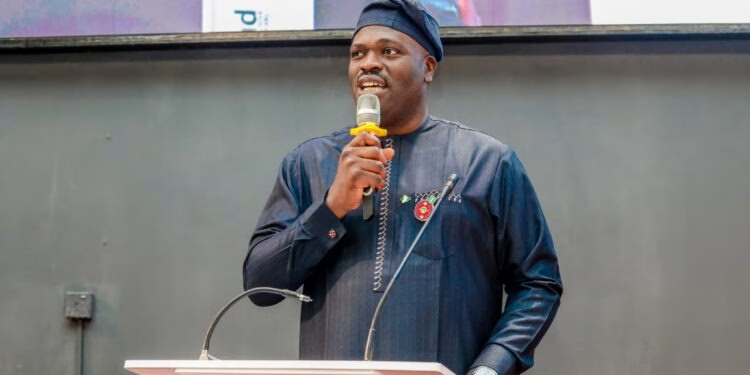
FG enforces 40% fare cut on CNG buses in Abuja to ease transport costs
The Federal Government has begun enforcing a 40% reduction in transport fares for commercial vehicles converted to run on compressed natural gas (CNG) in Abuja, aiming to make public transportation more affordable amid rising living costs. The initiative, launched Friday at Area 1 Motor Park in Garki, is a collaboration between the Presidential Compressed Natural Gas Initiative (P-CNGi) and the National Union of Road Transport Workers (NURTW). The fare reduction applies immediately to all NURTW vehicles that have switched to CNG, which are marked with official P-CNGi stickers for easy identification. “Our goal is to ease the financial burden on Nigerians by making public transport more affordable. We’ve partnered with NURTW, converted a large number of their vehicles, and agreed that fare reductions will follow as a direct benefit to commuters.”- said David Idakwo, regional CNG expansion coordinator, who represented P-CNGi CEO Micheal Oluwagbemi at the launch Passengers will now pay N900 instead of N1,500 from Area 1 to Gwagwalada, and N720 instead of N1,200 to Kuje. Other routes, such as Area 1 to Wuse, have dropped from N400 to N240, and Area 1 to Apo from N500 to N300. The fare cut comes as more than half of NURTW’s Abuja fleet has already switched to CNG, with further conversions and enforcement planned across the city and other states. Special attention is being given to airport shuttle operators, who are expected to announce new rates soon. To ensure compliance, a joint task force is monitoring the scheme, and passengers are encouraged to report violations via the P-CNGi hotline or email. Vehicles with reduced fares will display clear fare tags. The government’s push for CNG adoption is part of a broader effort to reduce reliance on petrol, lower transportation costs, and promote cleaner energy. Officials say the move will also help create jobs and support economic well-being for Nigerians. “We are building a cleaner environment for our nation as we move away from petrol and diesel,” Oluwagbemi said, highlighting the long-term benefits of the initiative. The fare reduction is expected to provide immediate relief for commuters, while supporting the government’s commitment to sustainable and affordable transportation.
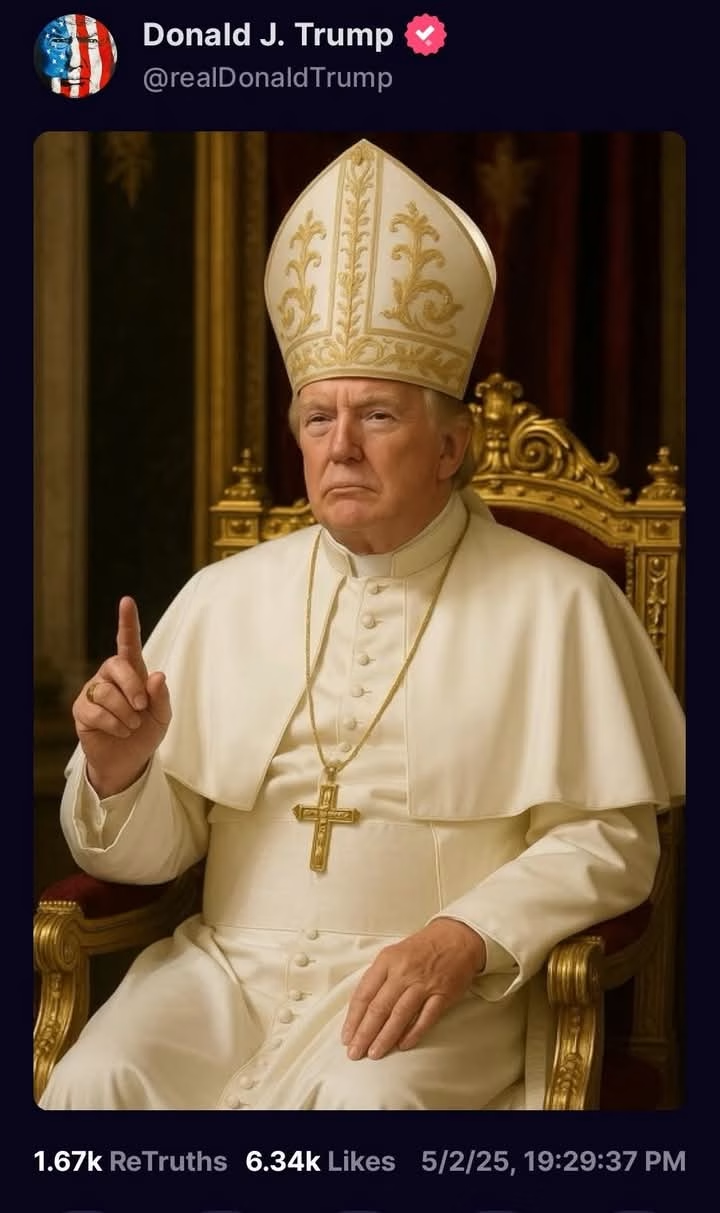
AI image of Trump as Pope goes viral, ignites debate over respect for Catholic church
US President Donald Trump ignited controversy on Saturday after posting an AI-generated image depicting himself as the new Pope. The image, shared on his Truth Social platform, showed Trump in traditional papal robes, complete with a mitre and golden crucifix, seated on a papal throne with his finger raised. The post quickly garnered over 12,000 reactions and was later reposted by the White House’s official X account. The timing of the post drew particular attention, coming just days after the death of Pope Francis at age 88. Trump, when asked by reporters about the papal succession, had joked, “I’d like to be Pope. That would be my number one choice,” further fueling discussion around the image. Public reaction was swift and divided. Many Catholics and social media users condemned the post as disrespectful, especially as the Catholic community mourns the late pontiff. “Please take this down,” pleaded one user. “Many Catholics, myself included, find this as a great disrespect to the past and future leader of our church.” Others described the image as a mockery of a sacred institution. Trump also faced criticism for his conduct at Pope Francis’ funeral last week, where he was seen wearing a blue suit and chewing gum during the ceremony. Some commentators called his actions and the AI post inappropriate during a period of mourning. The incident has sparked a wider debate about the use of AI in political satire and the boundaries of public figures’ behavior, especially during sensitive times. As the conclave to select a new pope continues, the controversy underscores the challenges of navigating respect, technology, and public discourse in 2025.
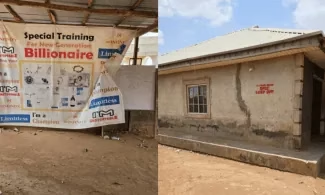
EFCC arrests three over Q-net scam, fake university degrees in Abuja
Operatives of Nigeria’s Economic and Financial Crimes Commission (EFCC) have arrested three men in Abuja for allegedly running a fraudulent scheme linked to the Q-net brand and operating a fake university, authorities confirmed on Thursday. The suspects-Olaniyan Joshua, Oyetunde Julius Akano, and Victor Oluwale-were taken into custody on May 1, 2025. According to the EFCC, they operated under the name “Mighty Infinity Millionaire Limited” and falsely claimed to represent Q-net, a global e-commerce and direct selling company. Q-net has denied any connection to the suspects or their activities. Investigators say the trio lured victims with promises of university degrees in fields such as Medicine, Nursing, Cybersecurity, and Geology, claiming a partnership with Quest International University in Malaysia. The Malaysian institution has also denied any affiliation. Classes were reportedly held under makeshift pavilions and even under trees. Victims, mostly students, paid between ₦1.2 million and ₦1.3 million each in registration fees. The EFCC estimates the suspects collected hundreds of millions of naira through the scam. This latest arrest follows a March 24, 2025, EFCC raid on “Q-net University” in Gwagwalada, Abuja, where 133 suspects were detained for similar offenses. The EFCC says the suspects are currently under interrogation and will be charged to court after investigations conclude. Authorities are urging the public to be cautious of fraudulent schemes and to verify the legitimacy of organizations before making financial commitments.