
The Federal Government has justified its decision to install a ₦10 billion solar power grid at the Aso Rock Presidential Villa, describing the move as necessary to curb what it calls an “unsustainable” annual electricity bill of ₦47 billion. The announcement was made Friday by Dr. Mustapha Abdullahi, Director-General of the Energy Commission of Nigeria (ECN), during a press briefing in Abuja. According to Abdullahi, the project-approved by President Bola Tinubu-aims to provide uninterrupted, clean energy to the seat of power, reduce the cost of governance, and lessen pressure on the national grid. “This project will not only ensure steady power supply at the Villa but also create jobs and foster innovation among Nigerian engineers and energy experts,” Abdullahi stated. Earlier this year, the Abuja Electricity Distribution Company (AEDC) threatened to disconnect the Presidential Villa and other government agencies over a collective ₦47.1 billion debt, with Aso Rock’s share initially reported as nearly ₦924 million. President Tinubu intervened, directing immediate settlement after a reconciliation process revealed the actual outstanding bill was ₦342 million. Government officials argue that the solar project aligns with Tinubu’s energy diversification agenda and could attract further investment in Nigeria’s power sector. Abdullahi revealed that development partners have earmarked about $5.3 billion for grid expansion and related initiatives. However, the decision has sparked debate among citizens and energy experts. Critics question the timing and cost of the project, especially as millions of Nigerians face high electricity tariffs and unreliable supply. Supporters, meanwhile, see it as a step toward sustainability and a model for other public institutions.

OPay shines as only fintech winner at 2025 Vanguard awards
OPay, one of Nigeria’s leading digital financial service providers, has clinched the title of “Most Innovative Fintech of the Year” at the 2025 Vanguard Awards, standing out as the only fintech company recognised at the event held at Eko Hotel and Suites, Lagos, on April 11, 2025. The award spotlights OPay’s relentless drive to expand financial inclusion and boost digital security for millions of Nigerians. The company has rolled out several groundbreaking features, including the Large Transaction Shield for enhanced security and NightGuard, which restricts account access during high-risk nighttime hours. These innovations, combined with user-friendly tools like network status notifications before transfers, double verification to prevent errors, facial verification for transactions, lightning-fast transfers, and responsive in-app customer service, have earned OPay widespread praise on social media and set it apart in Nigeria’s crowded fintech sector. Receiving the award, Elizabeth Wang, OPay’s Chief Commercial Officer, said, “We are deeply honored to be recognized as the Fintech Company of the Year. This award reaffirms our vision of creating a secure, inclusive, and innovative financial ecosystem for every Nigerian. We dedicate this achievement to our loyal customers who inspire us every day to do better”. Founded in 2018, OPay is licensed by the Central Bank of Nigeria and insured by the NDIC. The company offers a wide range of digital financial services, including money transfers, bill payments, airtime and data purchases, and merchant payments. This latest recognition cements OPay’s leadership role in shaping Africa’s digital payment landscape and its commitment to innovation, security, and customer-centric solutions.

FBI dismantles Nigerian-linked sextortion ring, links 20+ suicides to $65M scam
The FBI has disrupted a global sextortion network tied to Nigerian perpetrators, arresting 22 suspects and linking the crimes to over 20 American teen suicides. Victims lost nearly $65 million in two years, with cases surging 30% in recent months. Perpetrators posed as peers or love interests on social media, luring victims, mostly boys aged 14–17, into sharing explicit photos. They then demanded payments via gift cards, crypto, or wire transfers, often continuing threats even after payment. The emotional toll proved deadly: more than 20 minors died by suicide since 2021, including Jordan DeMay, a Michigan teen blackmailed by Nigerian brothers Samuel and Samson Ogoshi, who now face up to 30 years in prison. The FBI’s unprecedented crackdown involved agents from 13 U.S. cities, including St. Louis, collaborating with Nigerian authorities. “There’s no place to hide. Criminals will face consequences,” said FBI attaché Otunde Ademi in Nigeria. Three suspects have been extradited to the U.S., with others awaiting transfer. One grieving parent featured in an FBI video compared the crime to a home invasion: “Imagine someone frightening your child to death”. Investigators noted sextortion’s cyclical nature, perpetrators often escalate demands, leaving victims trapped in shame. Authorities urge parents to discuss online risks openly. “Children need to know they can come to you,” stressed St. Louis FBI agent Joe Weston. Public awareness campaigns in Nigeria aim to deter youth from viewing sextortion as a “victimless” crime, per EFCC investigator Abba Sambo. Victims should report incidents immediately via the National Center for Missing & Exploited Children. All suspects remain innocent until proven guilty.
MTN confirms cyberattack as customer data exposed in select markets
Africa’s largest telecom operator, MTN Group, has reported a cybersecurity breach resulting in unauthorized access to personal data of customers in select markets. The company confirmed that its core network, billing systems, and financial infrastructure remain secure and fully operational, with no evidence of compromised accounts or digital wallets. The breach, attributed to an unidentified third party, targeted parts of MTN’s systems but did not affect its Nigerian operations, according to sources. MTN swiftly activated its cybersecurity protocols, notifying law enforcement agencies including South Africa’s SAPS and the Hawks, and began alerting impacted customers in compliance with local regulations. Customers are urged to update apps, use strong passwords, enable multifactor authentication, and avoid suspicious links. The incident underscores rising cyber threats faced by global telecom providers, following similar attacks on operators like South Korea’s SK Telecom.
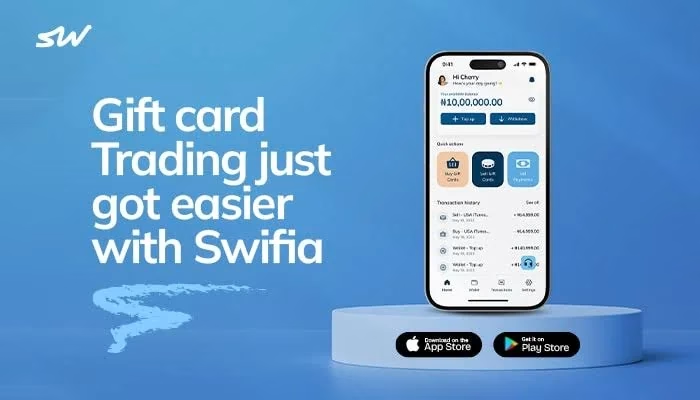
Swifia launches in Nigeria, promises instant gift card cashouts and unmatched reliability
A new era has begun for Nigerians looking to trade gift cards, as Swifia officially launches with a bold promise: instant payouts, top market rates, and a seamless, secure experience for all users. Swifia, now available nationwide, is designed to eliminate the usual headaches of gift card trading, no more slow transactions, unclear rates, or unreliable platforms. The platform supports a wide range of gift cards, including popular options like Amazon, eBay, Walmart, Apple/iTunes, Google Play, Steam, Xbox, PlayStation, and more, making it easy for anyone to convert unused cards into instant cash. What sets Swifia apart is its focus on speed and reliability. Trades are processed in real time, meaning users receive payouts immediately after a successful transaction. The platform also boasts some of the best exchange rates in the market, ensuring users get maximum value for their cards. Security is a top priority, with end-to-end encryption and fraud protection built in from the ground up. Swifia’s clean, user-friendly interface is designed for everyone, from first-time traders to seasoned pros. Whether you’re a student, entrepreneur, freelancer, or professional, Swifia aims to make gift card trading simple, transparent, and rewarding.
Nigeria eyes ₦13.8 billion data protection revenue in 2025
Nigeria’s data protection sector is set for another record year, with the Nigeria Data Protection Commission (NDPC) projecting ₦13.8 billion in revenue from the ecosystem in 2025, a 15% increase from the ₦12 billion generated in 2024. The NDPC’s National Commissioner, Dr. Vincent Olatunji, shared the outlook in Abuja, highlighting that the growth is driven by a surge in licensed Data Protection Compliance Organisations (DPCOs). These firms, established by trained professionals, help businesses navigate privacy laws and ensure compliance, with some charging as much as ₦10 million to ₦20 million for audit services, especially for multinational clients. Olatunji noted that each DPCO typically employs five to ten people, contributing to job creation and supporting Nigeria’s digital economy ambitions. As of early 2025, 256 DPCOs had been registered, with 55 more added in just a few months. He emphasized that the NDPC’s ultimate goal is to foster a culture of compliance, making Nigeria a trusted destination for digital business and foreign investment. “We want a country where foreign investors can trust our digital economy. This will attract direct foreign investment, create jobs, and provide wealth-building opportunities for the youth,” Olatunji said. Nigeria’s data protection framework received a major boost with the Nigeria Data Protection Act (NDPA) signed into law in 2023, replacing the earlier 2019 regulations and setting a new standard for personal data regulation in the country. Despite challenges like limited funding, the NDPC remains optimistic about the sector’s future, positioning Nigeria as a model for data privacy in Africa.