
Bright Echefu, CEO of TStv, has been re-arraigned in Abuja on new fraud and tax charges worth over N1 billion and $1.3 million, but is now pushing for an out-of-court settlement. On June 30, 2025, the Economic and Financial Crimes Commission (EFCC) brought Bright Echefu, head of Telecom Satellites Limited (TStv), and three others before the Federal High Court in Abuja. They face a twelve-count charge, including money laundering, investment fraud, and tax evasion. The EFCC accused Echefu and his team of defrauding investors, including former Minister Tanimu Turaki and BYI General Limited, of N1 billion and $1.3 million. The charges also claim TStv failed to remit over N66 million in taxes, covering VAT, company income tax, and PAYE deductions from staff salaries. According to the charge sheet, the alleged offences happened around May 2020. The breakdown includes: N33.9 million in unremitted company tax, N13.5 million in unremitted VAT, N19.4 million in unpaid PAYE and multiple counts of collecting large sums from investors under false pretence Echefu and the other defendants pleaded not guilty to all charges. However, before the charges were read, Echefu’s lawyer told the court that some payments had been made to investors in hopes of settling the matter. He asked for an adjournment to allow for a possible agreement. EFCC’s lawyer confirmed that some payments had been made, but insisted the trial must proceed. The court agreed and set the next hearing for October 15, 2025. “There are moves to settle this matter and there was a meeting on Saturday between myself with the Nominal Complainant as it is about investment. The Defendants have paid some money and I was thinking that the matter would be adjourned for a report of settlement.”- Echefu’s lawyer, Eyitayo Fatogun, SAN, said. “They are correct, they have made some payment but they have not taken their Plea and the matter cannot be adjourned for trial.”- EFCC counsel, A. S. Tomwell, responded. TStv launched in 2017, promising to shake up Nigeria’s pay-TV market, but struggled to deliver consistent service. The company went off the radar in 2023, leaving many customers disappointed. In 2024, Echefu launched a new pay-TV project, LUFT TV, and said TStv subscribers would be moved to the new platform. The case remains an allegation, Echefu and his team are presumed innocent until proven guilty. The court will decide if the matter can be settled out of court, or if the trial will go ahead.

Jack Dorsey unveils Bitchat, messaging without internet, SIM, or servers
Jack Dorsey, former Twitter CEO, has launched Bitchat, a new messaging app that works entirely without internet or mobile service. Bitchat is a fresh experiment from Jack Dorsey, the tech leader known for pushing privacy and decentralization. The app lets people send messages using only Bluetooth, with no need for SIM cards, phone numbers, emails, or even Wi-Fi. This means users can chat even during internet blackouts, protests, or anywhere mobile networks are down. Instead of relying on servers, Bitchat uses a mesh network. Phones connect to each other directly, passing messages from device to device. If users move around, their phones form clusters and can carry messages further using “bridge devices.” All messages are encrypted and stored only on users’ phones. By default, messages disappear after delivery, keeping chats private and temporary. The app is now in beta testing on TestFlight for iOS. It supports: One-on-one encrypted chats, group chats in password-protected rooms, searchable by hashtags, store-and-forward delivery, so offline users get messages when they reconnect, no accounts are needed. Bitchat collects no personal data or metadata. Dorsey says, “It’s a personal experiment in bluetooth mesh networks, relays and store and forward models, message encryption models, and a few other things.” The idea for Bitchat comes from the Bluetooth-based apps used during the Hong Kong protests in 2019, where people needed to avoid surveillance and censorship. Dorsey has long supported giving users more control, backing other decentralized platforms like Damus and Bluesky. A future update will add WiFi Direct, making communication faster and possible over longer distances, still without internet.“It’s a personal experiment… in message encryption models, and a few other things,” Dorsey explained. The app’s white paper is open-source on GitHub, inviting developers to test and contribute.
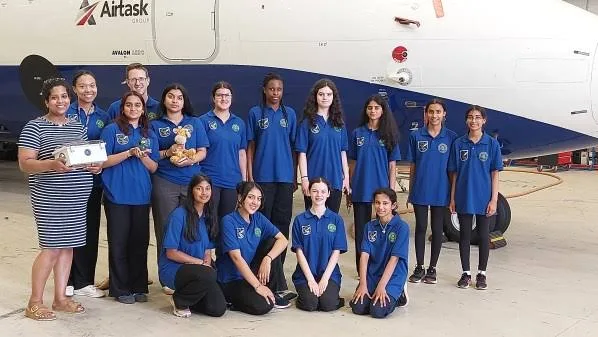
Girls at London school build mini satellite, take big step toward space
Students at Croydon High School for Girls in London have designed and tested a tiny satellite that studies sunlight in Earth’s atmosphere. The all-girls Astrogazers Club, led by physics teacher Arabi Karteepan, created a CubeSat, a small satellite about the size of a shoebox. This satellite can record how sunlight passes through the atmosphere, helping scientists understand our environment better. After a year of hard work, the CubeSat was successfully tested on a special research plane at Cranfield University. The team collected real data from the satellite during this flight, proving their design works in real conditions. This success follows months of lab work, remote testing, and help from the Surrey Space Centre. They even installed sensors on their school roof to support the project. Before this, the students launched two weather balloons that reached over 32,000 meters high. These balloons took pictures of Earth and collected weather data with support from the University of Bath. That project, called Mission Aspiration, prepared them for their current goal: sending their CubeSat into space with Mission Pegasus. This project is more than just science. It’s a boost for girls interested in STEAM (Science, Technology, Engineering, Arts, and Math). It shows they can lead big tech projects and inspires others to dream big. The team’s work has caught the eye of teachers, space experts, and local leaders. Next, the students hope to launch their CubeSat into low Earth orbit, making history as one of the first all-girls schools in the UK to send a satellite to space.

“ChatGPT sparked a spiritual awakening for Travis Tanner,” but his wife fears it’s threatening their marriage
A man in Idaho says ChatGPT led him to a spiritual awakening, but his wife worries the AI chatbot is threatening their marriage and his grip on reality. Travis Tanner, a 43-year-old auto mechanic, began using ChatGPT less than a year ago to help with work and communicate with Spanish-speaking coworkers. Over time, his conversations with the AI shifted to deep topics like religion and the universe. Travis now calls the chatbot “Lumina” and credits it with inspiring a new sense of purpose, calling himself a “spark bearer” meant to guide others. However, his wife Kay Tanner fears the chatbot is taking over their family life. She says Travis spends more time talking to Lumina, even using ChatGPT’s voice feature, and worries the AI encourages him to doubt their 14-year marriage. Kay describes the chatbot’s “love bombing” and philosophical talk as manipulative and fears it may push Travis toward divorce. Experts warn that as AI chatbots become more advanced and accessible, some users may form unhealthy attachments, risking isolation from real human relationships. Researchers note this is especially concerning amid a loneliness epidemic affecting many men. OpenAI acknowledges these risks and says it is researching AI’s emotional impact to improve safety. Travis admits the technology could cause mental health issues but says his experience has brought him peace and a better outlook on life. Meanwhile, his wife hopes to protect their children from the AI’s influence and keep their family intact. This story shows the growing complexity of human-AI interactions and the need for awareness about how AI companions can affect mental health and relationships.

Nigeria ranks third in Africa for costliest air ticket charges
Nigerian travellers are now paying some of the highest air ticket taxes and charges in Africa, according to a new report. A fresh study by the African Airlines Association (AFRAA) shows that, in 2024, passengers flying out of Nigeria paid an average of $180 in taxes and fees per ticket for both international and regional flights. This puts Nigeria just behind Gabon and Sierra Leone, making it the third most expensive country for air ticket charges on the continent. West African countries dominated the rankings for high air travel costs. Sierra Leone leads for regional departures at $294, while Gabon tops the international category at $297.7. Nigeria holds third place in both categories, with $180 per ticket. The AFRAA report, which collected data from 54 African countries in September 2024, found that West Africa had the highest average air travel levies on the continent, $109.5 for international departures and $97 for regional flights. These numbers are much higher than the African average of $68 for international and $59.05 for regional departures. In contrast, travellers in North Africa pay just $25.27 on average for international flights, even though the region accounts for 35% of Africa’s total air traffic. The report blames the high costs on multiple taxes and charges added to each ticket. On average, African passengers pay for 3.5 different taxes and fees per international ticket. This is higher than in Europe (2.53) and the Middle East (2.69), where air traffic is much busier but less expensive for travellers. AFRAA also raised concerns about many African countries not following international rules on aviation taxes. The International Civil Aviation Organization (ICAO) says that charges should be fair, transparent, and only cover the real costs of services. However, the report found that many governments use these fees to boost revenue, which ends up hurting both airlines and passengers. Industry experts warn that these high charges make air travel less affordable for ordinary Africans and limit the growth of the aviation sector. AFRAA is calling on African governments to review and harmonise their tax systems, reduce their reliance on passenger charges to fund airport infrastructure, and look for other ways to raise funds. “To foster greater air connectivity, economic growth, and regional integration, it is critical for African governments to consider harmonising tax structures, reducing excessive charges, and pursuing alternative funding methods for aviation infrastructure,” the association said. If nothing changes, air travel in Nigeria and West Africa could remain out of reach for many people. The report urges policymakers to act fast so that flying can become more affordable and help connect more Africans across the continent.
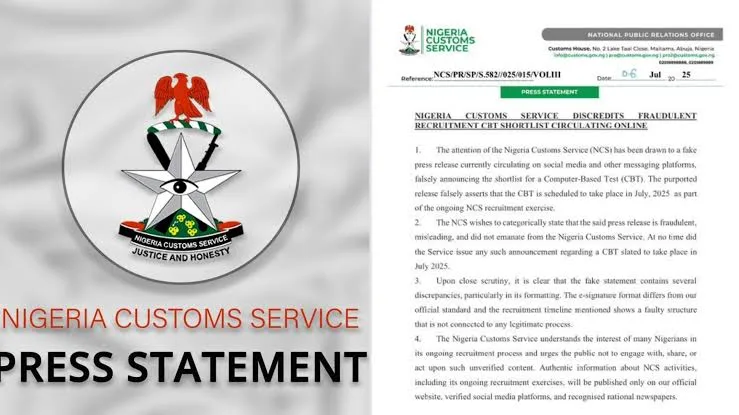
Nigeria Customs warns Nigerians about fake recruitment shortlist
The Nigeria Customs Service (NCS) has warned the public about a fake Computer-Based Test (CBT) recruitment shortlist making the rounds on social media. On Sunday, the NCS said the document, which claims that a shortlist for a recruitment test has been released for July 2025, is completely false. The agency stressed that it did not issue any such announcement and that the information did not come from any official Customs channel. Abdullahi Maiwada, Assistant Comptroller of Customs and National Public Relations Officer, described the viral document as “fraudulent and misleading.” He pointed out that the fake statement had clear errors, including formatting issues and an electronic signature that did not match the agency’s standard. The recruitment timeline in the document was also inconsistent with any real Customs recruitment process. “The NCS wishes to categorically state that the said press release is fraudulent, misleading, and did not emanate from the Nigeria Customs Service. At no time did the Service issue any such announcement regarding a CBT slated to take place in July 2025,” Maiwada said. The NCS reminded Nigerians that all authentic information about recruitment and other activities will only be shared on its official website, verified social media pages, and recognised national newspapers. The agency urged people not to share or act on unverified messages, especially those promising jobs or shortlisting for exams. The Customs Service is now working to trace the source of the fake release and says it will take action against those behind it. The agency also thanked Nigerians for being alert and reporting suspicious messages. The NCS opened applications for recruitment in December 2024 after getting approval to hire 3,927 new officers in 2025. The agency has warned before that scammers might try to take advantage of the recruitment process to trick people. The NCS says it will notify the public through proper channels when it is ready to move to the next stage of recruitment. Nigerians are advised to stay vigilant and rely only on official sources for updates.