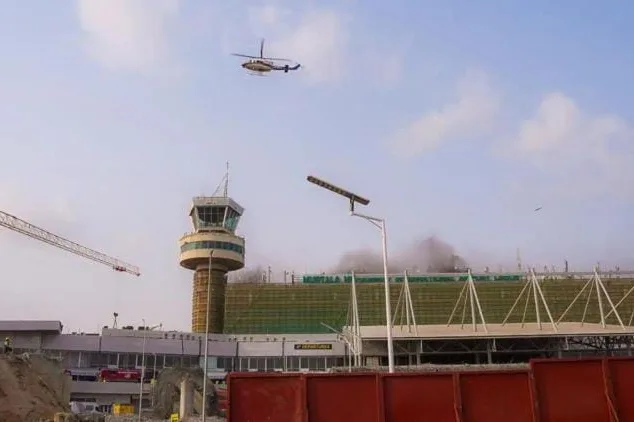
The Federal Government, through the Federal Airports Authority of Nigeria (FAAN), has temporarily closed the Lagos airspace following a fire outbreak at Terminal One of the Murtala Muhammed International Airport (MMIA), Lagos. FAAN in a statement released on Monday stated that the decision was taken in line with established safety protocols. FAAN also confirmed that the 14 persons initially trapped during the incident were safely rescued. A crane was deployed to support operations at the Control Tower, which led to the successful evacuation of all affected individuals. One of the victims was transferred to the FAAN Headquarters Hospital for further medical evaluation and is also stable. Six casualties, three males and three females were recorded. According to reports from the Fire Service, the fire originated from the server room on the first floor of Terminal 1. The blaze in the departure hall was brought under control by emergency responders, who stayed back to monitor the area to prevent it from spreading to other sections of the terminal. Investigations later traced the source to a burning lithium inverter battery installed in the basement. This incident comes nearly three years after a similar fire outbreak at the airport’s international wing in September 2023. At the time, FAAN said the smoke was caused by a suspected electrical spark in the ceiling of the baggage hall.
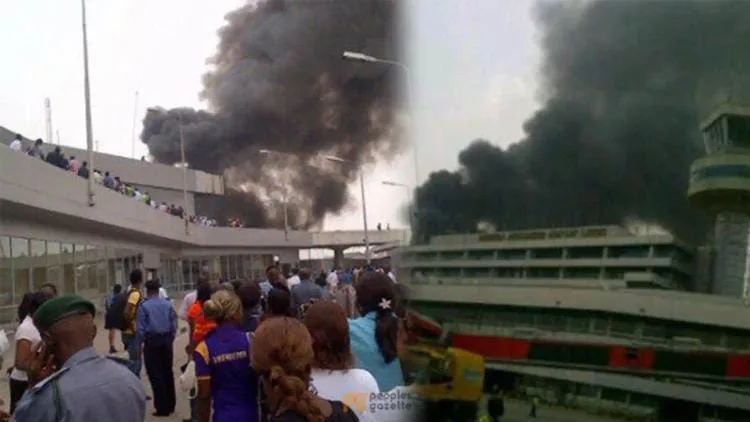
Fire outbreak hits Lagos International Airport terminal
There was panic on Monday after a massive fire outbreak engulfed the old terminal of the Murtala Muhammed International Airport in Lagos. According to reports, the fire started at about 3:30 p.m., although the cause of the inferno had not been determined as of the time this report was filed. The affected terminal is currently undergoing reconstruction by the Federal Government. The Director of Public Affairs and Consumer Protection at the Federal Airports Authority of Nigeria (FAAN), Henry Agbebire, stated that firefighters from FAAN were immediately deployed to the scene and were working to contain the blaze. This incident comes nearly two years after a similar fire outbreak was reported at the international wing of the same airport. On September 6, 2023, FAAN revealed that a suspected electrical spark in the baggage hall ceiling caused a smoke incident at Terminal 1. Authorities are yet to determine the exact cause of Monday’s fire. Details later…………

Nigeria, Japan partner on $50 million fund to support startups
Nigeria and Japan have signed an agreement to establish a $50 million innovation fund aimed at supporting Nigerian startups in tackling critical social challenges. The agreement was signed in Abuja by the Nigeria Sovereign Investment Authority (NSIA) and the Japan International Cooperation Agency (JICA), to structure public investment vehicles focused on sectors such as healthcare, education, food security, and financial inclusion. Under the established arrangement, JICA will provide $14 million in grants, while NSIA is committing up to $20 million. Selected startups will receive technical support, product development guidance, scaling expertise, and assistance in accessing new markets. According to the Japanese Ambassador to Nigeria, Suzuki Hideo, the scheme marks Japan’s first-ever deployment of a development financing model that incorporates official development assistance with private capital. Nigeria is the first country where this “co-creation” approach is being tested. The model is targeted at promoting collaboration between startups in Nigeria and Japanese partners, by combining development aid with market-driven investment to generate sustainable social impact. NSIA Managing Director and CEO, Aminu Umar-Sadiq, described the fund as filling the current existing gap in the startup ecosystem of Nigeria by providing early-stage capital alongside strategic growth support. The fund is currently in its preparatory phase, with NSIA identifying eligible startups aligned with its investment priorities. Investments are to begin once the selection process is completed.

Lagos State implements 5% tax on sports betting winnings across all online platforms
The Lagos State Government has introduced a mandatory 5% withholding tax on all sports betting winnings generated within the state. The Lagos State Lotteries and Gaming Authority (LSLGA) confirmed the policy in a statement, directing all licensed operators to automate deductions at the point of payout. According to the state’s government, all licensed betting platforms henceforth must deduct 5% from the winnings of bettors before the funds are released to the account of users. Winners are required to provide their National Identification Number (NIN) to fulfill “Know Your Customer” (KYC) requirements before withdrawing funds, in order to prevent fraud and ensure that high earners contribute to the developmental funding of the state. The deducted tax is remitted automatically to the Lagos State Internal Revenue Service (LIRS) as a withholding tax credit.Previously, individual winnings across betting platforms in Lagos were untaxed due to challenges in voluntary reporting and a lack of integrated digital tracking.The government aims to formalize the sector and create a consistent revenue stream from the gaming industry, by partnering with the Lagos State Internal Revenue Service (LIRS).The Lagos State Lotteries and Gaming Authority, led by CEO Bashir Are, stated that the rule was meant to enhance tax compliance, transparency, and accountability across the gaming sector of the state. All licensed betting operators are urged to implement the deduction immediately.

Abuja dispatch riders reject ₦15,000 permit fee, protest against multiple taxes
Thousands of dispatch riders in the Federal Capital Territory (FCT) staged a protest on February 19, 2026, against the introduction of a new ₦15,000 permit fee and what they describe as burdensome double taxation. The demonstrators in their numbers gathered at the FCTA Secretariat, halting logistics operations, demanding the harmonization of revenue collection across the capital. Before the protest, riders are legally required to pay annual levies to Area Councils, which include the Abuja Municipal Area Council (AMAC), Bwari, and Gwagwalada. However, the emergence of a new ₦15,000 paper permit, combined with the revenue demands from the FCT Administration (FCTA), has created an environment of double taxation.The protest was organized to resolve the recurring disputes between the central FCT authorities and the six Area Councils over who hold the constitutional right to collect operational fees from small businesses and logistics providers.Daily Tech Nigeria gathered that riders were reportedly asked to pay ₦25,000 by a new FCTA revenue collector, nearly double the ₦13,000 they usually pay to their individual Area Councils. Protesters alleged that many motorcycles have been impounded by security agents, with owners forced to pay the ₦15,000 or ₦25,000 fees to secure their release.Protesters also decries the payment of market entry fees, where riders are charged ₦300 for every single delivery made within major Abuja markets.The Dispatch Riders stressed that the current tax regime is crippling their livelihoods. They stated that they are not opposed to legitimate taxation but are being exploited by duplicate and unclear charges that do not reflect their actual daily earnings. “We riders know it is our statutory obligation to pay tax, and we have been complying… but all of a sudden, another group of tax collectors emerged from nowhere with another demand in the name of the FCT Administration, asking for a higher tax compared with what we pay to AMAC” – Olawale Ilesanmi The governing body in response to the grievances of the protesting protesters, have promised to investigate the allegations of illegal extortion and work toward a more transparent revenue framework. The protest was later suspended after an agreement between the representatives of the riders and the FCT Transportation Secretariat was reached. Meanwhile, logistics operators warned that they would resume protests if the FCT Minister, Nyesom Wike, does not intervene to permanently unify the tax collection process.

Interpol nabs 651 fraudsters, recovers $4.3M across 16 African nations
An operation led by Interpol has resulted in the arrests of 651 fraudsters and the recovery of $4.3 million across 16 African nations.The eight-week mission, titled “Operation Red Card 2.0,” which took place between December 8, 2025, and January 30, 2026, was led by Interpol to dismantle organized cybercrime networks involved in investment scams and mobile money fraud.It operated under the African Joint Operation against Cybercrime (AFJOC) framework, funded by the United Kingdom’s Foreign, Commonwealth & Development Office.According to the report by itwire, 1,247 victims worldwide suffered a combined financial loss exceeding $45 million, over fraudulent schemes during the period under review.The report also stated that Law enforcement agencies seized 2,341 digital devices and disabled 1,442 malicious IP addresses, domains, and servers used to host scams.On the Interpol list, Nigeria, Kenya, and Côte d’Ivoire emerged as primary hubs for these activities, with Nigeria alone dismantling a ring that utilized over 1,000 fraudulent social media accounts.In Nigeria, the police dismantled a syndicate that recruited young individuals for identity theft and social engineering. One notable success involved the arrest of six individuals accused of hacking a telecommunications operator’s internal platform to divert $4.8 million (N7.7 billion) in airtime and data.In Kenya, the Kenyan authorities targeted “pig butchering” investment scams, where victims were lured into making small initial payments on messaging apps before their accounts were blocked.Meanwhile, in Côte d’Ivoire, police arrested 58 individuals linked to predatory mobile loan applications that used abusive debt-collection practices to harvest sensitive financial data.Neal Jetton, Director of the Cybercrime Directorate of the Interpol, while speaking via the media, emphasized that collaboration should never be downplayed when combating transnational cybercrime; ”These cybercriminal syndicates cause significant financial and psychological harm to individuals and businesses. Operation Red Card highlights the importance of collaboration when combating transnational cybercrime” Interpol stated that these scams are spreading because many people lack digital literacy and face economic challenges. Interpol also encouraged all victims of online fraud to report incidents to local law enforcement to assist in ongoing investigations.